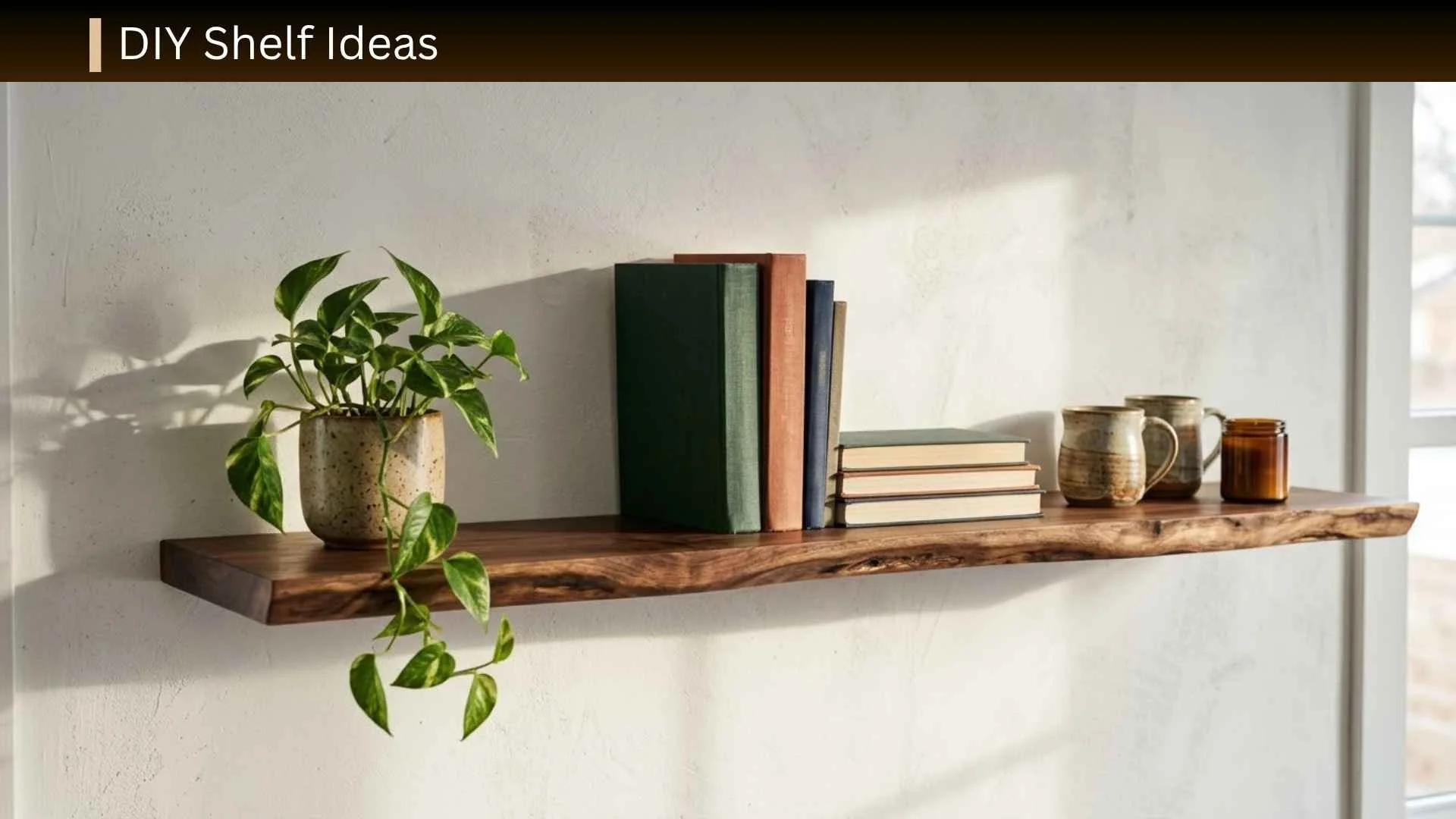
The best DIY shelf ideas are not simply the shelves that look good in a photo. The right shelf should fit your space, match what you need to store, support the expected load, and be realistic for your tools and skill level.
For a first project, a simple bracket shelf is usually the easiest place to start. If you want a clean, modern appearance, floating shelves are a popular choice. For garages and workshops, strength and storage capacity matter more than appearance. For small rooms, corner, narrow, and vertical shelves can turn unused wall space into practical storage.
This guide covers easy DIY shelf ideas, cheap shelf ideas, floating shelves, garage shelves, closet shelves, corner shelves, room-specific designs, shelf planning, mounting, weight considerations, and common mistakes so you can choose a project instead of simply scrolling through a list of pictures.
Which DIY Shelf Should You Build (Quick Answer)
Start with the problem you want the shelf to solve.
| Your goal | Good DIY shelf choice | Difficulty |
| First shelf project | Basic bracket shelf | Easy |
| Modern appearance | Floating shelf | Easy–Moderate |
| Display photos | Picture ledge | Easy |
| Use an empty corner | Corner shelf | Easy–Moderate |
| Store books | Supported wall shelf or bookshelf | Easy–Moderate |
| Organize a closet | Custom closet shelving | Moderate |
| Store garage bins | Heavy-duty garage shelving | Moderate |
| Save money | Simple board-and-bracket shelf | Easy |
| Use scrap wood | Scrap wood shelf | Easy |
| Display plants | Tiered plant shelf | Easy |
| Add industrial style | Pipe-and-wood shelf | Easy–Moderate |
| Small wall | Narrow shelf | Easy |
| Rental-friendly storage | Freestanding or minimally attached shelving | Easy–Moderate |
| Maximum customization | Built-in-style shelving | Moderate–Advanced |
The most important rule is simple: choose the shelf according to its job before choosing its appearance.
A decorative shelf holding a few lightweight objects has different requirements from a garage shelf loaded with storage bins.
Best DIY Shelf Ideas
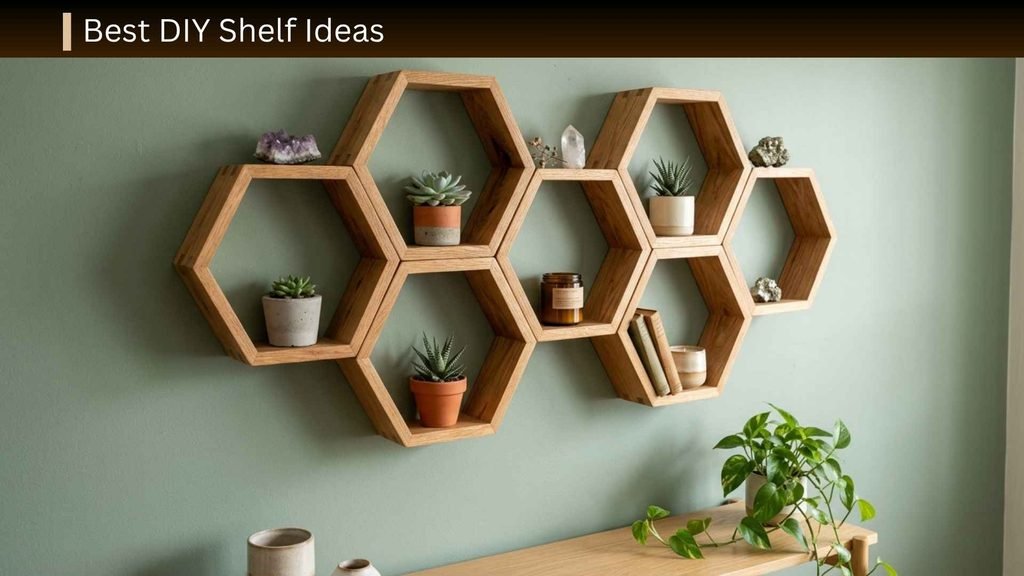
There are dozens of ways to build shelves, but the following designs cover the most useful combinations of appearance, cost, storage, and difficulty.
1. Easy Wooden Bracket Shelf
A basic wooden board supported by brackets is one of the best beginner DIY shelf projects.
It requires relatively few components and does not depend on complicated woodworking techniques.
A basic version can use:
- One wooden shelf board
- Two or more suitable brackets
- Appropriate screws or fasteners
- Wall anchors when appropriate
- Sandpaper
- Paint, stain, or another finish if desired
This design works particularly well for:
- Books
- Small plants
- Kitchen items
- Bathroom supplies
- Office supplies
- Decorative objects
- Small storage baskets
Visible brackets can also become part of the design rather than something you need to hide.
2. DIY Floating Shelves
Floating shelves are popular because the support hardware is hidden from normal view.
A common floating-shelf construction uses a wall-mounted support or cleat and a hollow shelf structure that fits over it. This creates the appearance that the shelf is projecting from the wall without visible brackets.
Floating shelves are particularly useful for:
- Living rooms
- Bedrooms
- Bathrooms
- Kitchens
- Hallways
- Offices
The important point is that the attractive appearance should not distract from the support system. A floating shelf is still a structural installation, and the mounting method needs to match the wall and expected load.
3. DIY Picture Ledge
A picture ledge is a shallow shelf designed primarily for displaying objects rather than storing large amounts of material.
It can hold:
- Framed photographs
- Small artwork
- Children’s books
- Small plants
- Decorative objects
A front lip can help keep displayed items from sliding forward.
Picture ledges are especially useful when you like changing your wall decor regularly because you can rearrange the contents without creating new holes for every picture.
4. DIY Corner Shelves
Corners are often overlooked storage opportunities.
A corner shelf can be triangular, curved, square, or built as a continuous wraparound arrangement.
Use corner shelves for:
- Plants
- Small books
- Bathroom items
- Decorative objects
- Collectibles
- Small kitchen supplies
Measure both walls carefully before cutting. Corners are not always perfectly square, so assuming that every corner is exactly 90 degrees can create frustrating gaps.
5. DIY Pipe-and-Wood Shelves
If you like industrial or rustic interiors, combine wooden boards with metal pipe fittings.
The visible hardware becomes part of the design.
These shelves work well in:
- Kitchens
- Offices
- Garages
- Workshops
- Living rooms
- Entryways
The design can be changed dramatically simply by changing the wood finish or pipe appearance.
6. DIY Ladder Shelf
A ladder-style shelf uses vertical supports with shelves arranged at different heights.
It can be useful when you want storage without creating a large, visually heavy wall unit.
Use it for:
- Books
- Plants
- Baskets
- Towels
- Decor
- Office supplies
A ladder shelf should be stable and appropriately secured for its location, particularly if children or pets may interact with it.
7. DIY Scrap Wood Shelves
Scrap lumber can become useful shelving instead of being thrown away.
This is one of the best choices when your priority is keeping material costs low.
Before using scrap wood, check for:
- Splits
- Severe warping
- Rot
- Structural damage
- Protruding nails or screws
- Excessive surface damage
Sand rough edges and choose a finish appropriate for the environment.
The Easiest DIY Shelf for Beginners
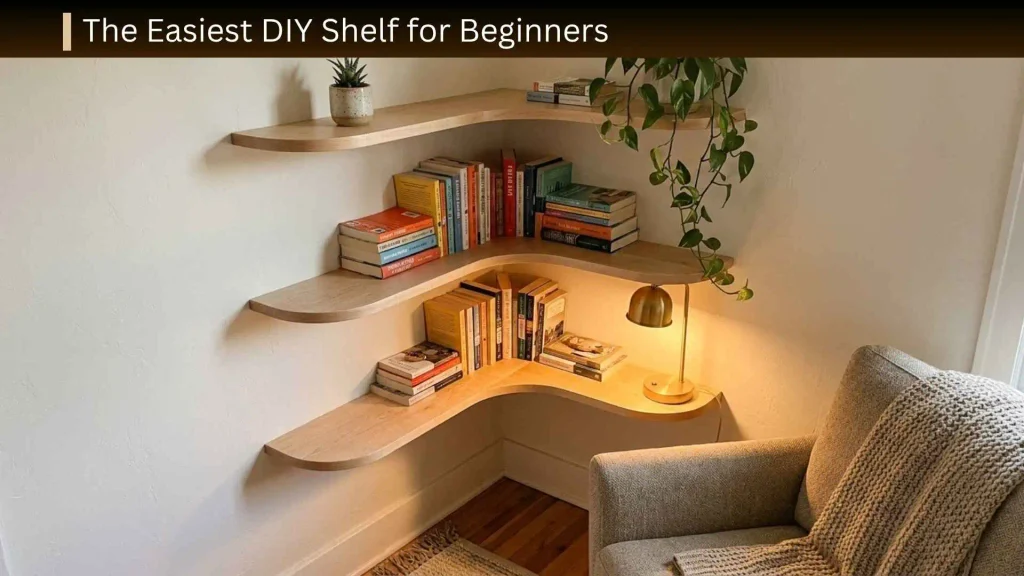
If you have never built a shelf before, do not start with a complicated built-in system.
A simple bracket shelf teaches the basic skills you will use in almost every future shelving project.
Materials
A basic beginner project can use:
- A straight shelf board
- Two appropriate brackets
- Suitable screws or fasteners
- Wall anchors if required by the wall and installation
- Sandpaper
- Optional paint or stain
The exact hardware depends on the wall construction and intended load, so avoid assuming that the same screws or anchors work everywhere.
Tools
You may need:
- Tape measure
- Pencil
- Level
- Drill/driver
- Appropriate drill bits
- Screwdriver bit
- Stud finder when appropriate
- Saw if the board needs cutting
- Sandpaper
- Safety glasses
You do not necessarily need every tool for every shelf.
Step 1: Measure the Space
Measure the available wall width.
Also check:
- Doors
- Windows
- Trim
- Light switches
- Outlets
- Nearby furniture
- Walkways
Do not choose shelf dimensions before understanding the surrounding space.
Step 2: Decide What the Shelf Will Hold
This determines how seriously you need to think about support.
A shelf holding photographs is very different from one holding books, dishes, tools, or storage containers.
Write down the approximate contents before buying hardware.
Step 3: Prepare the Board
Cut the board to the required length if necessary.
Sand the edges and surface until they are suitable for the finish you want.
If you plan to paint or stain the board, doing the main finishing work before installation can make the project easier.
Step 4: Plan the Supports
Mark where the brackets or other support system will be installed.
Use a level rather than relying on the ceiling, floor, or nearby trim as a visual reference.
Step 5: Mount the Supports
Choose fasteners based on the actual wall construction.
A wood-framed drywall wall, concrete wall, masonry wall, and other wall types can require different installation methods.
Step 6: Install the Shelf
Place the shelf on the supports and secure it according to the bracket design.
Check the level again after tightening the hardware.
Step 7: Test Before Fully Loading
Do not immediately fill the shelf with the heaviest objects you own.
Inspect the mounting points, shelf position, and overall stability first.
Then add the intended contents gradually.
How to Choose the Right DIY Shelf
A good shelf starts with planning rather than cutting.
Choose by What You Need to Store
Make a quick list of the items.
Ask:
- What will go on the shelf?
- How heavy are the items?
- How tall are they?
- How often will I use them?
- Will the contents change?
- Do the items need protection from moisture?
- Do I need the shelf to be adjustable?
Design around the objects instead of forcing the objects to fit an arbitrary shelf.
Choose by Wall Type
Before buying mounting hardware, identify the wall.
Possible wall conditions include:
- Drywall over wood framing
- Plaster
- Concrete
- Masonry
- Tile
- Other panel or wall systems
The mounting strategy should match the actual wall.
Choose by Shelf Depth
A deeper shelf is not automatically better.
Extra depth can provide more storage, but it can also:
- Project farther into the room
- Make items harder to reach
- Require stronger support
- Make a small room feel crowded
Measure the objects you actually intend to store.
Choose by Shelf Length
Long shelves need more planning than short shelves.
As a shelf becomes longer, factors such as material, thickness, support spacing, and expected load become increasingly important.
Instead of asking only:
“How long can I make this board?”
ask:
“How long can I make this shelf while keeping the construction appropriate for the material, support system, and load?”
Choose by Budget
If cost is the priority, start with a simple design.
A basic board-and-bracket shelf usually requires fewer specialized components than a concealed floating shelf or built-in storage system.
Also consider the cost of:
- Lumber
- Hardware
- Finish
- Tools you do not already own
- Cutting equipment
- Anchors
- Decorative trim
DIY does not automatically mean cheaper.
How Much Weight Can a DIY Shelf Hold?
There is no single weight limit that applies to every DIY shelf.
The capacity depends on the complete system rather than the shelf board alone.
What Affects Shelf Strength?
Important factors include:
- Shelf material
- Board thickness
- Shelf depth
- Shelf length
- Support spacing
- Bracket design
- Fastener type
- Wall construction
- Structural attachment points
- How the weight is distributed
A short shelf carrying a light decorative load has very different requirements from a long shelf carrying books or garage equipment.
Why Published Weight Numbers Can Be Misleading
A bracket or wall anchor may have a stated capacity, but that number does not automatically mean the entire shelf installation can safely carry the same load.
The wall, fasteners, supports, shelf material, installation method, and load distribution all matter.
For unusually heavy loads, use a professionally appropriate solution rather than relying on a generic DIY estimate.
How to Stop DIY Shelves From Sagging
Sagging is one of the most common problems with long or heavily loaded shelves.
Reduce the Unsupported Span
Adding another suitable support can reduce the distance that the shelf has to span.
Choose an Appropriate Material
Different boards behave differently under load.
Consider:
- Material type
- Thickness
- Grain or construction
- Shelf length
- Expected load
Avoid Overloading
A shelf should be designed around the load it is expected to carry.
If your storage needs increase later, reassess the shelf instead of continuously adding more weight.
Support Long Shelves Properly
A very long shelf may need additional support or a different construction approach.
This is especially important for:
- Bookshelves
- Pantry shelves
- Garage shelves
- Workshop storage
- Long wall-mounted displays
How to Choose Shelf Spacing
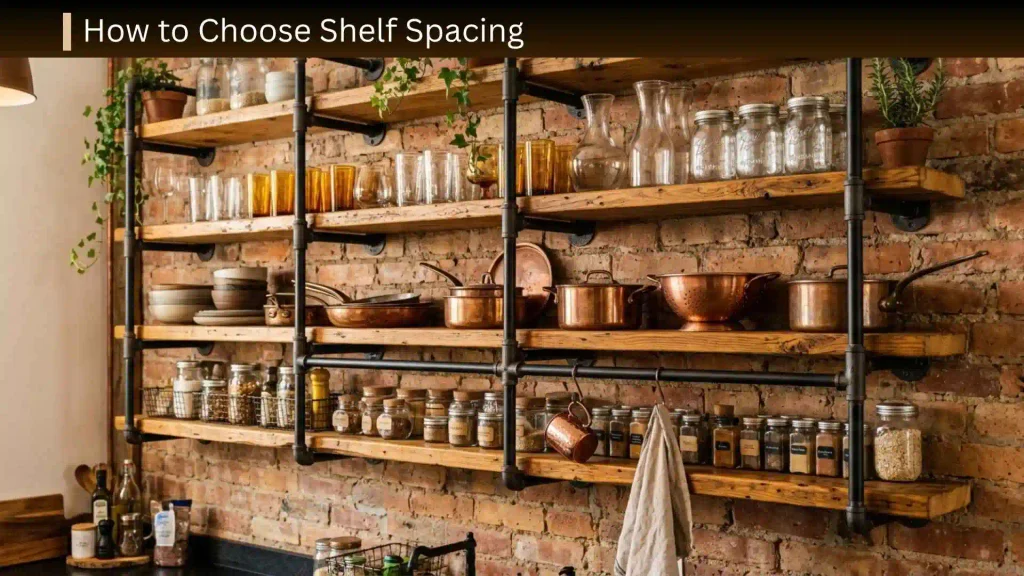
Shelf spacing should be based on the objects you plan to store.
Measure Your Tallest Items
Before fixing shelf positions, measure the tallest items that will occupy each section.
Leave enough usable clearance to remove them comfortably.
Leave Room for Future Storage
If you know your collection will grow, avoid designing every shelf with almost no extra clearance.
A few inches of flexibility can make future organization easier.
Do Not Make Every Shelf the Same Height Automatically
Equal spacing looks neat, but it may waste vertical space.
A better design can use different shelf heights for:
- Books
- Baskets
- Tall bottles
- Decor
- Small boxes
Cheap DIY Shelf Ideas on a Budget
You do not need expensive materials to make useful shelves.
Scrap Wood Shelves
If you already have usable lumber, this can be one of the lowest-cost approaches.
Make sure the material is structurally sound before using it.
Basic Board-and-Bracket Shelves
A standard board with visible brackets keeps the design simple and reduces the number of specialized parts.
Plywood Shelves
Plywood can be practical for storage projects and can be painted or finished to suit the room.
For visible shelving, you may want to cover or finish exposed edges depending on the appearance you want.
Reclaimed Wood Shelves
Reclaimed wood can create a distinctive rustic appearance.
Inspect it carefully before use and remove unsafe hardware.
Use Standard Sizes When Possible
Custom cutting can create a perfect fit, but designing around readily available board sizes can sometimes reduce waste and simplify the project.
DIY Floating Shelf Ideas in Detail
Floating shelves deserve extra planning because the support structure is hidden.
How Floating Shelves Work
A common approach uses:
- A wall-mounted cleat or concealed support
- A hollow shelf box
- An opening in the back of the shelf
- A snug fit over the support
The finished shelf hides the mounting structure.
Where Floating Shelves Work Best
Use floating shelves for:
- Living room displays
- Bedroom storage
- Bathroom accessories
- Kitchen displays
- Home offices
- Hallways
Floating Shelf Mistakes to Avoid
Avoid:
- Choosing the design based only on appearance
- Ignoring wall construction
- Using unsuitable hardware
- Making the shelf unnecessarily long
- Loading it immediately with heavy objects
- Assuming all floating shelf brackets are interchangeable
A concealed support is still a support system. It needs to be properly planned.
DIY Shelf Ideas for Small Spaces
Small rooms benefit from shelves that use vertical and overlooked areas.
Corner Shelves
Use an empty corner for plants, books, toiletries, or decor.
Narrow Wall Shelves
A shallow shelf can fit into a hallway or narrow wall without creating as much obstruction as a deep shelf.
Above-Door Shelves
The wall above a door can provide storage for lightweight or less frequently used objects.
Because the area can be difficult to reach, avoid using it for objects you need every day.
Behind-the-Door Shelves
A shallow shelf may work behind a door if there is sufficient clearance.
Check the door swing, handle, trim, and available depth before installing anything.
Vertical Shelving
When floor space is limited, build upward rather than outward.
A tall, narrow shelf can provide significant storage while using relatively little floor area.
DIY Shelf Ideas for the Living Room
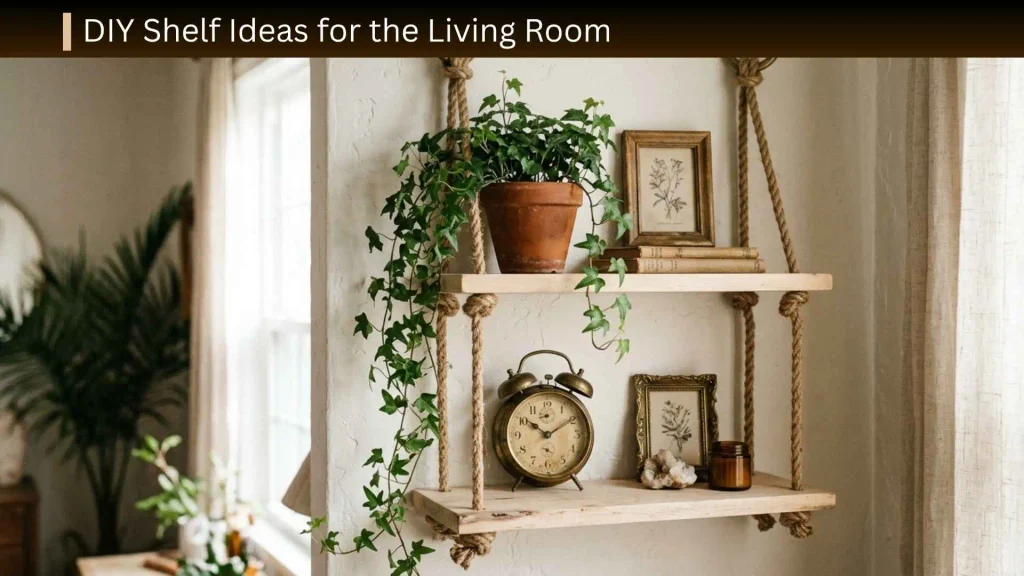
Living room shelves often need to balance storage with appearance.
Floating Display Shelves
Use floating shelves for:
- Books
- Photos
- Plants
- Artwork
- Small collections
Avoid filling every inch.
Picture Ledges
Picture ledges are useful when you like changing photographs or artwork.
Built-In-Style Wall Shelves
For a more substantial appearance, combine several shelves into a larger wall arrangement.
This requires more planning and may involve more complicated cutting and installation.
DIY Shelf Ideas for the Bedroom
Bedroom shelves can reduce the need for bulky furniture.
Bedside Shelf
A small wall shelf can hold:
- Phone
- Glasses
- Books
- Small lamp
- Alarm clock
- Decorative objects
Keep the design compact and securely mounted.
Bedroom Book Shelves
Measure your books before deciding the shelf depth.
You can create several shallow shelves instead of one extremely deep shelf.
Above-Desk Shelves
A shelf above a desk can provide space for:
- Books
- Stationery
- Small storage boxes
- Plants
- Decor
Keep frequently used items within easy reach.
DIY Shelf Ideas for the Kitchen
Kitchen shelving should be planned around the objects you actually use.
Open Kitchen Shelves
Open shelves can hold:
- Plates
- Bowls
- Mugs
- Jars
- Cookbooks
- Decorative pieces
Keep heavy or frequently handled items on appropriately supported shelves.
DIY Spice Shelf
A narrow shelf can organize spice containers without taking up much space.
A small front edge can help keep containers from moving forward.
Pantry Shelves
Measure your pantry containers before determining shelf spacing.
Designing around the actual height of cans, jars, boxes, and appliances can eliminate wasted vertical space.
DIY Shelf Ideas for the Bathroom
Bathrooms need storage without sacrificing limited floor space.
Over-the-Toilet Shelves
The wall above a toilet can become useful storage for:
- Towels
- Toilet paper
- Baskets
- Toiletries
- Decorative items
Keep stored objects secure and avoid creating a setup where items can easily fall into the toilet area.
Small Bathroom Shelves
Use narrow shelves for small products and accessories.
Bathroom Material Choices
Because bathrooms can be humid, choose materials and finishes suitable for the environment.
Also check carefully before drilling into walls because plumbing and electrical components may be hidden behind the surface.
DIY Shelf Ideas for the Garage
Garage shelving is more about organization and strength than decoration.
Current DIY garage-shelf projects commonly emphasize vertical storage, custom dimensions, and construction around the items being stored.
Heavy-Duty Garage Shelves
Garage shelves can store:
- Plastic bins
- Tools
- Automotive supplies
- Seasonal decorations
- Camping equipment
- Workshop materials
Plan the shelf around the actual load.
Wall-Mounted Garage Shelves
Wall-mounted shelving can free up floor space.
Before building, identify:
- Stud or structural locations where applicable
- Electrical panels
- Outlets
- Windows
- Doors
- Vehicle clearance
- Work areas
A garage shelf should not interfere with vehicle doors, walkways, or equipment access.
Freestanding Garage Shelves
A freestanding unit can be useful when wall mounting is difficult or when you want the option to reposition the storage.
For tall units, stability and appropriate anchoring should be considered, especially in households where children or pets may be present.
DIY Closet Shelf Ideas
Closet shelves should be designed around clothing and accessories rather than simply filling the wall with equally spaced boards.
Folded-Clothing Shelves
Use shelf spacing that fits your folded clothing without creating large unused gaps.
Shoe Shelves
Measure your shoes and available closet depth.
A dedicated shoe shelf can be shallower than a shelf intended for bulky storage boxes.
Basket Storage
Shelves can hold labeled baskets for:
- Accessories
- Seasonal items
- Bags
- Small clothing
- Miscellaneous items
Adjustable Closet Shelves
If your storage needs change frequently, adjustable shelving can be more useful than permanently fixed shelves.
DIY Shelf Ideas for Plants
Plants are a natural match for vertical storage.
Tiered Plant Shelf
A tiered shelf allows several plants to occupy one vertical area.
Leave adequate space between levels for plant growth.
Window Plant Shelf
A narrow shelf near a suitable window can display small plants without taking up floor space.
Consider moisture and water spills when choosing the material and finish.
Plant Corner Shelf
Use an empty corner for several small plants at different heights.
Make sure the combined weight of the plants, pots, soil, and water is appropriate for the shelf.
DIY Shelf Ideas Without Power Tools
You can build some simple shelves using hand tools, depending on the design.
Simple Hand-Tool Project
Choose a shelf board that is already the required length, then use:
- Tape measure
- Pencil
- Hand screwdriver
- Hand sanding tools
- Level
- Appropriate manual cutting tools if necessary
The simplest no-power-tool approach is to minimize cutting and choose a board that is already close to the required dimensions.
What You Should Not Do
Do not choose a weak mounting method simply because you want to avoid using a drill.
A shelf that holds heavy objects still needs an appropriate attachment system.
DIY Shelf Ideas for Renters
Renters may need storage without making permanent changes to their walls.
Freestanding Shelves
Freestanding shelves are usually the easiest option when wall modification is restricted.
Ladder Shelves
A ladder-style unit can add vertical storage without requiring a large cabinet.
Furniture-Style Shelving
Turn a small bookcase, cabinet, or existing furniture piece into a customized storage solution.
Check Your Lease First
Before making holes or permanent modifications, check the rules for your rental property.
If permanent wall attachment is not permitted, choose a design that does not depend on it.
Decorative Shelves vs. Storage Shelves
One of the most important decisions is determining whether your shelf is primarily decorative or functional storage.
Decorative Shelves
Decorative shelves typically prioritize:
- Appearance
- Styling
- Artwork
- Photos
- Plants
- Lightweight objects
Storage Shelves
Storage shelves prioritize:
- Load capacity
- Support
- Accessibility
- Durability
- Organization
- Appropriate dimensions
A shelf that looks perfect in a decorating photo may not be appropriate for storing heavy books, tools, or garage equipment.
How to Make DIY Shelves Look More Expensive
A simple shelf can look much more polished with thoughtful finishing.
Choose a Consistent Finish
Use colors or finishes that coordinate with the room.
Sand the Edges
Smooth edges can make inexpensive boards look significantly more finished.
Hide or Embrace Hardware
If the design is meant to look minimalist, concealed hardware can help.
If you are using brackets or pipes, choose hardware that intentionally matches the style.
Add a Front Edge
A thicker-looking front edge can make a simple board appear more substantial.
Avoid Overstyling
Leave some empty space.
A shelf does not need to be completely covered to look finished.
How to Make DIY Shelves Stronger
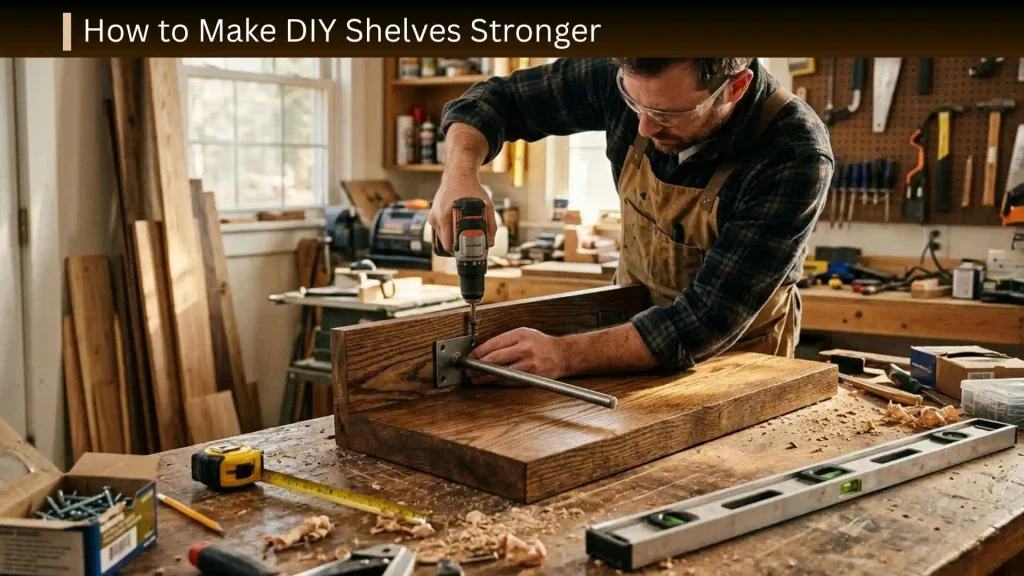
If a shelf needs to carry more weight, focus on the entire structure.
Improve the Mounting
Use an attachment method appropriate for the wall construction.
Reduce the Unsupported Span
Additional support can reduce the distance over which the shelf carries its load.
Choose Appropriate Material Thickness
Long or heavily loaded shelves generally need more careful material selection than short decorative shelves.
Distribute Weight
Do not place the heaviest object at the weakest part of the shelf.
Spread the load appropriately across the supported area.
Consider a Different Shelf Design
Sometimes the best solution is not to make the original shelf stronger but to choose a different structure.
A freestanding frame, supported bracket system, or built-in arrangement may be more appropriate for a heavy storage application.
Common DIY Shelf Mistakes to Avoid
Good shelf construction is often about avoiding preventable problems.
Guessing the Dimensions
Measure your actual space and belongings.
Using the Same Fasteners Everywhere
Wall materials differ, so mounting hardware should be chosen accordingly.
Ignoring the Expected Load
A shelf intended for decorative objects should not automatically become heavy storage.
Making Shelves Too Deep
Extra depth can create unnecessary weight and make items harder to reach.
Making Shelves Too Long
Long shelves need more attention to support and sagging.
Skipping the Level
Even a small angle can become obvious once the shelf is filled.
Drilling Without Considering Hidden Services
Before drilling, consider potential electrical wiring, plumbing, framing, and other hidden components.
Loading the Shelf Immediately
Inspect the installation first and add weight gradually.
Copying Someone Else’s Measurements
A shelf that works in one room may be completely wrong for another.
Use online projects for inspiration, not as a substitute for measuring your own space.
Do This, Not That: DIY Shelf Planning
| Do this | Avoid this |
| Measure the wall first | Buy materials before measuring |
| Measure the objects you will store | Guess shelf depth |
| Match hardware to the wall | Use one anchor type everywhere |
| Plan around the expected load | Choose only by appearance |
| Check the shelf with a level | Trust nearby trim to be level |
| Plan support for long shelves | Make an extra-long unsupported shelf |
| Test before fully loading | Immediately stack heavy items |
| Consider future storage | Design with zero flexibility |
| Protect moisture-sensitive materials | Use unsuitable finishes in wet areas |
DIY Shelf Troubleshooting
Sometimes the shelf is already installed but something does not look or feel right.
The Shelf Is Crooked
Check both the support and the shelf itself.
If the support is not level, correcting only the shelf board may not solve the underlying problem.
The Shelf Moves When Touched
Inspect the fasteners and attachment points.
Do not simply add more objects to the shelf and hope the movement disappears.
The Shelf Is Sagging
Reduce the load and reassess:
- Shelf length
- Material
- Thickness
- Support spacing
- Mounting method
The Shelf Looks Too Bulky
Consider reducing:
- Shelf depth
- Visual thickness
- Number of shelves
You may also use a lighter finish or fewer objects to reduce visual weight.
The Shelf Does Not Fit the Items
Measure the tallest and deepest items again.
You may need to change the shelf spacing or depth rather than rebuilding the entire system.
DIY Shelf Safety Checklist
Before using a new shelf, check:
- Is the shelf appropriate for its intended load?
- Is the mounting hardware suitable for the wall?
- Are the supports secure?
- Is the shelf level?
- Does the shelf move when lightly checked?
- Are heavy objects positioned appropriately?
- Could anything fall onto people below?
- Is the shelf above a bed or seating area?
- Is the shelf accessible without unsafe climbing?
- Are there children or pets who could interact with it?
- Could moisture damage the material?
- Have you avoided drilling into potential electrical or plumbing services?
For unusually heavy storage or complicated structural installations, consider professional advice rather than relying on a generic DIY plan.
DIY Shelf Planning Worksheet
Before buying materials, fill out this simple checklist.
Space
Room:
Wall location:
Available width:
Available height:
Maximum depth:
Storage
What will the shelf hold?
Approximate total load:
Largest item:
Tallest item:
How often will items be accessed?
Construction
Wall type:
Shelf material:
Shelf thickness:
Shelf depth:
Shelf length:
Number of shelves:
Support type:
Fastener type:
Appearance
Painted, stained, natural, or unfinished:
Visible brackets or hidden support:
Room style:
Budget
Material budget:
Hardware budget:
Finish budget:
Tools already owned:
Tools that need to be purchased or borrowed:
Installation
Will the shelf require cutting?
Will it require drilling?
Are there possible hidden utilities?
Does the design require structural attachment?
Planning these details before cutting wood can save both money and time.
DIY Shelf Ideas by Budget
Your budget can determine which design makes the most sense.
Lowest-Budget Option
Choose a simple board and appropriate brackets, especially if you already own the necessary tools.
Budget With Scrap Materials
Use sound leftover lumber and existing hardware when appropriate.
Mid-Range Project
Consider a floating shelf, pipe shelf, finished plywood shelf, or multi-shelf storage unit.
Higher-End DIY Project
For a premium result, consider:
- Better-quality lumber
- Custom dimensions
- Higher-quality finish
- Concealed hardware
- Trim details
- Multiple coordinated shelves
- Built-in-style construction
The goal is not simply to spend less. It is to get the best combination of function, appearance, durability, and customization for your space.
DIY Shelves vs. Store-Bought Shelves
DIY shelving is not automatically the better choice.
| Factor | DIY shelves | Store-bought shelves |
| Custom dimensions | Excellent | Usually limited |
| Material choice | High control | Limited to available products |
| Appearance | Fully customizable | Predetermined |
| Labor | Your responsibility | Usually lower |
| Tool requirement | Can be significant | Usually minimal |
| Unique spaces | Excellent | May not fit |
| Installation | Often required | Varies |
| Cost | Can be lower or higher | Easier to predict |
| Learning value | High | Low |
| Replacement parts | Custom | Depends on manufacturer |
Choose DIY when customization, learning, or a specific fit matters.
Choose store-bought shelving when speed, convenience, or a standardized solution is more important.
When You Should Hire a Professional
Not every shelving project needs professional help, but some situations deserve extra caution.
Consider professional assistance when:
- The shelf will carry an unusually heavy load
- The installation involves structural modifications
- You need to cut into a wall
- The wall construction is uncertain
- The project involves complicated masonry
- You are creating a large built-in system
- The shelf will be installed in a location where failure could cause serious injury
- You are unsure whether the wall can support the proposed installation
A professional can be particularly useful when the project goes beyond ordinary furniture-style shelving.
Frequently Asked Questions About DIY Shelf Ideas
What is the easiest DIY shelf to build?
A simple board mounted on suitable brackets is one of the easiest shelf projects for beginners. It involves fewer complicated cuts than many floating or built-in designs.
What is the cheapest way to make DIY shelves?
A simple board-and-bracket design or a shelf made from usable scrap wood can keep material requirements relatively low. Your actual cost will depend on lumber, hardware, finish, and whether you already own the required tools.
Are floating shelves difficult to build?
A basic floating shelf can be a manageable DIY project, but the hidden support system requires careful planning. The shelf must be properly attached to the wall rather than simply relying on its appearance.
How deep should a DIY shelf be?
There is no universal depth that works for every shelf. Measure the objects you want to store and choose enough depth to hold them comfortably without making the shelf unnecessarily large.
How far apart should DIY shelves be?
Shelf spacing should be based on the height of the objects you plan to store. Measure your tallest items and leave enough clearance to remove them easily.
How do I stop a DIY shelf from sagging?
Reduce the unsupported span, avoid overloading the shelf, choose appropriate material and thickness, and provide adequate support. Long shelves require more planning than short decorative shelves.
Can I install shelves without studs?
Some wall systems can use appropriately rated anchors, while heavier applications may require attachment to framing or another structural support. The correct approach depends on the wall construction and intended load.
Can I build shelves without power tools?
Yes. Some simple shelves can be built with hand tools, especially if the material is already cut to size. Avoid compromising the mounting system just to eliminate the need for power tools.
What is the best wood for DIY shelves?
There is no single best material for every project. Solid wood, plywood, MDF, and other sheet materials can work in different applications. Consider strength, appearance, moisture, budget, and finishing requirements.
Are DIY shelves cheaper than store-bought shelves?
Sometimes, but not always. DIY costs include materials, hardware, finishing supplies, tools, and your time. The main advantage is often customization rather than guaranteed savings.
What are the best DIY shelves for small spaces?
Corner shelves, narrow shelves, vertical shelving, above-door shelves, and shallow picture ledges can make good use of limited space.
What are the best DIY shelves for a garage?
Garage shelves should be designed around the items being stored and the expected load. Heavy-duty wall-mounted or freestanding shelving can be useful when properly constructed and secured.
Can I use reclaimed wood for DIY shelves?
Yes, provided the wood is structurally sound and suitable for the application. Inspect it carefully, remove unsafe hardware, and prepare the surface before installation.
Final Thoughts on DIY Shelf Ideas
The best DIY shelf ideas are the ones that solve a real storage problem without creating a new one.
Start by deciding what the shelf needs to hold. Then measure your space, identify the wall type, consider the expected load, choose an appropriate material, and select a support system that matches the installation.
If you are new to DIY, begin with a straightforward bracket shelf. Once you are comfortable measuring, cutting, finishing, leveling, and mounting, you can move to floating shelves, corner systems, closet storage, garage shelving, and larger built-in projects.
And remember: a good shelf is not simply a piece of wood attached to a wall. It is a complete system made up of the shelf material, supports, fasteners, wall, dimensions, and intended load.
That mindset will help you choose better projects, avoid common mistakes, and create shelving that is both useful and attractive.