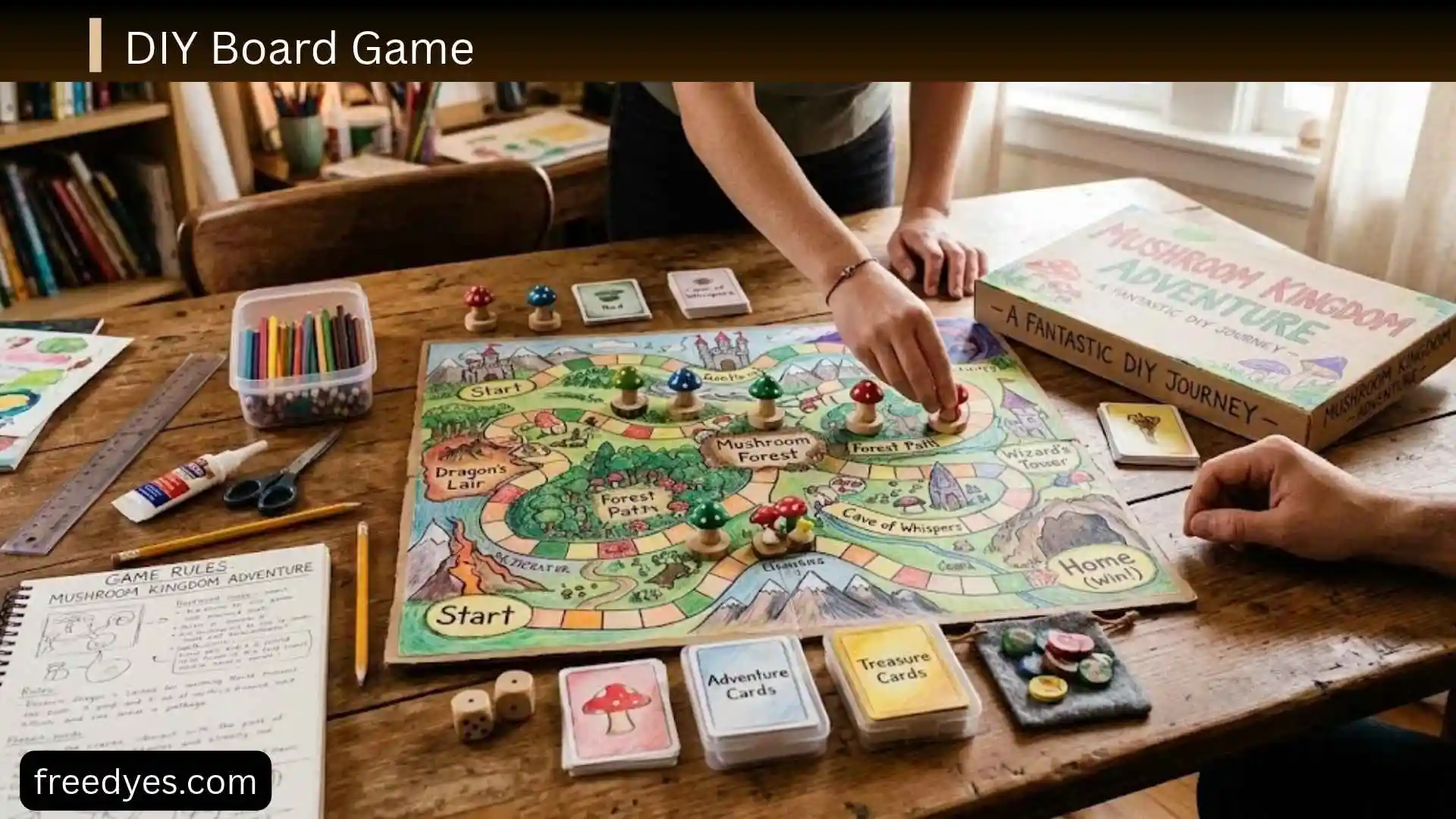
I have always believed that the best games are the ones I create myself. Instead of buying another board game that everyone else already owns, I decided to make something unique that reflects my ideas, creativity, and personality. I am constantly amazed by how a few simple materials cardboard, markers, dice, and a little imagination,can turn into hours of fun for family and friends.
If you have ever wanted to design your own game but didn’t know where to start, I am here to show you that it’s much easier than you might think. Whether you want a fast-paced party game, a strategy challenge, or a family-friendly adventure, creating a DIY board game lets you build rules, characters, and challenges that are completely your own.
In this guide, I am sharing everything you need to know to create a DIY board game from scratch. You’ll discover creative ideas, essential materials, easy design tips, and practical steps that will help you turn your imagination into a game everyone will want to play. By the end, I am confident you’ll be inspired to start crafting a board game that’s as fun to make as it is to play.
DIY Board Game at a Glance
Before gathering supplies, it helps to understand what you are actually creating.
| Project | DIY board game |
| Skill level | Beginner to intermediate |
| Best for | Kids, families, classrooms, teens, hobby designers |
| Main materials | Cardboard, paper, markers, dice, tokens |
| Expensive supplies required? | No |
| First version | Simple prototype |
| Main goal | Create a playable game |
| Most important improvement step | Playtesting |
The physical board is only one part of the project. Your game also needs rules, player actions, a goal, and a winning condition.
A useful way to think about the process is:
Idea → Rules → Prototype → Playtest → Improve → Play again
That cycle is more important than making the first version look perfect. Current board-game design guidance similarly emphasizes getting an early prototype into play so designers can discover whether the basic mechanics and flow actually work.
What You Can Make With This Guide
You can use the same basic process to create:
- A simple race game
- A family board game
- A children’s learning game
- A treasure-hunt game
- An adventure game
- A trivia game
- A cooperative game
- A strategy game
- A holiday-themed game
- A classroom activity
- A homemade prototype for a larger game idea
The theme and complexity can change, but the basic design process stays similar.
Who This DIY Board Game Project Is For
This project works especially well for:
- Families looking for a creative activity
- Parents making a game with children
- Teachers creating educational activities
- Kids who enjoy inventing stories and rules
- Teens experimenting with game design
- Adults developing a board-game concept
- Anyone who wants to create a personalized game without buying a complete commercial set
For younger children, keep the rules short and visual. Older children and adults can handle more choices, resources, cards, and strategic decisions.
How to Create a Board Game Idea
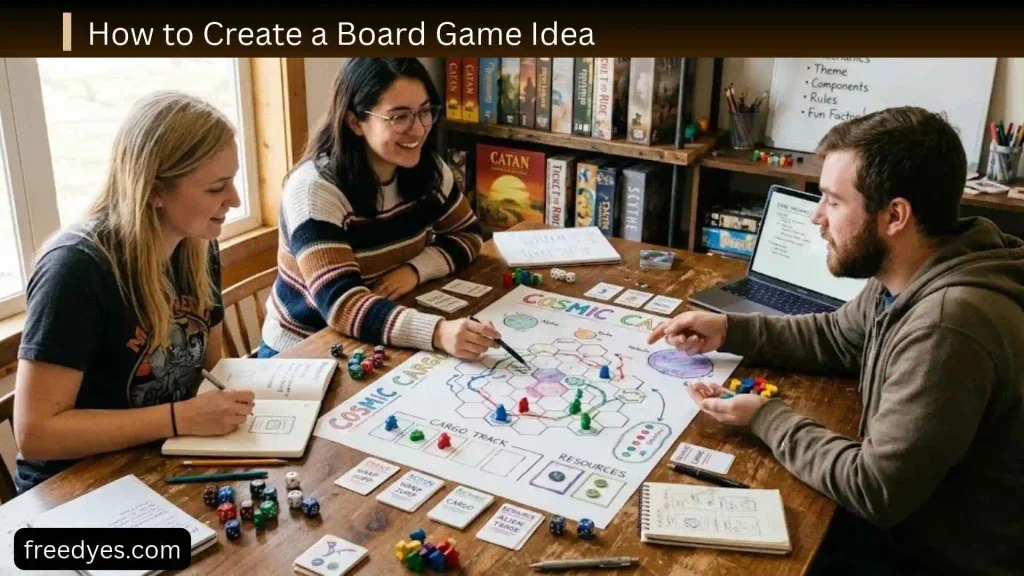
The easiest mistake to make is starting with the board.
Before drawing anything, decide what players are supposed to do.
A useful starting point is to answer three questions:
- What are players trying to accomplish?
- What interesting choice do they make during their turns?
- What determines who wins?
These questions help prevent the project from becoming nothing more than a decorated track. Current prototyping guidance also recommends defining the objective, player choices, and success condition before building all the components.
Choose a Theme
The theme gives your game its setting and personality.
Possible themes include:
- Dinosaur adventure
- Pirate treasure
- Space exploration
- Haunted house
- Jungle expedition
- Magical kingdom
- Animal rescue
- School challenge
- Underwater exploration
- Farm management
- Holiday adventure
- Mystery investigation
Choose something that fits the intended players.
For example, a dinosaur theme may be ideal for younger children, while a mystery or strategy theme may work better for older players.
Remember that the theme is not the same as the game mechanics.
A dinosaur game could be a racing game, a collection game, a cooperative rescue game, or a strategy game. The dinosaurs determine the setting; the mechanics determine what players actually do.
Choose the Main Goal
Give players a reason to take actions.
Your goal could be:
- Reach the finish first.
- Collect five treasures.
- Earn the most points.
- Rescue all the characters.
- Complete three missions.
- Build the largest city.
- Solve the mystery.
- Survive until the final round.
- Work together to stop a shared threat.
A simple goal is usually best for a first homemade game.
For example:
Goal: Be the first player to collect three treasure tokens and reach the treasure chest.
That is much easier to build around than a vague goal such as “explore the island.”
Choose the Core Mechanic
A mechanic is an action or system that controls how the game works.
Beginner-friendly mechanics include:
- Roll and move
- Draw a card
- Choose between two actions
- Collect items
- Answer questions
- Trade resources
- Race other players
- Move through a grid
- Complete challenges
- Cooperate against a shared objective
You can combine simple mechanics.
For example:
Roll → Move → Resolve the space → Collect or lose something → Next player’s turn
That simple structure can support many different themes.
Decide How Players Win
Do not leave the winning condition until the end.
Choose one clear method.
Race: First player to reach the finish wins.
Collection: First player to collect a specific number of objects wins.
Points: The player with the highest score wins.
Mission: The player who completes the required objectives wins.
Cooperative: Everyone wins if the shared goal is completed before the game ends.
For a beginner project, avoid creating several complicated ways to win unless there is a good reason.
DIY Board Game Materials
You can make a playable prototype with inexpensive materials. Common beginner supplies include cardboard, markers, dice, tokens, scissors, a ruler, glue or tape, and coloring materials. Household objects can replace many of these items.
Basic Supplies
Gather:
- Cardboard
- Plain paper
- Pencil
- Eraser
- Ruler
- Markers or colored pencils
- Scissors
- Glue or tape
- Dice
- Small tokens
- Index cards or cardstock
- Notebook or extra paper for rules
You do not necessarily need every item.
If you are making a rough prototype, paper and a pencil may be enough.
Household Materials You Can Reuse
A DIY board game is a great way to reuse everyday materials.
Try:
- Cereal boxes for boards
- Shoebox cardboard for larger boards
- Bottle caps for player pieces
- Buttons for counters
- Coins for temporary tokens
- Scrap paper for cards
- Sticky notes for temporary labels
- Old playing cards for random events
- Small toys as themed pieces
- Paper clips as markers
- Jar lids as round tokens
A cereal box can provide surprisingly useful cardboard for a lightweight homemade board. DIY game resources also commonly suggest recycled cardboard and household objects as substitutes for purchased components.
Optional Supplies
If you want a cleaner finished version, you can add:
- Cardstock
- Colored paper
- Laminating sheets
- Clear sleeves
- Craft foam
- Wooden craft sticks
- Stickers
- Printed artwork
- Decorative tape
- Small storage containers
These are optional.
Do not spend heavily on components before you know that the game itself works.
How to Make a DIY Board Game Step by Step
Now you can begin building the actual game.
The most important rule is simple:
Make the first version easy to change.
Your first board is a prototype, not a museum piece.
Step 1: Sketch the Game
Start on ordinary paper.
Write down:
- Game name
- Theme
- Number of players
- Objective
- How a turn works
- How players move
- Special actions
- How the game ends
- How the winner is determined
For example:
Game name: Treasure Trail
Players: 2–4
Goal: Collect three treasures and reach the finish.
Turn: Roll the die, move, and follow the instruction on the space.
Special spaces: Treasure, trap, shortcut, and challenge.
Winner: First player to collect three treasures and reach the finish.
This simple outline gives you enough information to build the first version.
Step 2: Design the Board
Draw the basic layout on paper before transferring it to cardboard.
You can choose from several structures.
Race Track
Create a connected path from Start to Finish.
This is one of the easiest designs for beginners.
It works well for:
- Kids
- Family games
- Simple racing games
- First prototypes
Branching Paths
Give players opportunities to choose different routes.
For example:
Short dangerous path versus longer safer path.
This adds decision-making without requiring complicated rules.
Grid
Create rows and columns of spaces.
A grid works well for:
- Tactical movement
- Adventure games
- Battle games
- Strategy games
Map
Use a map-like board with locations connected by routes.
This works particularly well for:
- Treasure hunts
- Travel games
- Fantasy adventures
- Geography games
Choose the layout based on what you want players to do.
Do not choose a complicated board merely because it looks impressive.
Step 3: Add Start, Finish, and Special Spaces
Make the important spaces easy to identify.
Possible spaces include:
Start: Where everyone begins.
Finish: Where the race ends.
Treasure: Gain an item or point.
Trap: Lose a turn or move backward.
Shortcut: Move ahead.
Challenge: Draw a card or answer a question.
Choice: Pick between two actions.
Rest: Nothing happens.
Do not fill every space with an effect.
Sometimes a normal space is useful because it keeps the game moving.
Step 4: Make the Game Pieces
Each player needs something that shows their position.
Simple options include:
- Bottle caps
- Coins
- Buttons
- Paper standees
- Small toys
- Cardboard circles
- Colored beads
- Wooden pieces
Give each player a different color or symbol.
If children are making the game, they can draw small characters on cardstock, cut them out, and fold the bottom to create simple standing pieces.
The pieces do not need to be professionally made. They only need to be easy to identify and move.
Step 5: Create the Cards
Cards can add variety to an otherwise simple board.
A card might say:
- Move forward two spaces.
- Lose one treasure.
- Take another turn.
- Choose another player to move backward one space.
- Answer a question.
- Collect a bonus.
- Choose the safe route or risky route.
Keep the wording short.
A player should be able to understand what the card does without needing a long explanation.
For a first prototype, make a small deck rather than creating dozens of cards.
You can always add more later.
Step 6: Choose Dice, Cards, or a Spinner
You need a way to introduce movement or randomness if your game requires it.
Options include:
- Standard die
- Paper spinner
- Number cards
- Playing cards
- Coin flip
- Custom numbered tokens
A die is useful for simple movement.
A spinner can make the project more visually interesting.
Cards can provide both movement and special events.
You can also remove randomness entirely if your game works better with player choices.
The important question is not “Which randomizer should I use?”
It is:
Does this randomizer make the game more enjoyable or meaningful?
Step 7: Write the Basic Rules
Create a one-page rule sheet.
Include:
- Game objective
- Number of players
- Components
- Setup
- Starting positions
- Turn order
- Available actions
- Special spaces
- Card rules
- Scoring
- Winning condition
- Tie-breaking rule
If you cannot explain your game clearly, the game itself may still need simplifying.
Step 8: Assemble the First Prototype
Now put the pieces together.
Do not worry about perfect artwork.
Use:
- Pencil lines
- Handwritten cards
- Scrap cardboard
- Temporary tokens
- Tape
- Simple symbols
A rough prototype is valuable because you can change it quickly.
Early prototypes are commonly built with inexpensive materials precisely because rules and components often change during testing.
A Simple DIY Board Game Example
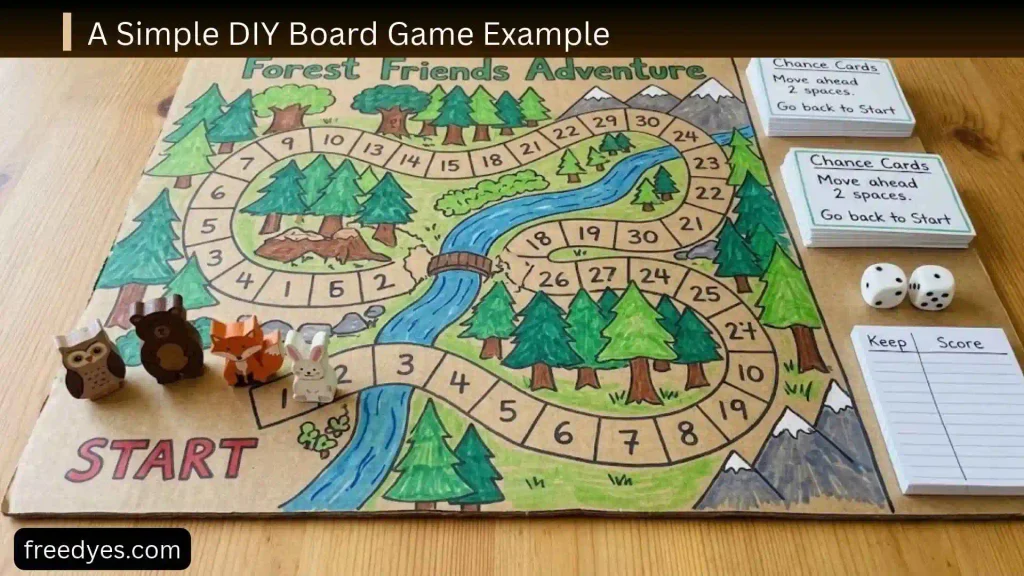
If you want a concrete starting point, try a basic treasure race.
Game Concept
Players are explorers searching for hidden treasure.
Objective
Collect three treasure tokens and reach the final treasure space.
Players
2–4 players.
Board
Draw approximately 30–40 spaces between Start and Finish.
You can make the path straight, winding, or branching.
Special Spaces
Add:
- Treasure spaces
- Trap spaces
- Shortcut spaces
- Challenge spaces
Movement
Each player rolls a die and moves that many spaces.
Treasure
When a player lands on a treasure space, they collect one treasure token.
Trap
A trap space can make the player:
- Move backward
- Lose one treasure
- Miss their next turn
Choose only one consequence for your first version.
Challenge
The player draws a challenge card.
Examples:
- Move forward two spaces.
- Lose one turn.
- Give one treasure to another player.
- Choose a shortcut.
- Roll again.
Winning
The first player to collect three treasures and reach the final space wins.
This is intentionally simple.
You can later add strategy, different paths, special abilities, or more interesting cards after testing the basic version.
How to Make Your Board Game Fun
A beautiful board does not automatically create a fun game.
Players need reasons to care about what happens during their turns.
Give Players Meaningful Choices
If every turn is simply:
Roll → Move → Next player
the game may become repetitive.
You can introduce choices.
For example:
You rolled a 5. Do you take the safe route or the shortcut?
Now the player has a decision.
Even simple choices can make a homemade game feel much more interactive.
Keep Turns Moving
Long turns can make other players lose interest.
Try to keep the basic turn structure clear.
For example:
Roll → Move → Resolve → End turn
If a player’s turn requires several calculations, card combinations, or decisions, make sure those steps actually add value.
Balance Luck and Strategy
Luck can make a game exciting, especially for children.
But too much randomness can make players feel that their decisions do not matter.
If the winner is almost completely determined by dice rolls, consider adding choices.
For example:
- Choose which direction to move.
- Choose which card to keep.
- Spend a token for a reroll.
- Choose a safe or risky challenge.
- Trade resources with another player.
This gives players some control over the outcome.
Create a Satisfying Ending
A game should not simply continue until everyone becomes tired.
Use a clear ending such as:
- First to the finish
- First to a target score
- Last round completed
- Final mission completed
- Resource supply exhausted
- Shared objective achieved
Players should know when the game is approaching its conclusion.
DIY Board Game Ideas
Once you understand the basic structure, you can create many different types of games.
Adventure Games
Try themes such as:
- Lost jungle expedition
- Haunted mansion
- Pirate treasure
- Space rescue
- Magical castle
- Underwater exploration
Players can move between locations, collect objects, and overcome challenges.
Educational Games
You can build learning into the mechanics.
Ideas include:
- Math challenge race
- Multiplication adventure
- Vocabulary treasure hunt
- Geography exploration
- Science mission
- History challenge
- Spelling race
Instead of making the entire game a quiz, connect the educational task to an actual decision.
For example, answering a question correctly might let the player choose between two routes.
Family Games
Family games can focus on simple decisions and social interaction.
Ideas include:
- Family trivia
- Holiday race
- Animal adventure
- Cooking challenge
- Around-the-house adventure
- Vacation planning game
Keep the rules accessible so younger and older players can participate together.
Cooperative Games
Not every game needs one winner.
In a cooperative game, players work together.
For example:
Save the Village
Players must collect enough supplies before a storm reaches the village.
Everyone succeeds if the group completes the objective.
Everyone loses if the storm reaches the final space first.
Cooperative games can be especially useful when the goal is shared family play rather than competition.
Strategy Games
For older children, teens, or adults, try:
- Build a kingdom
- Manage a farm
- Create a city
- Run a trading company
- Explore a new planet
- Control limited resources
Strategy games generally need more careful balancing, so expect to test and revise them more than a simple race game.
How to Make a DIY Board Game for Kids
Children can be involved in almost every stage of the process.
The key is matching complexity to the child’s age and attention span.
Simple Mechanics for Younger Players
Younger children often benefit from:
- Short rules
- Large pieces
- Bright visual symbols
- Counting
- Matching
- Simple movement
- Clear rewards
- Short games
A basic race game can be a good starting point.
For example:
Roll → Count → Move → Follow the picture
You can replace text-heavy cards with pictures or symbols.
Ideas for Older Children
Older children can handle:
- Multiple paths
- Resource collection
- Challenge cards
- Trading
- Strategy
- Different character abilities
- More complex scoring
Let them participate in designing the rules rather than simply decorating the board.
Educational Variations
To make the game educational, connect learning to gameplay.
For example:
Math: Solve a multiplication problem to move.
Vocabulary: Define a word to receive a bonus.
Geography: Identify a country before taking a shortcut.
Science: Answer a question to collect a resource.
The educational element should support the game instead of making the game feel like a worksheet.
How to Playtest Your DIY Board Game

This is one of the most important stages.
Your first version will probably have problems.
That is normal.
Playtesting helps reveal issues that are difficult to notice while designing alone. Board-game design resources consistently emphasize testing and revision as central parts of developing a playable game.
Self-Testing
Before inviting other people, play several turns yourself.
Pretend to control multiple players.
Check:
- Can every player take a legal turn?
- Do the rules contradict each other?
- Can the game actually end?
- Are some spaces useless?
- Is any card obviously too powerful?
- Can a player become permanently stuck?
- Does one strategy always produce the best result?
This does not replace group playtesting, but it can reveal obvious problems early.
Testing With Family and Friends
Give players the rules and watch what happens.
Try not to explain every rule before they encounter it.
If everyone keeps asking the same question, your written rules may need improvement.
Watch for:
- Confusion
- Long pauses
- Repeated mistakes
- Excitement
- Boredom
- Arguments about rules
- Unexpected strategies
Do not interrupt every few seconds to correct players.
Sometimes the confusion is useful information.
Questions to Ask Test Players
After the game, ask open-ended questions.
For example:
- What was the most fun part?
- What was confusing?
- Which part felt boring?
- Was the game too long?
- Did you feel like your choices mattered?
- Was anything unfair?
- What would you change?
- Would you play it again?
- Which rule was hardest to remember?
Questions like these provide more useful information than simply asking, “Did you like it?”
How to Use Feedback
Do not automatically change everything someone suggests.
Look for patterns.
If one person dislikes a particular card, you may or may not need to change it.
If several players independently struggle with the same rule, that is stronger evidence that the rule needs attention.
Change one or two important things at a time and test again.
This makes it easier to understand whether an adjustment actually improved the game.
How to Fix Common Board Game Problems
A prototype often reveals problems that were invisible during the planning stage.
Here is how to diagnose common issues.
The Game Is Too Long
Possible causes:
- Too many spaces
- Players move too slowly
- The winning target is too high
- Too many rounds
- Players have too many actions
Possible fixes:
- Shorten the board
- Increase movement
- Reduce the winning score
- Remove repetitive actions
- Add a clear final-round condition
Do not simply tell players to “play faster.” Fix the structure.
The Game Is Too Easy
Try adding:
- More meaningful decisions
- Stronger challenges
- Resource limitations
- Risk-and-reward choices
- A tougher final objective
Avoid simply making every challenge more difficult.
Difficulty should create interesting decisions, not frustration.
The Game Is Too Random
If players feel they have no control, add choices.
For example:
Instead of:
Roll a die and move.
Try:
Roll a die, then choose one of two available paths.
Or:
Spend a token to change your roll.
The goal is not to remove luck completely. The goal is to give players some influence over what happens.
One Player Always Wins
Look for advantages that may be causing the problem.
Ask:
- Does the first player have too much power?
- Is one strategy clearly dominant?
- Are certain cards too strong?
- Is a particular starting position better?
- Can players recover after falling behind?
You might need to adjust scoring, starting positions, card effects, or available choices.
Players Do Not Understand the Rules
Look for:
- Long explanations
- Inconsistent terminology
- Missing examples
- Rules that contradict each other
- Unclear card instructions
Rewrite the rule in simpler language.
Then test it with someone who has never played before.
If they understand it without your help, you are moving in the right direction.
Nobody Wants to Play Again
This can have several causes.
The game may be:
- Too repetitive
- Too long
- Too predictable
- Too random
- Too complicated
- Too easy
- Missing meaningful decisions
Ask players which moment they enjoyed most.
Then look for ways to create more moments like that.
How to Make DIY Board Game Cards and Pieces
The components should support the game rather than become the entire project.
Homemade Cards
Cut cardstock or recycled packaging into similarly sized rectangles.
Each card can include:
- Card name
- Short instruction
- Number or value
- Symbol
- Optional illustration
Keep important information large enough to read.
For early prototypes, handwritten cards are completely acceptable.
DIY Tokens
Try:
- Bottle caps
- Buttons
- Coins
- Cardboard circles
- Beads
- Small toys
- Folded paper pieces
Use different colors or symbols for different players.
Dice and Counters
If you do not have enough dice, you can use:
- A paper spinner
- Number cards
- Playing cards
- A coin
- A homemade numbered system
The randomizer should be easy for everyone to use.
How to Make a Printable Board Game
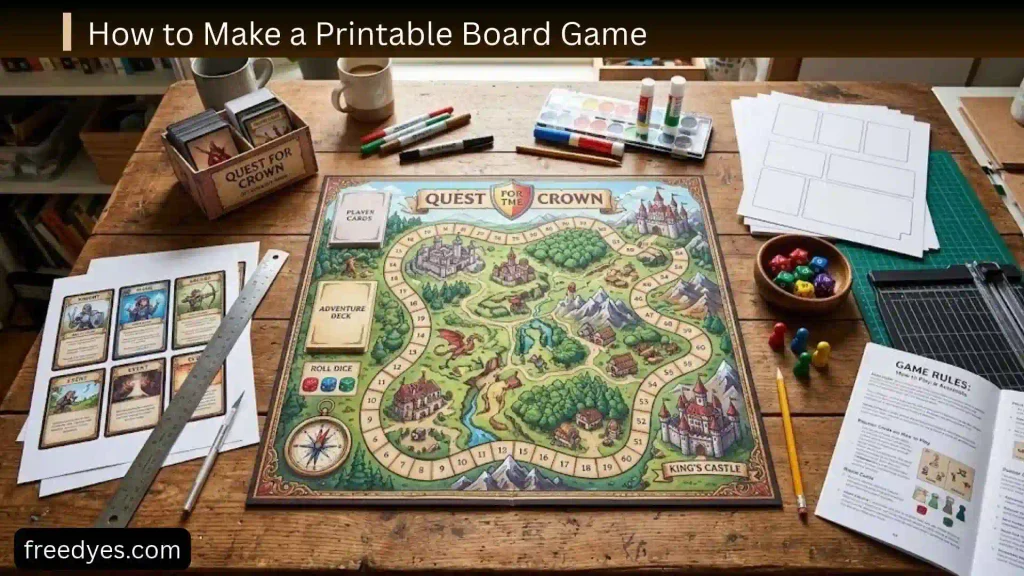
A printable version can be useful when you want multiple copies or a cleaner presentation.
Printable Board
Design the board so that:
- Spaces are clearly separated
- Text is readable
- Start and Finish are obvious
- Important areas use recognizable symbols
- The board fits your intended paper size
Do not fill every available area with artwork.
The board must remain easy to understand during play.
Printable Cards
Use consistent card dimensions.
Keep the layout simple:
Title
Instruction
Optional symbol or illustration
Avoid tiny text.
Printable Game Pieces
You can create:
- Paper tokens
- Foldable standees
- Circular counters
- Numbered tokens
- Character cards
For children, make pieces large enough to handle comfortably.
How to Improve Replayability
A game can work perfectly once and still become boring after the first play.
Replayability means players have reasons to return to the game.
Add Different Choices
Players might choose between:
- Safe versus risky paths
- Short versus long routes
- Immediate reward versus future reward
- Collecting points versus blocking another player
Change the Setup
You can vary:
- Starting positions
- Card order
- Special spaces
- Objectives
- Available resources
Add Multiple Strategies
If every player should use exactly the same strategy, the game may become predictable.
Give players different ways to succeed.
For example:
One player might focus on collecting resources while another focuses on taking shortcuts.
Avoid Adding Complexity Just for Replayability
More cards do not automatically make a game better.
More rules do not automatically make it more strategic.
Only add a component if it creates a meaningful change in how the game is played.
DIY Board Game Mistakes to Avoid
Decorating Before Testing
Do not spend hours creating perfect artwork before you know whether the rules work.
Your prototype may require major changes.
Making Too Many Components
A huge deck of cards is difficult to revise.
Start small.
Add components only when you know they improve the game.
Overcomplicating the Rules
Beginners often add rules to solve every possible situation.
This can make the game difficult to learn.
Start with the simplest rule that solves the problem.
Skipping Playtesting
Playing the game yourself is not enough.
Other people will make choices you did not expect.
Those unexpected choices are valuable.
Changing Everything at Once
If you change the board, cards, scoring, movement, and rules simultaneously, you may not know what actually fixed the problem.
Make focused changes and test again.
Making the Board Look Better Than It Plays
Appearance matters, but gameplay comes first.
A simple board that people want to play again is more successful than a beautiful board that nobody understands.
How to Improve Your Board Game After Testing
Once you have completed your first test, resist the temptation to immediately rebuild everything.
Instead, identify the biggest problem.
Simplify
Remove rules that do not add anything meaningful.
Ask:
Does this rule make the game more interesting?
If the answer is no, consider removing it.
Balance
Check whether:
- One player has an obvious advantage
- One card is too powerful
- One route is always best
- Scores increase too quickly
- Losing players have no chance to recover
Make small adjustments and test again.
Improve Replayability
If players understand the game but do not want to play again, look for ways to create more meaningful variation.
Add choices rather than unnecessary components.
Improve the Rules
Rewrite confusing instructions.
Use the same term for the same thing throughout the rule sheet.
For example, do not call the same component a “treasure token” in one paragraph and a “gold piece” in another unless those are actually different things.
Include a short example when a rule is difficult to understand.
DIY Board Game for Different Purposes
The same basic process can produce very different games.
For a Family Activity
Focus on:
- Simple rules
- Short turns
- Shared laughter
- Easy setup
- Moderate competition
For a Classroom
Focus on:
- A clear learning objective
- Repeatable questions
- Simple scoring
- Easy component storage
- Multiple players
For a Children’s Craft
Focus on:
- Recycled materials
- Visual instructions
- Large pieces
- Simple mechanics
- Creative decoration
For a Serious Game Prototype
Focus more heavily on:
- Mechanics
- Balance
- Player decisions
- Rules clarity
- Repeated playtesting
- Iterative changes
A polished prototype should come after the basic gameplay has been tested, not before.
How to Turn a Homemade Game Into a More Polished Prototype
Once the game works, you can improve its appearance.
Replace:
- Rough paper with cardstock
- Handwritten cards with printed cards
- Temporary tokens with consistent pieces
- Pencil marks with clean graphics
- Loose components with labeled storage
At this stage, durability and readability become more important.
But remember the difference between a prototype and a finished product.
A prototype exists to test the game.
A finished version exists to present and play repeatedly.
Keeping those purposes separate can save considerable time and money.
Safety Tips for Making a DIY Board Game
DIY games are generally simple projects, but craft tools and small components still require reasonable care.
Scissors and Cutting Tools
Children should use age-appropriate scissors.
If a craft knife is needed for thick cardboard, an adult should handle it or supervise closely.
Always cut on a suitable surface rather than directly on furniture.
Small Game Pieces
Buttons, coins, beads, dice, and small tokens can be choking hazards for young children.
Keep small components away from children who may put objects in their mouths.
Glue and Paint
Use craft materials according to their labels.
Allow painted or glued pieces to dry completely before playing.
Keep adhesives away from food and children’s reach when appropriate.
Frequently Asked Questions
How do I make a DIY board game at home?
Start by choosing a theme, objective, number of players, turn structure, and winning condition. Then sketch the board on paper, create simple pieces and cards, write the rules, assemble a basic prototype, and playtest it. Improve the game based on what you discover.
What materials do I need to make a homemade board game?
You can start with cardboard or paper, a pencil, markers, scissors, glue or tape, dice, and simple tokens. Coins, buttons, bottle caps, cereal boxes, and scrap paper can replace many traditional game supplies.
Can I make a board game with cardboard?
Yes. Cardboard works well for homemade game boards because it is inexpensive and easy to cut, draw on, and decorate. A cereal box or other clean recycled cardboard can also work for a lightweight prototype.
How do I create rules for my own board game?
Start with the objective, setup, turn order, player actions, movement, special spaces, scoring, and winning condition. Write the rules as simply as possible, then give them to someone else and see whether they can play without constant explanations.
How do I make my DIY board game fun?
Give players meaningful choices, keep turns moving, balance luck with decision-making, create a clear objective, and provide a satisfying ending. Most importantly, playtest the game and use repeated feedback to improve it.
How do I make a board game for kids?
Use simple rules, visual symbols, easy-to-handle pieces, short turns, and a clear objective. Counting, matching, collecting, and simple racing mechanics are good starting points for younger children.
Can I make a board game without buying supplies?
Yes. A basic prototype can be made from paper, recycled cardboard, coins, buttons, bottle caps, pencils, and other household items. You do not need specialized components to test whether your game works.
How do I make DIY board game pieces?
Use coins, buttons, bottle caps, cardboard circles, beads, small toys, or folded paper standees. Give each player a different color, shape, or symbol so pieces are easy to identify.
How do I make board game cards?
Cut cardstock or sturdy paper into equal-sized rectangles. Put a short title and clear instruction on each card. Keep the text large and simple enough to read during play.
How do I test my homemade board game?
First, run a basic solo test to find obvious problems. Then have friends or family play while you observe. Pay attention to confusion, waiting time, dominant strategies, boredom, and unexpected choices. Ask players what they enjoyed, what confused them, and what they would change.
What should I do if my DIY board game is too long?
Look for unnecessary spaces, repetitive actions, excessive scoring requirements, or slow turns. You can shorten the board, increase movement, reduce the target score, remove repetitive steps, or introduce a clearer ending condition.
What should I do if my game is too random?
Give players more control. Add choices, alternative routes, limited rerolls, resource management, or decisions about how to use cards. You do not necessarily need to remove randomness completely.
How do I balance a homemade board game?
Play it repeatedly and watch for patterns. Check whether one strategy, card, route, starting position, or player order consistently provides an advantage. Make one focused change and test again.
Can I make a board game by myself?
Yes. You can design, prototype, and self-test a game alone before involving other players. However, outside playtesting is valuable because other people will interpret rules and make decisions differently from the designer.
How can I make my board game more replayable?
Add meaningful choices, variable setups, different objectives, alternate routes, changing challenges, or multiple strategies. Avoid adding complexity simply for the sake of variety.
Should I decorate my board before testing it?
It is usually better to test the basic game first. A rough prototype is faster to change, while detailed artwork can take considerable time. Once the gameplay works, you can make the board and components look more polished.
Can a DIY board game be cooperative?
Absolutely. Players can work together toward a shared goal instead of competing against each other. You can create a timer, threat, resource limit, or final objective that the entire group must overcome.
Can I make a printable board game?
Yes. You can create a printable board, cards, tokens, and player aids. Make sure the text is readable, the spaces are clearly marked, and the printed components are practical to cut and use.
Final DIY Board Game Checklist
Before calling your game finished, check each item:
- The game has a clear theme or concept.
- Players know what they are trying to accomplish.
- The winning condition is clear.
- Each player knows what to do during a turn.
- The board is easy to understand.
- The pieces are easy to identify.
- Cards are readable.
- The game can actually end.
- The rules do not contradict one another.
- The game has been tested.
- Confusing rules have been rewritten.
- Major balance problems have been addressed.
- The game length feels appropriate.
- Players have meaningful choices.
- The game is enjoyable for its intended audience.
- The final artwork does not make the board harder to read.
Final Thoughts
Creating a DIY board game is part craft project, part storytelling exercise, and part problem-solving challenge. You are not simply making a board; you are creating an experience that other people need to understand and enjoy.
Start small.
Use materials you already have. Sketch the idea before building the final board. Create simple rules, make a rough prototype, and play it as soon as possible.
Most importantly, do not be discouraged when the first version has problems. A weak first prototype can be more useful than a beautiful game that was never tested. Playtesting shows where players become confused, where turns become boring, where luck overwhelms decisions, and where the game becomes exciting.
Once you know what is not working, make focused changes and test again.
The goal of your first DIY board game does not have to be perfection. The goal is to create something playable, learn from it, and turn the next version into a better game.