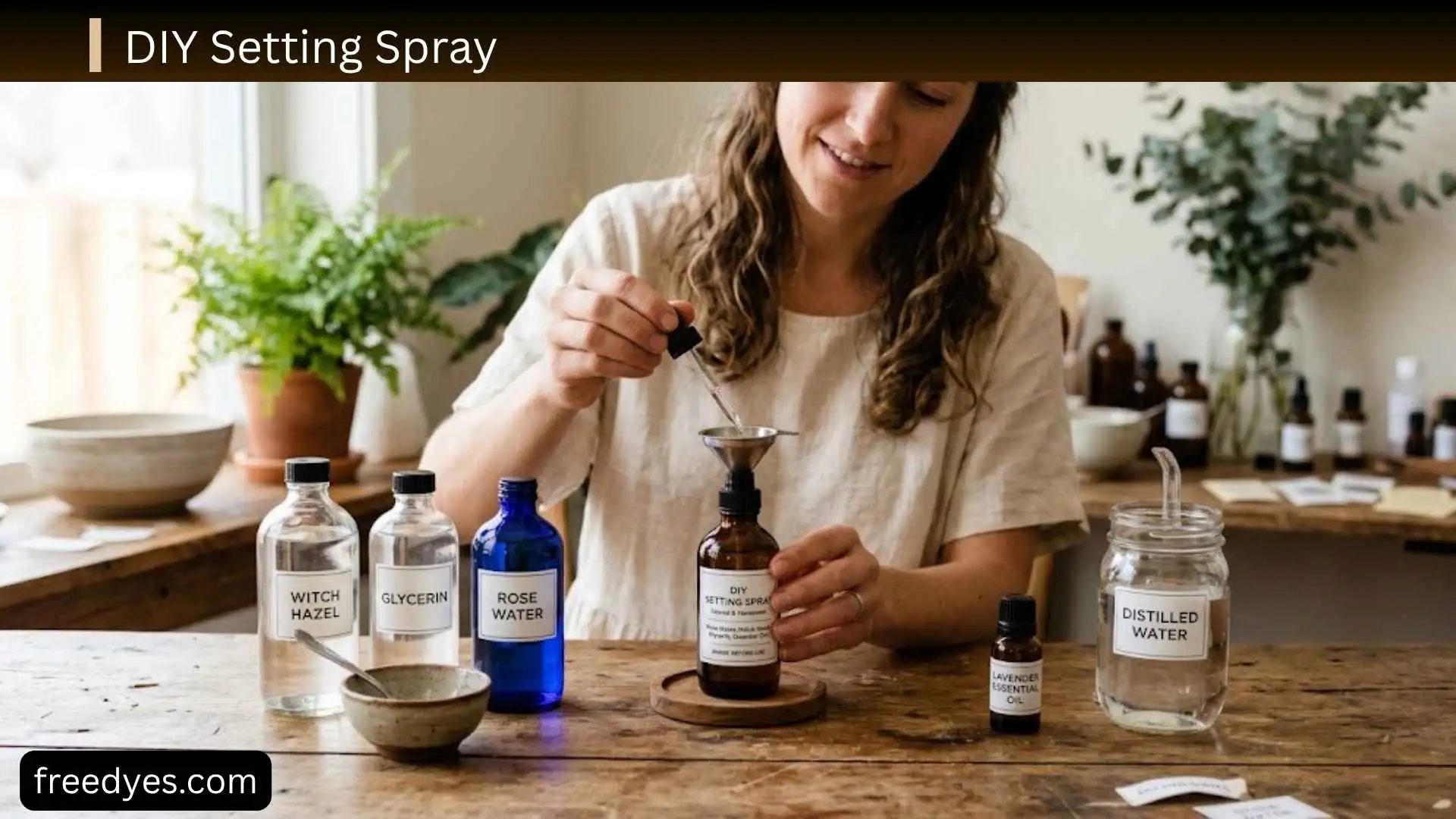
I am always looking for simple ways to keep my makeup looking fresh from morning to night without spending a fortune. If you are like me, you have probably wondered whether a DIY setting spray can really lock in your makeup while keeping your skin comfortable. The good news is that it can when you use the right ingredients and follow a safe recipe.
In this guide, I am sharing everything I have learned about making a DIY setting spray at home. I will explain which ingredients work best, which ones you should avoid, and how to customize your spray for dry, oily, or combination skin. By the end, you will know how to create a budget-friendly setting spray that helps your makeup last longer while giving your skin a fresh, natural finish.
DIY Setting Spray (Quick answer)
For a simple homemade finishing mist, combine distilled water with a small amount of glycerin, place it in a clean spray bottle, shake gently, and mist lightly over finished makeup. Because this is a homemade water-based mixture without a professionally validated preservation system, make a small batch rather than treating it like a shelf-stable cosmetic.
Best DIY Setting Spray Recipe
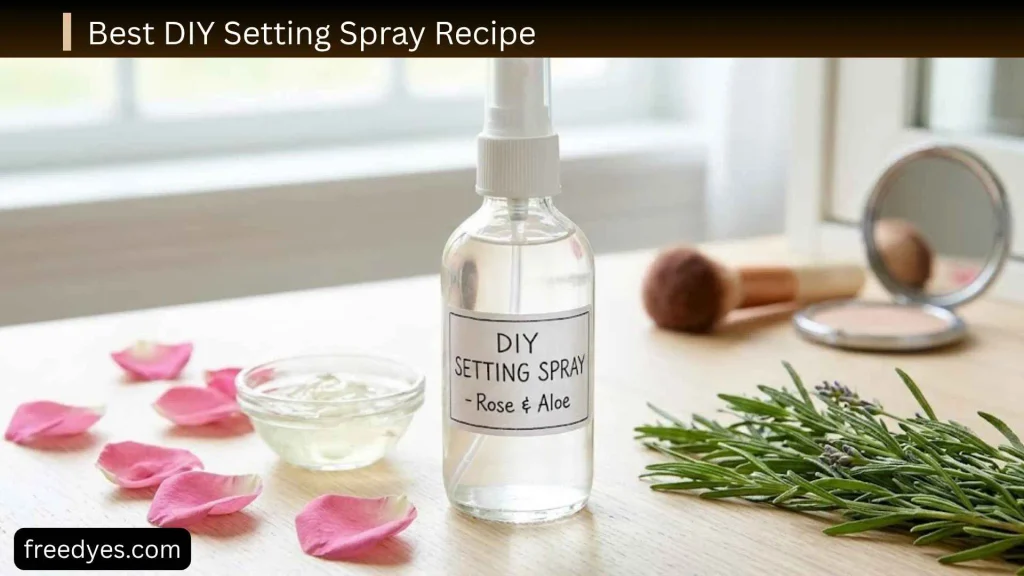
If this is your first time making homemade setting spray, start with the simplest formula instead of adding several ingredients.
Ingredients
- 4 tablespoons distilled water
- ½ teaspoon vegetable glycerin
- 1 small clean spray bottle
- Small measuring spoon
- Funnel, optional
Glycerin is commonly used in cosmetics as a humectant and skin-conditioning ingredient, and a Cosmetic Ingredient Review assessment concluded that glycerin is safe for cosmetic use under the conditions evaluated.
How to Make DIY Setting Spray
- Wash your hands before preparing the mixture.
- Make sure the spray bottle is clean and completely dry.
- Measure 4 tablespoons of distilled water.
- Pour the water into the spray bottle.
- Add ½ teaspoon of glycerin.
- Close the bottle tightly.
- Shake gently to combine the ingredients.
- Label the bottle with the date you made it.
You do not need to heat the mixture or use complicated equipment.
The goal is to make a small, simple finishing mist, not to reproduce a commercial cosmetic formula in your kitchen.
How to Apply It
After completing your makeup:
- Hold the bottle several inches away from your face.
- Close your eyes and mouth.
- Spray a light, fine mist.
- Move the bottle as you spray rather than concentrating it in one spot.
- Allow the mist to dry naturally.
- Avoid rubbing your face while it is still damp.
Your face should look lightly misted rather than wet or dripping.
What Does DIY Setting Spray Actually Do?
The term setting spray can be confusing because homemade and commercial products can perform very different jobs.
A simple DIY mixture can help:
- Reduce a powdery appearance
- Make makeup layers look more blended
- Give skin a slightly fresher finish
- Add some moisture to the surface of makeup
- Create a softer-looking finish
It should not automatically be expected to make makeup completely transfer-proof or last all day.
DIY Finishing Mist vs. Commercial Setting Spray
A homemade water-and-glycerin mist is best thought of as a finishing mist.
Commercial setting sprays can contain more sophisticated combinations of ingredients designed for particular finishes and wear characteristics.
That difference matters.
If you need makeup to survive a long wedding, heavy sweating, very humid weather, stage lights, or an entire day without touch-ups, a professionally formulated setting spray may be a more dependable choice.
Why Glycerin Is Used in DIY Setting Spray
Glycerin is one of the most useful ingredients for a simple homemade facial mist.
It functions as a humectant, meaning it can help attract and retain water.
In a DIY spray, a small amount can help give the skin a softer, less dry-feeling finish.
However, more glycerin does not mean better makeup setting.
Adding too much can make the spray feel:
- Sticky
- Tacky
- Heavy
- Overly dewy
Start with a small amount and adjust your approach in a future batch if the finish does not suit you.
Why Use Distilled Water?
Distilled water provides a simple water base for the recipe.
That does not mean distilled water makes a homemade spray sterile or gives it a guaranteed shelf life.
A water-based cosmetic can become contaminated through ingredients, equipment, packaging, handling, or environmental exposure. FDA guidance specifically identifies microbial contamination as a potential cosmetic safety problem.
For that reason, the recipe is intentionally small.
DIY Setting Spray Recipe by Bottle Size
Rather than making a large bottle that may sit around for weeks or months, make only enough for your short-term needs.
You can use the basic recipe as a starting ratio:
| Bottle size | Distilled water | Glycerin |
| Small batch | 4 tbsp | ½ tsp |
| Larger batch | Scale carefully | Scale carefully |
These measurements should be treated as a simple DIY starting formulation, not a professionally validated cosmetic formulation.
If you increase the batch size, you also increase the amount of product exposed to handling and storage. Larger batches therefore do not automatically make sense for homemade use.
How to Make DIY Setting Spray Without Glycerin
Maybe you want to make a setting spray but do not have glycerin.
The simplest answer is: do not replace glycerin with a random kitchen ingredient just because it is available.
You can make a very simple refreshing mist using a suitable cosmetic facial mist, but plain water will behave more like a refreshing spray than a true setting product.
Can You Use Just Water?
Yes, you can mist water over makeup, but plain water does not contain ingredients specifically designed to improve makeup wear.
It may temporarily make powder look less dry, but it should not be expected to provide strong makeup hold.
What Should You Avoid as a Glycerin Substitute?
Avoid experimenting with ingredients such as:
- Lemon juice
- Baking soda
- Sugar
- Honey
- Food flavorings
- Perfume
- Undiluted essential oils
- Random kitchen extracts
A facial spray is not the place to add ingredients simply because they are natural or available in the pantry.
DIY Setting Spray for Dry Skin
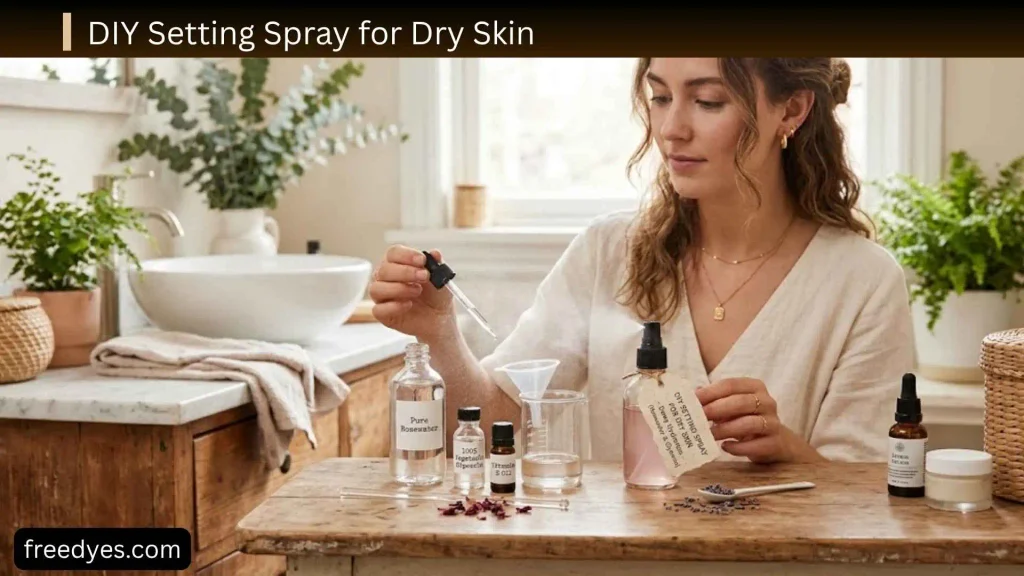
If your makeup tends to look dry or powdery, your main goal should be a comfortable, lightly hydrated finish.
A small amount of glycerin may help the surface of makeup appear softer.
Tips for Dry-Looking Makeup
- Moisturize before applying makeup.
- Allow skincare to settle before foundation.
- Use thinner layers of foundation.
- Avoid applying excessive powder.
- Mist lightly rather than soaking your face.
- Let the spray dry naturally.
If your foundation is already clinging to dry patches, adding more setting spray will not necessarily fix the problem.
Skin preparation still matters.
DIY Setting Spray for Oily Skin
If you have oily skin, you may prefer a less sticky and less dewy finish.
Instead of increasing the amount of glycerin, focus on controlling the layers underneath your makeup.
Try This Approach
- Use lightweight skincare.
- Allow moisturizer to settle.
- Apply primer if it works well with your foundation.
- Use a thin layer of foundation.
- Powder only where needed.
- Apply a very light mist.
If glycerin makes your skin feel too tacky or shiny, reduce it in a future small batch or choose a different finishing product.
There is no single DIY formula that will behave identically on every person’s skin.
DIY Setting Spray for Combination Skin
Combination skin can benefit from treating different areas differently.
For example, you might want:
- Less shine around the forehead and nose
- A softer finish on the cheeks
- Less powder on dry areas
Rather than changing the recipe dramatically, adjust how you prepare and set different parts of your face.
A light final mist can then help the overall makeup look more cohesive.
DIY Setting Spray for Sensitive Skin
If your skin is sensitive or easily irritated, simpler is generally better.
A homemade spray should not become an experiment involving numerous fragrances, essential oils, acids, herbs, and other ingredients.
Keep a Sensitive-Skin Approach Simple
- Choose a minimal ingredient list.
- Avoid adding fragrance just for scent.
- Skip essential oils.
- Avoid spraying directly into the eyes.
- Do not use the mixture on irritated or damaged skin.
- Stop using it if you experience burning, itching, redness, or another unexpected reaction.
Introducing one new cosmetic ingredient at a time also makes it easier to identify what caused a problem.
DIY Setting Spray for a Dewy Makeup Look
If you prefer glowing makeup, a light mist can help reduce the overly powdery appearance that sometimes happens after setting makeup.
The key is moderation.
You want a softly misted finish, not a wet face.
For a Natural Dewy Finish
Try:
- Apply your skincare.
- Use lightweight makeup layers.
- Powder only where necessary.
- Apply a small amount of DIY mist.
- Let the makeup dry naturally.
If your foundation begins moving or becoming uneven, you are probably using too much liquid.
DIY Setting Spray for Matte Makeup
A homemade glycerin mist is not necessarily the best choice if your goal is extremely matte, oil-resistant makeup.
Glycerin can contribute to a more hydrated skin feel, so using too much may work against the finish you want.
For matte makeup:
- Keep skincare lightweight.
- Use controlled amounts of powder.
- Avoid overapplying the DIY mist.
- Consider a professionally formulated matte setting spray when long wear is important.
How to Apply DIY Setting Spray Correctly
Even a simple recipe can perform poorly if it is applied incorrectly.
How Far Away Should You Spray?
Hold the bottle away from your face rather than pressing the nozzle directly against the skin.
The exact distance depends on the spray bottle.
A good spray bottle should produce a reasonably fine mist.
If it creates large droplets, test it away from your face first.
How Much Should You Use?
Use enough to lightly mist the surface of the makeup.
You should not need to make your face visibly wet.
If foundation starts moving, streaking, or collecting in certain areas, reduce the amount.
Should You Spray Before or After Powder?
For beginners, use the spray after your makeup is finished.
A typical order might look like:
Skincare → primer → foundation → concealer → powder → blush/bronzer → DIY setting mist
You can experiment with different application techniques once you understand how your makeup reacts, but the final-step method is the easiest place to start.
Should You Let It Dry?
Yes.
Allow the mist to dry naturally.
Do not immediately wipe, rub, or press your hands against your face.
Can You Use DIY Setting Spray Over Powder?
Yes.
In fact, one useful purpose of a light finishing mist is to reduce the overly dry or dusty appearance that powder can sometimes create.
The important word is light.
Heavy spraying can turn powder into wet patches and disturb the makeup underneath.
Can You Use DIY Setting Spray Over Foundation?
Yes, but if you are using it as your final mist, it is usually more practical to finish the rest of your makeup first.
This gives you a better idea of how the entire makeup layer responds to the spray.
Can You Use DIY Setting Spray Before Makeup?
You can use a suitable facial mist as part of skin preparation, but that is different from using a product specifically to set makeup.
If your goal is makeup longevity, apply your makeup first and use the DIY mist as the final finishing step.
DIY Setting Spray With Aloe Vera
Aloe vera frequently appears in homemade facial mist recipes.
It can be tempting to add aloe simply because it sounds soothing or hydrating.
However, adding aloe makes the formula more complicated.
Why Keep It Simple?
Every additional water-based ingredient can introduce another variable involving:
- Ingredient quality
- Compatibility
- Contamination
- Preservation
- Skin tolerance
- Storage
For that reason, aloe should be considered an optional formulation ingredient, not something you need to add to make the basic recipe work.
If you use aloe, choose a product intended for cosmetic use rather than assuming a random household aloe product is appropriate for a facial spray.
Can You Use Rose Water as DIY Setting Spray?
Rose water can be confusing because products sold under similar names may be very different.
A professionally manufactured cosmetic facial mist or rose-water product is not the same thing as homemade rose-petal water.
Commercial Rose Water
A properly manufactured cosmetic product is produced under controlled conditions and has its own ingredient and preservation considerations.
Homemade Rose Water
Making water from fresh rose petals and then storing it creates a water-based mixture with additional contamination and preservation concerns.
If you want a rose-scented facial mist, a properly formulated cosmetic product is a more predictable choice than storing homemade floral water.
Can You Use Witch Hazel in DIY Setting Spray?
Witch hazel is another popular ingredient in homemade beauty recipes.
However, different witch-hazel products can contain different additional ingredients, including alcohol.
You do not need witch hazel to make the basic DIY setting mist.
If your skin is easily irritated, adding unnecessary ingredients simply makes the formula more complicated.
Should You Add Essential Oils?
For a basic facial setting spray, there is little reason to add essential oils.
They are not required for makeup setting, and fragrance ingredients can be irritating for some people.
If you want a scented product, using a professionally formulated facial mist is a more predictable option than attempting to fragrance a homemade water-based cosmetic.
Can You Add Alcohol to DIY Setting Spray?
Some commercial makeup sprays contain alcohol, but that does not mean adding rubbing alcohol to a homemade recipe will recreate a commercial setting spray.
Commercial formulations are designed as complete systems.
Alcohol can affect evaporation, skin feel, irritation potential, and the behavior of other ingredients.
Do not use household rubbing alcohol as a shortcut to create a “stronger” setting spray.
If long wear is your priority, use a professionally formulated product designed for that purpose.
Ingredients to Avoid in DIY Setting Spray
One of the easiest ways to make a DIY beauty recipe more complicated is to keep adding ingredients.
For a simple homemade facial mist, avoid experimenting with:
Lemon Juice
Lemon juice is acidic and is unnecessary for setting makeup.
Baking Soda
Baking soda does not belong in a basic facial setting spray.
Sugar
Sugar can make the mixture sticky and does not provide a sensible reason to include it.
Perfume
A facial mist does not need perfume to work.
Undiluted Essential Oils
These are unnecessary for the makeup-setting purpose of the product.
Kitchen Extracts
Food ingredients are not automatically appropriate for use in a facial cosmetic.
The basic principle is simple:
Do not add an ingredient just because a DIY recipe somewhere says it works.
How Long Does DIY Setting Spray Last?
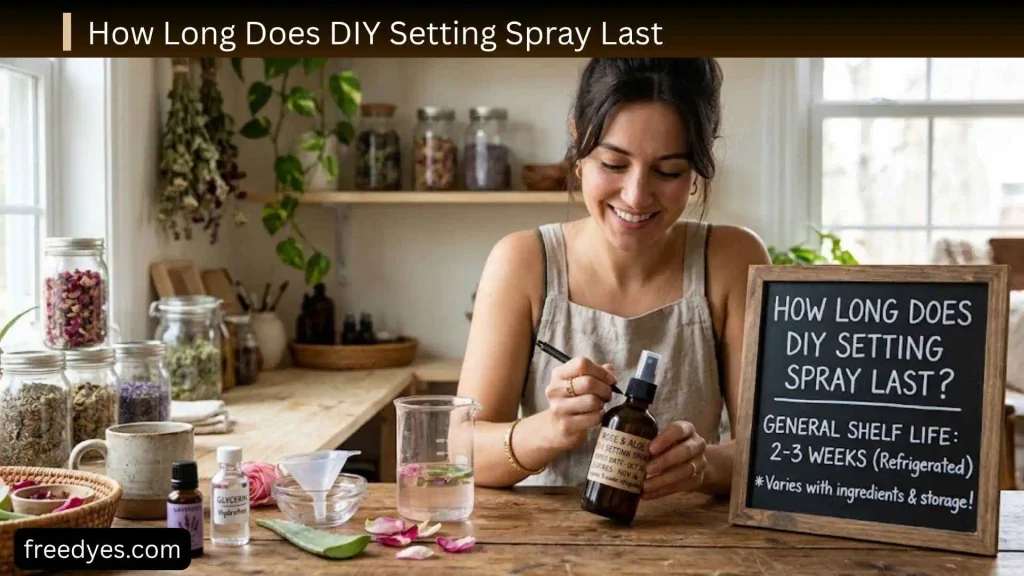
This is one of the most important parts of making homemade setting spray.
A water-based homemade cosmetic does not automatically have a reliable shelf life.
FDA notes that microbial contamination can make cosmetics unsafe and that contamination can occur through ingredients, manufacturing conditions, packaging, and consumer use.
Therefore, it would be misleading to tell you that an unpreserved homemade spray is definitely safe for 30, 60, or 90 days.
The Safer Homemade Approach
Instead:
- Make a small batch.
- Use a clean bottle.
- Wash your hands before preparation.
- Keep the bottle closed.
- Avoid touching the nozzle.
- Do not share the product.
- Label the date.
- Do not keep it indefinitely.
- Throw it away if its smell, appearance, color, or texture changes.
FDA consumer guidance also recommends keeping cosmetic containers clean and tightly closed and discarding cosmetics when there are changes in color or smell.
Why Refrigeration Is Not a Complete Solution
Putting a homemade spray in the refrigerator does not transform it into a professionally preserved cosmetic.
Cold storage may affect microbial growth, but it does not give an untested homemade formulation a validated shelf life.
The better strategy is to make less rather than trying to preserve a large amount.
How to Keep DIY Setting Spray Cleaner
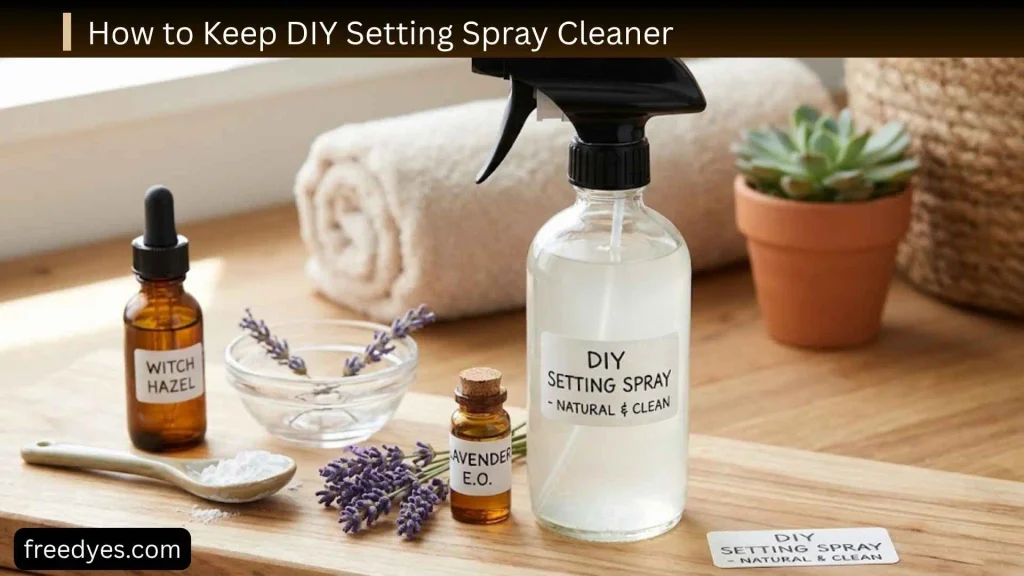
You cannot turn a kitchen-made product into a professionally tested cosmetic simply by washing a bottle, but good hygiene can reduce unnecessary contamination.
Clean the Bottle
Use a clean spray bottle before preparing the mixture.
Wash Your Hands
Clean hands reduce avoidable contamination during preparation.
Keep the Bottle Closed
Do not leave the cap or nozzle exposed unnecessarily.
Do Not Touch the Nozzle
Avoid putting your fingers over the spray opening.
Do Not Add Water Later
Do not keep topping up an old batch with fresh water.
Do Not Share It
Sharing facial cosmetics increases the possibility of transferring microorganisms.
When Should You Throw DIY Setting Spray Away?
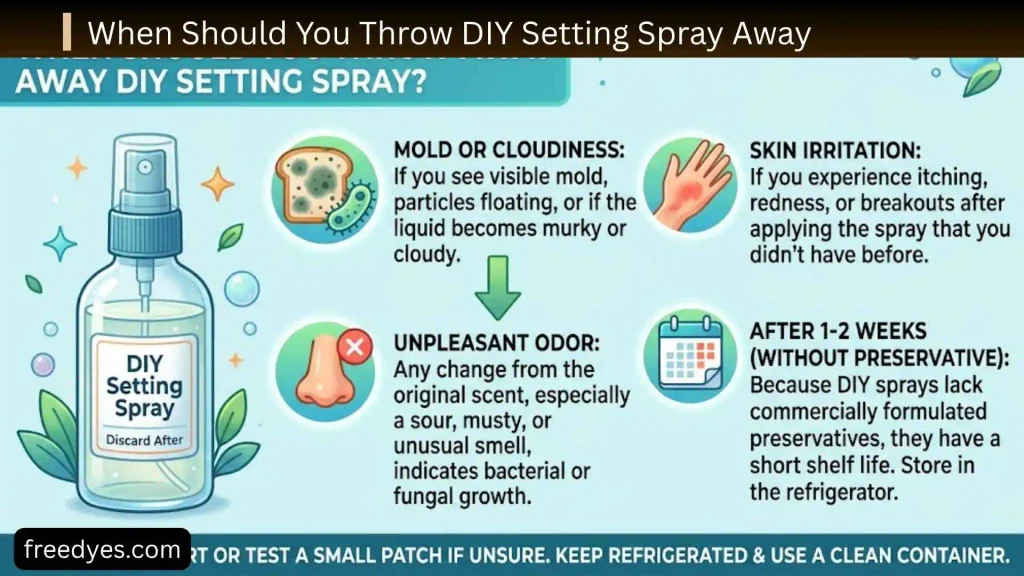
Do not try to rescue a homemade cosmetic simply because you hate wasting it.
Discard it if:
- The smell changes
- The color changes
- The liquid becomes cloudy in an unusual way
- The texture changes
- You see unexpected particles or growth
- The bottle or nozzle becomes visibly contaminated
- It causes unexpected irritation
FDA recommends discarding cosmetics when there are changes in color or smell.
DIY Setting Spray Troubleshooting
Even a simple recipe can fail because of the formula, spray bottle, makeup underneath, or application technique.
| Problem | Possible cause | What to try |
| Spray feels sticky | Too much glycerin | Use less glycerin in the next small batch |
| Makeup looks wet | Too much product | Use a lighter mist |
| Makeup becomes patchy | Large droplets or excessive spraying | Use a finer sprayer and spray less |
| Makeup separates | Too many layers underneath or incompatible products | Simplify the base makeup |
| Face looks too shiny | Formula is too dewy for your preference | Reduce glycerin or use a different finishing product |
| Makeup still doesn’t last | Homemade mist lacks strong fixing properties | Use a commercial long-wear setting spray |
| Powder looks cakey | Too much powder or too much makeup | Reduce powder before spraying |
| Skin feels irritated | Ingredient sensitivity | Stop using the mixture |
Why Is My DIY Setting Spray Sticky?
The first thing to consider is the glycerin.
Glycerin affects the feel of the mixture, and using too much can make the face feel tacky.
Do not keep adding ingredients to correct it.
For the next batch, reduce the amount and test the finish.
Why Does My DIY Setting Spray Make Makeup Wet?
Your spray bottle may be producing large droplets, or you may be applying too much.
Test the sprayer over a sink or tissue first.
A good finishing mist should be light enough that you do not feel like you are washing your face.
Why Is My Makeup Separating?
The spray may not be the only problem.
Foundation separation can also be related to:
- Too much moisturizer
- Too much primer
- Heavy foundation
- Excess oil
- Incompatible product combinations
- Rubbing the skin
- Applying too many layers
Try simplifying your makeup routine before assuming the spray itself is responsible.
Why Doesn’t DIY Setting Spray Make My Makeup Last?
This is where expectations matter.
A basic homemade mist does not necessarily contain the specialized ingredients responsible for strong makeup fixation.
If you need serious wear resistance, a commercial product may be a better choice.
DIY Setting Spray vs. Commercial Setting Spray
| Feature | DIY Setting Spray | Commercial Setting Spray |
| Cost | Usually inexpensive | Usually costs more |
| Formula | Simple | Often more complex |
| Customization | Easy | Limited |
| Preservation | Homemade limitations | Designed for product storage |
| Long-wear performance | Usually limited | Depends on product |
| Humidity resistance | Limited | Some formulas are designed for it |
| Convenience | Must be made | Ready to use |
| Best use | Simple finishing mist | Predictable makeup performance |
The important point is not that DIY is “better” or commercial products are “better.”
They solve different problems.
When DIY Setting Spray Makes Sense
A homemade finishing mist can make sense when you:
- Want an inexpensive option
- Enjoy DIY beauty projects
- Want a simple ingredient list
- Mainly want to reduce a powdery appearance
- Do not need extreme makeup longevity
- Are willing to make small fresh batches
When You Should Skip DIY Setting Spray
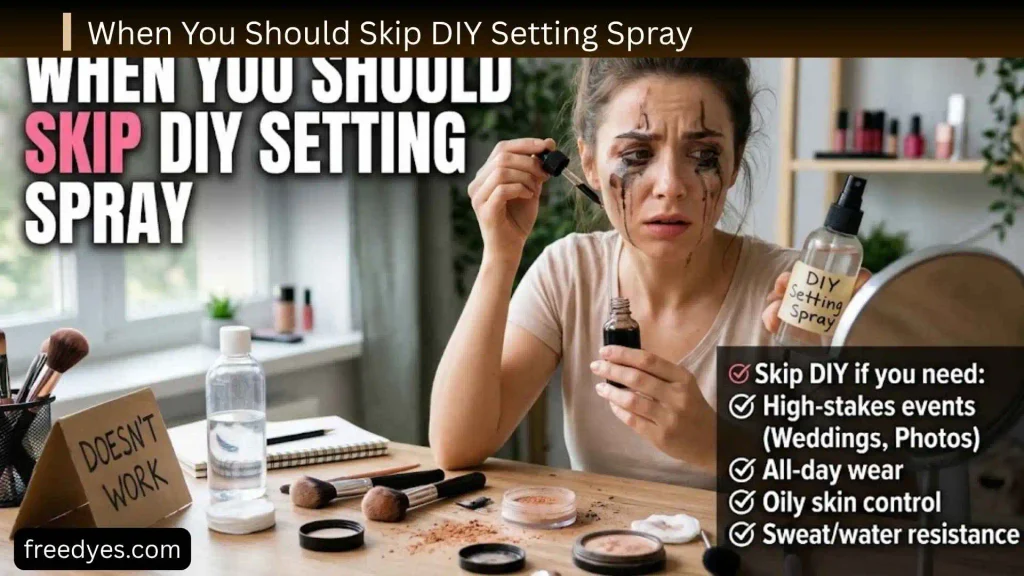
Choose a professionally formulated setting spray instead if you need:
- Wedding-day makeup
- Stage makeup
- Long events
- Heavy humidity resistance
- Strong sweat resistance
- Reliable transfer resistance
- Consistent performance
- Long-term storage
- A product you can keep in your makeup bag for months
A professionally formulated product has an advantage because the finished formula, packaging, preservation, and intended use are designed as a system.
DIY Setting Spray for Humid Weather
Humidity can be especially challenging for makeup.
A simple homemade water-based mist should not be presented as a reliable barrier against sweat and humidity.
If you are preparing makeup for a hot or humid day:
- Keep skincare lightweight.
- Avoid unnecessarily thick makeup layers.
- Powder strategically.
- Use a properly formulated long-wear setting product if durability is important.
- Carry blotting materials for touch-ups.
The DIY spray may still improve the appearance of powder, but it should not be treated as waterproofing.
DIY Setting Spray for Weddings and Special Events
A wedding or major event is not the ideal time to discover that a homemade formula does not work for your makeup.
If you still want to use a DIY mist, test the complete makeup routine beforehand.
Do not experiment for the first time on the actual event day.
For very important occasions, a professionally formulated product offers more predictable performance.
How to Test Your DIY Setting Spray Before Using It
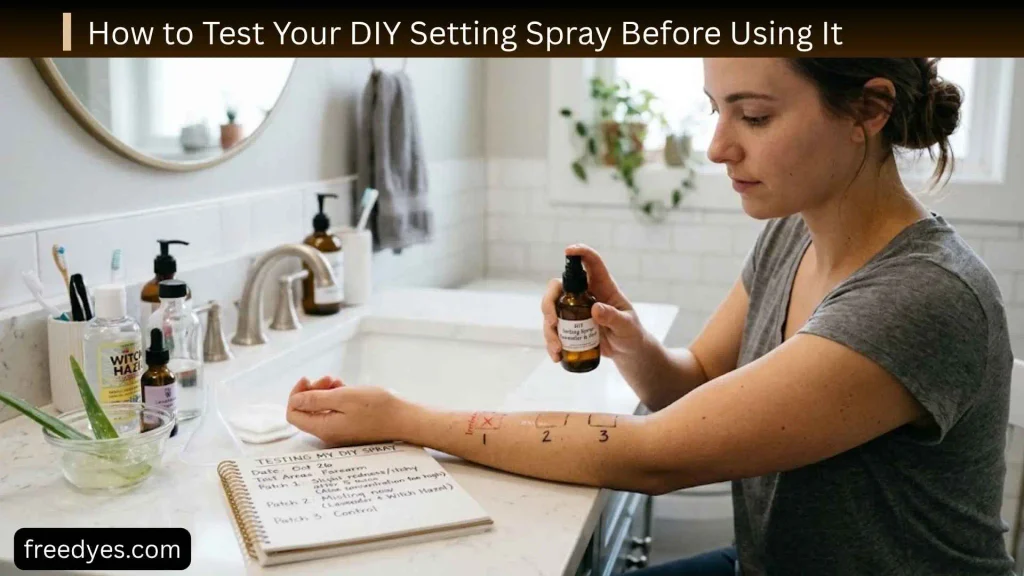
If you have never used the ingredients before, do not immediately spray a homemade mixture across your entire face.
Step 1: Check the Ingredients
Make sure you know what is actually in each ingredient you are using.
Step 2: Test Your Skin
Try a small amount on an appropriate area before full-face use.
Step 3: Test Your Makeup
Apply your normal makeup and use a light mist.
Step 4: Observe the Finish
Check whether your skin feels:
- Comfortable
- Sticky
- Too wet
- Too dry
- Irritated
Step 5: Check the Makeup Later
Look at the makeup after some time to see whether it has:
- Stayed smooth
- Become patchy
- Separated
- Become excessively shiny
- Become uncomfortable
This gives you useful information about whether the DIY approach actually suits you.
How to Make DIY Setting Spray Work Better
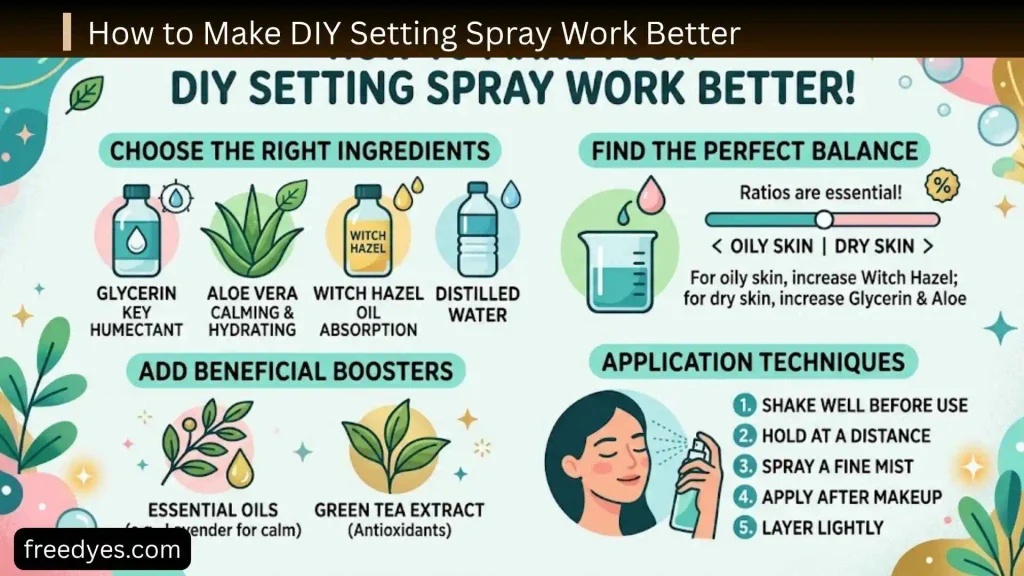
The recipe is only one part of the result.
Start With Good Skin Preparation
Dry or overly oily skin can affect how makeup wears.
Use Thin Makeup Layers
A thick base is harder to keep looking fresh.
Do Not Over-Powder
Excess powder can make makeup look cakey.
Use a Fine Mist
Large droplets can disturb the makeup.
Do Not Rub Your Face
Let the mist dry naturally.
Keep Expectations Realistic
A finishing mist can improve appearance without turning ordinary makeup into waterproof makeup.
DIY Setting Spray: Quick Decision Guide
Not sure which approach is right for you?
I want the simplest homemade option
Use the basic distilled-water-and-glycerin recipe.
I don’t have glycerin
Use a suitable commercial facial mist or accept that plain water will mainly function as a refreshing mist.
I want a dewy finish
Use a light mist and avoid excessive powder.
I have oily skin
Keep the formula light and avoid making the finish overly sticky or dewy.
I have sensitive skin
Keep ingredients minimal and avoid fragrance and unnecessary essential oils.
I need makeup to last all day
A professionally formulated setting spray is usually the better choice.
I need the product to last for months
Do not rely on an unpreserved homemade water-based mixture.
Frequently Asked Questions About DIY Setting Spray
What is the easiest DIY setting spray recipe?
A simple starting recipe is distilled water combined with a small amount of glycerin. Mix it in a clean spray bottle and apply a light mist over finished makeup.
Does DIY setting spray really work?
It can help makeup look less powdery and more blended, but a homemade mist should not be expected to provide the same long-wear performance as every commercial setting spray.
Can I make setting spray with just water?
Yes, but plain water is better described as a refreshing mist. It does not contain the ingredients that can give professionally formulated setting sprays their specific makeup-wear properties.
Can I make DIY setting spray without glycerin?
Yes, but without glycerin the result may be closer to a simple refreshing mist. Do not substitute random kitchen ingredients simply to make the formula more complicated.
Can I use rose water as setting spray?
A commercially manufactured cosmetic rose-water product may be used as a facial mist, but homemade rose-petal water has additional preservation and contamination concerns.
Can I use aloe vera in DIY setting spray?
A cosmetic-grade aloe ingredient can be incorporated into some facial mist formulations, but adding it makes the formula more complicated. It is not necessary for the simplest recipe.
Can I use witch hazel as setting spray?
Witch hazel is not required for a basic DIY setting spray. Different witch-hazel products also have different formulations, so check the ingredient list rather than assuming every product is interchangeable.
Can I use rubbing alcohol as setting spray?
Rubbing alcohol is not a sensible shortcut for making a professional setting spray. Commercial formulas are designed around their complete ingredient systems.
Can I add essential oils?
You do not need essential oils in a DIY setting spray. They add fragrance but do not provide an essential makeup-setting benefit.
Why is my DIY setting spray sticky?
The glycerin may be too high for your preferred finish, or you may simply be using too much product. Reduce the glycerin in your next small batch and mist more lightly.
Why does my DIY setting spray make my makeup patchy?
Large droplets, excessive spraying, heavy makeup layers, or product incompatibility can contribute to patchiness. Try a finer mist and use less liquid.
Can I use DIY setting spray every day?
You can use a simple mist if your skin tolerates it, but homemade water-based cosmetics have preservation limitations. For frequent long-term use, a properly formulated commercial product is more predictable.
Can I store DIY setting spray in the refrigerator?
Refrigeration does not give an unpreserved homemade cosmetic a validated shelf life. It is better to make a small quantity than rely on refrigeration for long-term storage.
Can I use DIY setting spray over powder?
Yes. A light mist can help powder appear more blended and less dusty. Avoid spraying enough to make the powder visibly wet.
Can DIY setting spray make makeup waterproof?
No. A basic homemade water-and-glycerin mist should not be described as waterproofing makeup.
Is homemade setting spray safer than store-bought setting spray?
Not automatically. “Homemade” and “natural” do not guarantee safety. Homemade water-based cosmetics have their own contamination and preservation challenges. FDA notes that cosmetic manufacturers are responsible for ensuring products are safe under customary conditions of use.
Final Thoughts
A DIY setting spray can be a simple and inexpensive way to give finished makeup a softer, fresher appearance.
For beginners, the best approach is also the simplest: use distilled water and a small amount of glycerin, prepare only a small batch, use clean equipment, and apply a fine mist rather than soaking the face.
The most important thing is to understand what the homemade spray can—and cannot—do.
It may help powder look less dry and makeup appear more blended, but it should not automatically be treated as a long-wear, waterproof, sweat-resistant replacement for a professionally formulated setting spray.
Keep the formula simple, avoid unnecessary kitchen ingredients and fragrances, pay attention to how your skin reacts, and do not assign an artificial shelf life to an unpreserved water-based mixture.
If you need reliable all-day performance or long-term storage, a professionally formulated product is the more predictable choice.
Most importantly, don’t make the recipe more complicated simply because you can. For homemade cosmetics, simple, clean, small-batch, and realistic is a much better approach than adding a dozen ingredients.