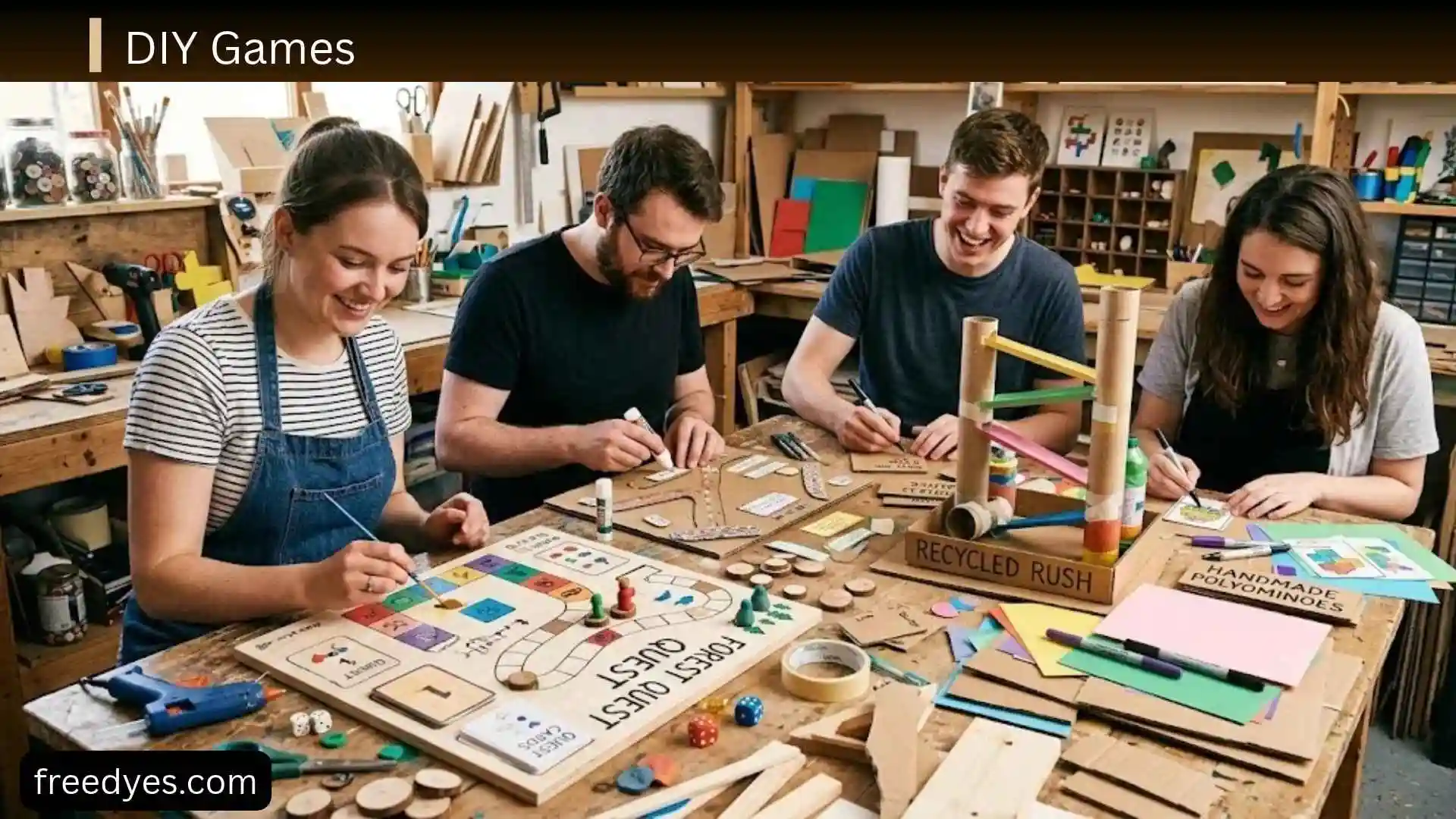
Looking for DIY games you can make at home without buying expensive equipment? You can turn paper, cardboard, cups, bottles, balloons, socks, and other everyday items into games for kids, adults, families, and parties.
The best homemade games are not necessarily complicated. A good DIY game should have a clear goal, simple rules, materials that are easy to find, and enough flexibility to work for different ages and group sizes.
This guide focuses on games you can actually make and play, including quick five-minute activities, indoor games, outdoor challenges, party games, family games, no-supply games, and homemade board games.
DIY Games at a Glance
| If you need… | Try… | Players | Setup |
| A quick indoor game | Cup Target Challenge | 2–6 | 5 minutes |
| A cheap game | Paper Target Toss | 2–8 | 5 minutes |
| A backyard game | DIY Ring Toss | 2–10 | 10 minutes |
| A quiet game | Homemade Memory Game | 2–6 | 15 minutes |
| A family game | Homemade Trivia | 3+ | 10 minutes |
| A creative project | DIY Board Game | 2–6 | 30+ minutes |
| A party activity | One-Minute Challenges | 4+ | 10 minutes |
| A large-group game | Team Relay | 6+ | 10–15 minutes |
| A game with no supplies | Story Builder | 2+ | Almost none |
| A treasure-hunt activity | DIY Clue Hunt | 2+ | 15–30 minutes |
Times are practical estimates rather than fixed requirements. Your preparation time will depend on the materials, number of players, and complexity of the game.
How to Choose the Best DIY Game
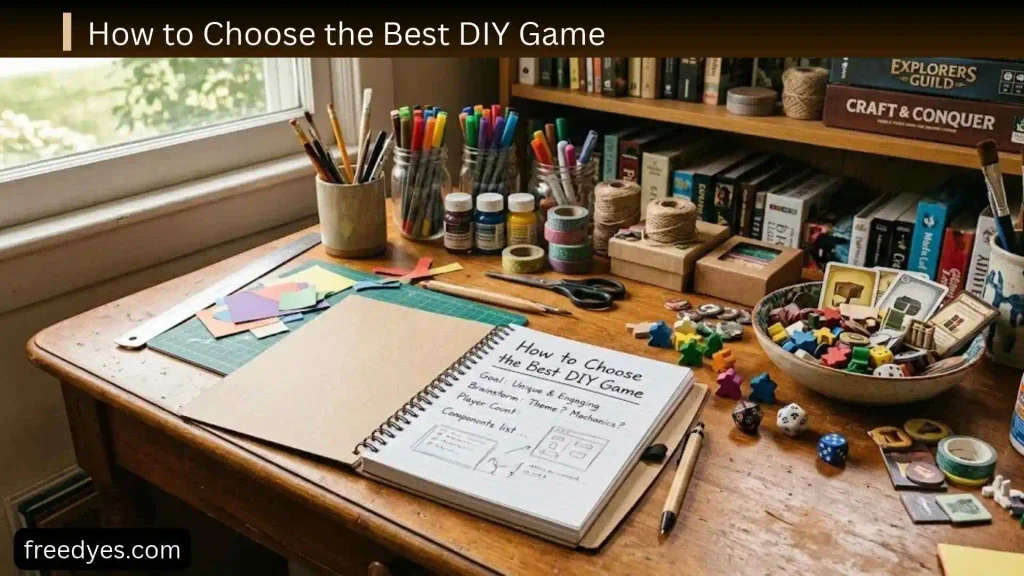
Instead of making a random game and hoping everyone enjoys it, start with the situation.
Choose by age
Young children: Use large, easy-to-handle materials, short rounds, simple rules, and plenty of opportunities to participate.
Older kids: Add targets, timers, puzzles, scoring, and more challenging rules.
Teens: Competitive challenges, trivia, strategy, and team games often work well.
Adults: Consider trivia, timed competitions, creative challenges, and team-based games.
Mixed ages: Use teams, adjustable distances, or different scoring rules so younger and older players can compete together.
Choose by number of players
| Players | Good DIY game types |
| 2 | Memory, trivia, target games |
| 3–4 | Drawing, board games, ring toss |
| 5–8 | Team challenges, trivia, relays |
| 9–15 | Party games, team competitions |
| 15+ | Large-team relays and rotating stations |
Choose by available space
For a small room, choose drawing, trivia, memory, bingo, storytelling, or cup games.
For a large indoor area, use relay challenges or target games.
For a backyard, ring toss, bowling, obstacle courses, and team games give players more room to move.
Choose by preparation time
If you have only five minutes, don’t start building a complicated board game.
Use:
- Cup challenges
- Paper targets
- Drawing games
- Trivia
- Story games
If you have 30 minutes or more, you can make:
- A board game
- A memory game
- A treasure hunt
- A multi-station challenge
DIY Cup Target Challenge
This is a simple homemade game when you want something that can be prepared quickly.
What you need
- 6–10 paper or plastic cups
- Soft balls, beanbags, or rolled socks
- Tape
- Paper and pencil for scoring
How to make it
Arrange the cups on a table or floor.
If you want different difficulty levels, put some cups closer and others farther away.
Assign each target a score. For example:
- Close cup = 1 point
- Middle cup = 3 points
- Far cup = 5 points
Mark a throwing line with tape.
How to play
Each player gets five throws.
Add the points from the cups they successfully hit.
The highest score after an agreed number of rounds wins.
Make it easier
Move the throwing line closer or use larger cups.
Make it harder
Move the targets farther away, reduce the number of throws, or give higher scores to smaller targets.
Safety: Use soft objects indoors and keep breakable objects away from the playing area.
DIY Ring Toss
Ring toss is a useful homemade game for a backyard, birthday party, classroom activity, or family gathering.
Materials
- Empty plastic bottles
- Cardboard or lightweight rings
- Tape
- Markers
- A flat playing area
Make the targets
Clean and dry several empty bottles.
Decorate them with numbers.
For example:
- Bottle 1 = 1 point
- Bottle 2 = 2 points
- Bottle 3 = 5 points
Place the bottles at different distances.
Make the rings
Cut rings from sturdy cardboard and smooth any rough edges.
You can also use lightweight rings you already have.
How to play
Give each player five rings.
Players stand behind a marked line and try to land the rings over the bottles.
Add the scores after each round.
For younger players
Use larger targets and allow them to stand closer.
For older players
Move the targets farther away or give the smallest target the highest score.
DIY Bottle Bowling
Turn empty bottles into a homemade bowling game.
What you need
- 6–10 empty plastic bottles
- A soft ball
- Tape
- Optional markers or paper for decorating
Make it
Place the bottles in a triangular formation.
Mark a starting line.
If you want the game to look more finished, decorate the bottles with numbers or simple designs.
How to play
Each player gets two rolls per turn.
Count how many bottles are knocked down.
You can use traditional-style scoring or simply award one point per bottle.
Make it more challenging
Increase the distance between the player and the bottles.
For younger children, use a larger lightweight ball and place the pins closer.
DIY Paper Target Toss
This is one of the easiest homemade games when you need something inexpensive.
Materials
- Large sheet of paper or cardboard
- Marker
- Tape
- Paper to make throwing balls
Make the target
Draw several circles or other shapes.
Give each section a different point value.
For example:
- Large outer area = 1 point
- Middle area = 3 points
- Small center = 5 points
Tape the target to the floor or another safe flat surface.
Make the throwing pieces
Crumple sheets of paper into small balls.
Avoid making them excessively hard.
How to play
Each player gets five throws.
Add the points where the paper balls land.
Variation
Create themed targets for:
- Birthday parties
- Halloween
- Classroom activities
- Holiday parties
- Sports parties
DIY Memory Matching Game
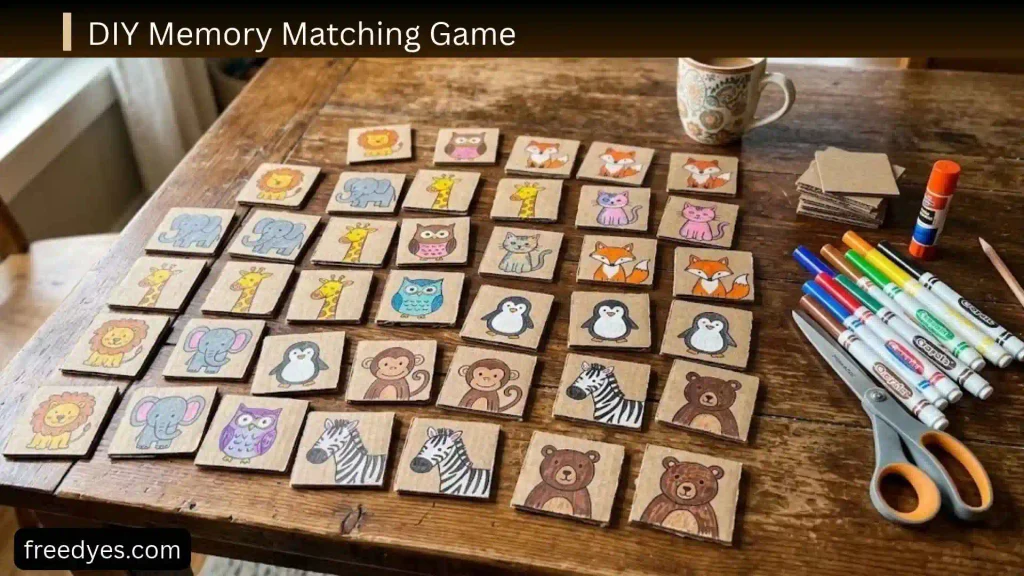
A homemade memory game is easy to customize for different ages.
Materials
- Cardstock, index cards, or thin cardboard
- Marker
- Ruler
- Scissors
Make the cards
Cut equal-sized cards.
Create matching pairs.
For example:
- Two stars
- Two cats
- Two trees
- Two hearts
- Two numbers
You can also make pairs using colors or simple symbols.
How to play
Mix the cards and place them face down.
The first player turns over two cards.
If they match, the player keeps the pair.
If they don’t match, turn them face down again.
The player with the most pairs at the end wins.
Make it easier
Use fewer pairs and obvious pictures.
Make it harder
Use more pairs or symbols that look similar.
Homemade Trivia Game
Trivia is particularly useful when you need a game for a family gathering, classroom, or adult party.
How to make it
Write questions on index cards or pieces of paper.
Create several categories, such as:
- Animals
- Food
- Movies
- Geography
- General knowledge
- Sports
- Music
- Family-friendly personal questions
How to play
Players can compete individually or in teams.
Ask one question at a time.
Give one point for each correct answer.
For a longer game, make difficult questions worth two or three points.
Make it fair for mixed ages
Create separate difficulty levels.
Younger players can answer easier questions while older players receive more challenging ones.
DIY One Minute Challenge Game

Instead of making one large game, create several short challenges.
Each challenge lasts one minute.
Challenge ideas
- Stack cups
- Sort objects by color
- Build a paper tower
- Move cotton balls with a spoon
- Transfer objects between containers
- Stack coins
- Toss soft objects into a cup
- Build the tallest structure from paper
How to play
Choose three to five challenges.
Give every player the same amount of time.
Award points based on performance.
The player or team with the most points wins.
Why this format works
Short rounds prevent the game from becoming repetitive.
Players also get several chances to recover if one challenge doesn’t go well.
DIY Homemade Board Game
If you want a DIY project that becomes a reusable game, make your own board game.
Materials
- Cardboard
- Paper
- Markers
- Scissors
- Dice
- Small objects for playing pieces
Step 1: Choose the objective
Decide what players are trying to accomplish.
Examples:
- Reach the finish first
- Collect the most tokens
- Complete a set of challenges
- Solve a mystery
- Collect five objects
A clear objective should come before you draw the board.
Step 2: Draw the board
Create a path from START to FINISH.
You can make it:
- Straight
- Circular
- Zigzag
- Branching
Don’t make the path unnecessarily complicated.
Step 3: Add special spaces
Add spaces such as:
- Move forward two
- Move backward one
- Roll again
- Draw a card
- Lose a turn
- Choose another player
Step 4: Make challenge cards
Write questions, actions, or surprises on cards.
For example:
- Name three animals.
- Move forward two spaces.
- Answer a trivia question.
- Skip your next turn.
- Swap places with another player.
Step 5: Test the game
Play one complete round before decorating the board.
Look for problems such as:
- The game takes too long.
- One player gets too many advantages.
- The rules are confusing.
- Players have no meaningful choices.
- The winner is determined too early.
Fix the rules before adding decorative details.
How to Invent Your Own DIY Game
You don’t have to copy an existing game format.
A simple way to design your own game is to combine five elements:
Goal + Action + Obstacle + Scoring + Winning Condition
Goal
What are players trying to achieve?
Action
What do players actually do?
They might:
- Toss
- Draw
- Build
- Guess
- Move
- Match
- Answer
- Search
Obstacle
What makes the goal challenging?
Examples include:
- A timer
- Limited attempts
- Special cards
- Distance
- Memory
- Other players
Scoring
Decide how players earn points.
Keep scoring easy enough to calculate while playing.
Winning condition
Decide exactly when the game ends.
Examples:
- First player to 10 points
- Highest score after five rounds
- First team to finish
- Player with the most matching pairs
This framework lets you turn ordinary household objects into a completely new homemade game.
DIY Games Using Household Items
You can make many games without buying special craft supplies.
| Household item | Possible game |
| Plastic cups | Target toss, stacking challenge |
| Empty bottles | Bowling, ring toss |
| Cardboard | Board game, targets |
| Paper | Trivia, bingo, memory, targets |
| Balloons | Relay and target games |
| Socks | Soft throwing games |
| Boxes | Toss targets and obstacle games |
| Tape | Floor targets and game boundaries |
| Spoons | Transfer challenges |
| Coins | Stacking challenges |
The key is to choose materials based on the game rather than buying supplies first.
DIY Games With No Supplies

Sometimes the goal isn’t to make a physical object at all. You may simply want a game you can start immediately.
Story Builder
One person starts a story with a sentence.
Each player adds one sentence.
Add a rule that every player must introduce a specific word or object to make the story more challenging.
Twenty Questions
One player thinks of something.
The others ask questions that can be answered with yes or no.
Set a maximum number of questions if you want a clear challenge.
Categories
Choose a category such as animals.
Players take turns naming something that belongs to that category.
Anyone who repeats an answer or cannot think of one within the agreed time loses the round.
Charades
One player acts out a word or phrase without speaking.
The others try to guess it.
Freeze Game
Players move while music plays.
When the music stops, everyone freezes.
For younger children, keep everyone in the game rather than eliminating players.
DIY Games for Kids
Kids’ games should generally have simple rules and quick feedback.
Ages 3–5
Choose:
- Color hunts
- Large target games
- Simple matching
- Bowling
- Movement games
Avoid small loose pieces when they could present a choking risk.
Ages 6–8
Try:
- Memory games
- Ring toss
- Treasure hunts
- Drawing challenges
- Cup games
Ages 9–12
Add:
- Trivia
- Timed challenges
- Team competitions
- DIY board games
- Puzzle hunts
The important thing is not just the child’s age. Consider reading ability, motor skills, attention span, and the complexity of the rules.
DIY Games for Adults
Adult games can use the same basic materials but benefit from more challenging rules.
Adult Trivia Challenge
Create categories that suit your group.
Team Drawing Challenge
Give teams a word and a short drawing time.
One-Minute Competition
Use several timed tasks and total the scores.
Homemade Strategy Board Game
Create cards that force players to make choices rather than simply roll and move.
For adult parties, keep the rules quick to explain and make sure players can participate without waiting through long turns.
DIY Games for Families
Family games work best when the rules can be adjusted.
Use teams
Pair younger and older players together.
Adjust the distance
A child can stand closer to a target than an adult.
Adjust the scoring
Younger players can receive bonus points without changing the basic game.
Avoid early elimination
If someone loses after the first round, they may spend most of the activity watching.
Use cumulative scoring instead.
DIY Party Games for Large Groups

Large groups need a different approach from a two-player game.
Instead of having everyone wait for one person to finish, use teams or stations.
Team Relay
Create three to five stations.
For example:
- Stack three cups.
- Toss a soft ball into a container.
- Complete a simple puzzle.
- Move around a marker.
- Return and tag the next teammate.
The first team to complete all stations wins.
Rotating Challenge Stations
Set up different activities around the room.
Teams spend a fixed amount of time at each station before moving to the next.
This keeps more people active at the same time.
DIY Treasure Hunt
A homemade treasure hunt can work indoors or outdoors.
What you need
- Paper
- Pen
- Optional small prize
- Safe locations for hiding clues
Create the clues
Start with an easy clue.
Then gradually increase the difficulty.
For younger players, use pictures or simple descriptions.
For older players, use riddles, codes, or puzzles.
Keep the route safe
Don’t hide clues near:
- Sharp objects
- Electrical equipment
- Unsafe heights
- Roads
- Hot surfaces
- Places where players could trip
The goal is to create a puzzle, not a physical hazard.
How to Make DIY Games Fair
A homemade game can become frustrating if one player has a major advantage.
Give everyone the same number of attempts
This is especially important for target games.
Adjust distance by age
Instead of forcing every player to throw from the same distance, give younger players a closer line.
Use teams
Teams can balance different ages and abilities.
Test the scoring
If the highest-value target is extremely easy to hit, the scoring system may need adjustment.
Keep the winner uncertain
A game is usually more exciting when several players still have a realistic chance to win near the end.
How to Make a DIY Game More Challenging
If players master the basic version, don’t immediately create a completely new game.
Change one variable.
Increase distance
Useful for throwing games.
Reduce time
Useful for timed challenges.
Add obstacles
Useful for target and relay games.
Add a memory element
Useful for matching or trivia games.
Reduce attempts
Fewer attempts make each decision more important.
How to Make a DIY Game Easier
If players are struggling:
- Move targets closer.
- Increase the number of attempts.
- Reduce the number of rules.
- Make targets larger.
- Give more time.
- Reduce the number of cards.
- Let players work in teams.
Don’t make a game easier by adding confusing bonus rules. Simplifying the main challenge is usually better.
Common DIY Game Problems and Solutions
| Problem | Better solution |
| Game is too easy | Increase distance or reduce attempts |
| Game is too hard | Move targets closer or increase attempts |
| One person always wins | Adjust scoring or use teams |
| Players are waiting too long | Use simultaneous stations |
| Younger children struggle | Simplify rules or adjust distance |
| Game takes too long | Set a round limit |
| Players argue over rules | Write rules before playing |
| Players lose interest | Shorten rounds |
| Setup takes too long | Use fewer materials |
| Game becomes messy | Use designated playing areas |
DIY Game Safety
Choose materials appropriate for the players’ ages. Small objects can be choking hazards for young children.
Use soft throwing materials indoors. Avoid hard objects that can damage furniture or injure someone.
Check cardboard edges. Cut pieces cleanly and remove sharp or jagged sections.
Be careful with balloons. Broken balloon pieces can be hazardous to young children and should be collected immediately.
Keep obstacle courses stable. Don’t use furniture or objects that can tip when climbed on or pushed.
Clear the playing area. Remove glass, sharp objects, slippery items, and anything that could cause players to trip.
Supervise young children when appropriate. The right level of supervision depends on the child’s age, materials, and activity.
DIY Games for Different Situations
| Situation | Recommended game |
| Rainy afternoon | Memory game |
| Birthday party | One-minute challenges |
| Family game night | Homemade trivia |
| Backyard gathering | Ring toss |
| Small room | Drawing challenge |
| Large group | Team relay |
| Classroom activity | Homemade bingo |
| No supplies | Story Builder |
| Five-minute setup | Cup Target Challenge |
| Creative afternoon | DIY Board Game |
| Mixed-age family | Team trivia |
| Kids’ party | Treasure hunt |
| Adult gathering | Team trivia |
Frequently Asked Questions About DIY Games
What are the easiest DIY games to make?
Cup target games, paper target toss, homemade trivia, memory cards, bottle bowling, and simple drawing games require relatively little preparation.
What DIY games can I make with things I already have?
Plastic cups, empty bottles, cardboard, paper, socks, tape, balloons, boxes, and household containers can become targets, bowling pins, game boards, cards, or challenge equipment.
What are good DIY games for kids?
Memory games, ring toss, bowling, target toss, treasure hunts, drawing challenges, and simple relay games can be adapted for children. Choose materials and rules according to age.
What are good DIY games for adults?
Trivia, team drawing challenges, timed competitions, strategy board games, and homemade challenge stations are good options when you want more competition or social interaction.
What DIY games can you play indoors?
Try cup target games, memory matching, trivia, drawing, homemade bingo, paper targets, storytelling, and board games.
What DIY games can I play without supplies?
Story Builder, Twenty Questions, Categories, Charades, and Freeze Game can be played without making physical equipment.
How do I make a DIY board game?
Start with the objective, create a simple path or board, add player pieces, create cards if needed, establish the rules and winning condition, then play-test the game before decorating it.
How do I make a DIY game fair for different ages?
Use teams, age-adjusted distances, bonus points, or different difficulty levels. The goal is to give everyone a reasonable chance to contribute.
How do I make a DIY game more fun?
Give players a clear objective, keep turns reasonably short, make scoring easy to understand, and introduce variations only when they improve the experience.
How many DIY games should I prepare for a party?
You usually don’t need dozens. A few well-matched games are better than a long schedule that leaves players confused or waiting. For a larger gathering, prepare a mix of one active game, one team game, and one quieter activity.
Final Thoughts
The best DIY games are the ones that solve a real problem: you need something fun, affordable, easy to prepare, and appropriate for the people who will actually play it.
Start with the materials and space you already have. For a quick activity, try a cup target game or paper target toss. For a family gathering, make homemade trivia or a memory game. For a larger party, use team relays or rotating one-minute challenges. If you want a longer creative project, build your own DIY board game and test the rules before decorating it.
Most importantly, don’t make a homemade game complicated just because it is DIY. Simple rules, fair scoring, suitable materials, and short engaging rounds usually matter more than elaborate decorations or expensive supplies.