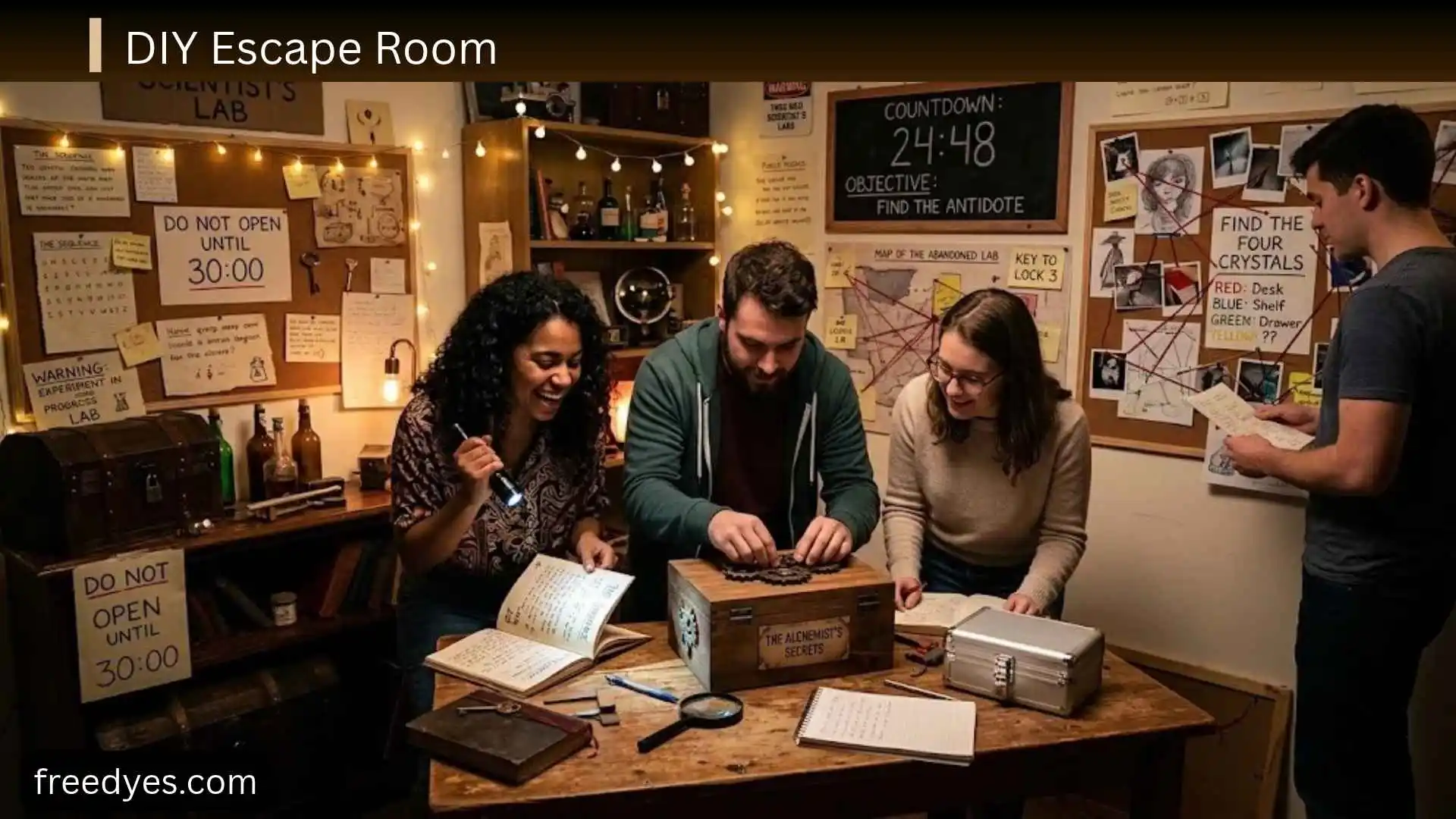
A DIY escape room is a fun way to turn an ordinary room into a puzzle game without spending much money. You can create one for a birthday party, family night, kids, teens, adults, or a small group of friends using simple things such as paper, envelopes, boxes, books, pens, and household objects.
The basic idea is simple: players follow a series of clues, solve puzzles, discover codes, and complete a final challenge before time runs out.
You do not need expensive locks, special equipment, or a complicated room makeover. A good homemade escape room depends more on a clear story, logical puzzle order, well-hidden clues, and proper testing than on decorations.
This guide shows you how to build one from scratch, including a simple ready-to-use example.
DIY Escape Room at a Glance
| Feature | Simple DIY Setup |
| Players | 2–6 |
| Play time | 30–60 minutes |
| Setup time | 20–60 minutes |
| Cost | $0–$15 possible |
| Difficulty | Easy to medium |
| Best location | Living room, bedroom, classroom, office |
| Locks required | No |
| Printer required | No |
| Best for | Kids, teens, adults, birthdays and family games |
If you are making your first escape room, start with 4–6 puzzles rather than trying to create 15 or 20. A smaller game is much easier to test and keeps the experience moving.
How to Make a DIY Escape Room

A successful homemade escape room has seven basic parts:
- A simple story
- A clear objective
- A sequence of puzzles
- Clues that lead naturally to the next puzzle
- A final challenge
- A time limit
- A host who knows the answers and can provide hints
The most important rule is that players should always have a reasonable way to figure out what to do next.
A puzzle should make players think, not make them guess what the creator was thinking.
Choose Your Escape Room Format
Before making clues, decide how complicated you want the game to be.
15-Minute Escape Room
This is the best choice for a last-minute activity.
Use:
- 2–3 puzzles
- 1 final code or answer
- 2–4 players
- One small area of the house
You can prepare it quickly using paper clues and envelopes.
30-Minute Escape Room
A 30-minute game is a good beginner format.
Use:
- 3–5 puzzles
- One main story
- 2–6 players
- A final locked box, envelope, or secret message
This gives players enough time to feel like they are solving a real game without requiring a large setup.
60-Minute Escape Room
For a birthday or larger gathering, a 45–60 minute game gives you more room for story and multiple puzzles.
Use:
- 5–7 puzzles
- Several hiding locations
- A mixture of puzzle types
- A final challenge
- A three-level hint system
For larger groups, consider having some puzzles available at the same time rather than forcing everyone to solve one clue before anyone can work on the next.
Decide the Story and Goal
The story does not need to be complicated.
Give players three things:
What happened?
What do they need to accomplish?
What happens if they succeed?
For example:
A birthday treasure has disappeared. The players have 45 minutes to follow the clues, discover the secret code, and recover the hidden prize before the final message disappears.
That is enough story to give the puzzles a purpose.
Other easy themes include:
- Secret agent mission
- Missing treasure
- Haunted house
- Detective mystery
- Lost scientist’s research
- Stolen birthday gift
- Pirate treasure
- Museum mystery
- Time-travel mission
Choose a theme that matches the age of the players.
How Many Puzzles Do You Need?
You do not need dozens of puzzles.
A simple guide is:
| Game Length | Recommended Puzzles |
| 10–15 minutes | 2–3 |
| 20–30 minutes | 3–5 |
| 45 minutes | 4–6 |
| 60 minutes | 5–7 |
The quality and connection between puzzles matter more than the number.
A common mistake is adding puzzle after puzzle without considering whether players can understand how they connect.
Build the Puzzle Flow
There are three useful ways to arrange your puzzles.
Linear Puzzle Flow
Players solve Puzzle 1 to get Puzzle 2, then Puzzle 2 reveals Puzzle 3.
Puzzle 1 → Puzzle 2 → Puzzle 3 → Final
This is easiest for beginners and small groups.
Parallel Puzzle Flow
Players receive two or more puzzles that can be solved independently.
Puzzle A + Puzzle B + Puzzle C → Final
This works better for larger groups because several players can stay busy.
Hybrid Puzzle Flow
This combines both systems.
For example, players solve two separate clues, and the answers are eventually combined to create one final code.
This is often a good choice for 4–6 players.
DIY Escape Room Puzzle Ideas

You can create many puzzles with ordinary household materials.
Number Code
Give players a clue that produces three or four numbers.
Example:
Count the candles, books, and picture frames.
The numbers might produce:
4 – 7 – 2
That becomes the code for the next envelope.
Hidden Message
Write a message using:
- Every second letter
- Acrostics
- Different-sized letters
- A simple symbol key
- Words hidden inside a paragraph
Keep the hiding method discoverable.
Riddle
A short riddle can lead players to an object.
For example:
I have pages but I cannot speak.
Find me where stories sleep.
The answer is book.
The next clue can be hidden inside a book.
Matching Puzzle
Create pairs of:
- Symbols and numbers
- Colors and letters
- Pictures and words
- Objects and locations
When players correctly match everything, the remaining symbols can reveal a code.
Ordering Puzzle
Give players several cards that must be placed in the correct order.
The correct order can reveal:
5 – 1 – 8 – 3
That becomes the next code.
Map Puzzle
Draw a simple map of the room or house.
Mark several locations with symbols.
Players follow the path to identify the next hiding place.
Rebus Puzzle
Combine pictures or symbols to represent a word or phrase.
For younger players, pictures are often easier than complicated written ciphers.
Jigsaw Message
Write a clue on paper, cut it into several pieces, and mix them together.
Players must reconstruct the message before they can continue.
Book Cipher
Choose a specific book and give players a simple instruction such as:
Page – line – word
Make sure the required page and text actually exist.
Symbol Code
Create a key such as:
| Symbol | Letter |
| ★ | A |
| ● | B |
| ▲ | C |
| ◆ | D |
Players decode the symbols to reveal the next instruction.
Complete DIY Escape Room Example

Here is a simple original game you can adapt for a birthday, family night, or casual party.
Theme: The Missing Birthday Treasure
Players: 2–6
Age: About 8+
Play time: 30–45 minutes
Difficulty: Easy to medium
Cost: $0–$5
Materials:
- 5 envelopes
- Paper
- Pen
- One small box or gift bag
- Tape
- A book
- A few household objects
- Optional prize or candy
The game does not require actual locks.
The Story
Read this to the players:
The birthday treasure has been hidden somewhere in the house. Five clues were left behind, but they can only be solved in the correct order. You have 40 minutes to find the final hiding place.
Start the timer.
Puzzle 1: The First Message
Place this clue in the starting envelope:
Before you begin, look carefully.
Only one place holds the next secret.
Open the place where stories wait.
The first letters spell:
BOOK
Players should look for a book.
Hide the next envelope inside the chosen book.
Puzzle 2: The Number Clue
Inside the book, place:
Find these three things:
Number of cushions on the sofa
Number of clocks in the room
Number of plants nearby
Put the numbers together.
For example, if there are:
- 3 cushions
- 1 clock
- 2 plants
the code becomes:
312
Write the next instruction on an envelope marked with that number.
This makes the clue adaptable to different homes.
Puzzle 3: The Hidden Word
Inside the next envelope, write:
Look at the first letter of each line.
Take your time.
Answers are hiding nearby.
Pay attention to the beginning.
The answer is:
TAP
Players should look for something they can tap.
You can choose a table, door, or another safe object and place the next clue there.
Puzzle 4: The Order Challenge
Give players four cards:
- Moon
- Star
- Sun
- Cloud
Add a clue:
Put the sky in the order you would normally see it during a simple day-and-night cycle.
For a beginner-friendly version, write small numbers on the back of the cards after the correct order is determined.
For example:
Sun → Cloud → Star → Moon
The numbers on the backs can reveal:
4 – 2 – 7 – 1
That becomes the final code.
Puzzle 5: The Final Location
Give players a final note:
You found the code.
But a code is useless without a place.
Four numbers point to four letters:
4 = D
2 = B
7 = G
1 = A
Players decode the final sequence.
You can use the resulting letters to spell a location such as BAG, BED, or another location appropriate to your setup.
Place the birthday prize there.
Complete Answer Key
| Puzzle | Answer |
| Puzzle 1 | BOOK |
| Puzzle 2 | Household number code |
| Puzzle 3 | TAP |
| Puzzle 4 | Correct card order and number sequence |
| Puzzle 5 | Final hiding location |
Before playing, check every answer yourself and make sure every clue points to exactly one reasonable next step.
How to Give Hints
Do not immediately give players the answer when they get stuck.
Use three levels.
Hint 1: Gentle
Point players toward the relevant part of the clue.
Example:
Have you looked at the beginning of each line?
Hint 2: More Direct
Tell them what type of information they should look for.
The first letters may be more important than the complete sentences.
Hint 3: Almost the Answer
Give them enough information to continue.
Take the first letter of each line and read them from top to bottom.
This keeps the game moving without taking away all the satisfaction.
DIY Escape Room for Kids

For younger children, the puzzles should rely more on observation, matching, colors, pictures, and simple counting.
Ages 5–7
Use:
- Picture matching
- Colors
- Simple counting
- Hidden objects
- Very short riddles
- Easy ordering
Avoid complicated ciphers and long written instructions.
Ages 8–10
You can introduce:
- Simple number codes
- Word puzzles
- Secret messages
- Maps
- Matching
- Basic riddles
Keep instructions short.
Ages 11–13
Older children can handle:
- Multi-step clues
- Symbol codes
- Simple book ciphers
- Rebus puzzles
- Logic puzzles
- Parallel clues
DIY Escape Room for Teens and Adults
For older players, increase the challenge by combining two pieces of information.
For example:
Clue A gives a number.
Clue B gives a letter.
Players must combine them to determine the final answer.
You can also add:
- More misleading information
- Multi-step puzzles
- Hidden patterns
- Timed decisions
- Multiple simultaneous puzzles
However, do not make the game difficult simply by making clues obscure.
DIY Escape Room for a Birthday Party
A birthday escape room works best when the final solution leads to something rewarding.
The final prize could be:
- Birthday gift
- Candy
- Small toys
- Party favors
- Dessert
- A special birthday message
For a party, prepare everything before guests arrive.
A simple schedule is:
10 minutes: Explain the story and rules
30–45 minutes: Play
5 minutes: Final reveal and prize
If younger children are playing, have an adult act as the Game Master.
How to Make a DIY Escape Room Without Locks
You do not need physical combination locks.
Use:
- Numbered envelopes
- Hidden envelopes
- Host-controlled clues
- Boxes that open normally
- Secret locations
- Passwords
- Answer cards
For example:
“Tell the Game Master the password.”
If the answer is correct, the host gives the next envelope.
This is one of the easiest ways to create an escape room with no special equipment.
How to Make a DIY Escape Room Without a Printer
Everything can be handwritten.
You need only:
- Paper
- Pen
- Envelopes
- Tape
- Household objects
Instead of printing a map, draw one.
Instead of printing cards, cut paper into rectangles.
Instead of printing a cipher key, write it by hand.
The game does not need to look professionally printed to be fun.
How to Make a Free DIY Escape Room
A $0 escape room can use objects already found around the house.
Try using:
- Books
- Pillows
- Cups
- Clocks
- Pictures
- Doors
- Tables
- Cabinets
- Paper
- Pens
The trick is to make the information interesting rather than relying on expensive props.
How to Make an Escape Room in 15 Minutes
If you need something quickly, use this formula:
Story → 3 clues → final answer
Step 1
Write a one-paragraph story.
Step 2
Create one hidden message.
Step 3
Create one number or word puzzle.
Step 4
Create one final clue.
Step 5
Hide each clue in a logical location.
Step 6
Solve the entire game yourself before giving it to players.
A short game that works properly is much better than a complicated game that has not been tested.
How to Make Your Escape Room Easier or Harder
Make It Easier
- Use fewer steps
- Give clearer instructions
- Use familiar objects
- Provide hints earlier
- Avoid unnecessary red herrings
- Use visual clues
Make It Harder
- Combine two clues
- Use a multi-step code
- Add parallel puzzles
- Hide information more carefully
- Reduce the number of hints
- Add a time pressure
Do not make a puzzle harder by making the instructions vague. Players should understand what the puzzle is asking even when the answer requires thought.
Test the Escape Room Before Playing
This is one of the most important steps.
Solve the entire game yourself from the player’s perspective.
Check:
- Can every clue be found?
- Does every puzzle have one clear answer?
- Does each answer lead somewhere?
- Are the instructions understandable?
- Is anything accidentally giving away an answer?
- Is the final puzzle actually solvable?
- Does the estimated play time make sense?
If possible, have someone who has not seen the game try it.
Do not explain the solution while they play. Watch where they naturally get stuck.
Common DIY Escape Room Mistakes
Too Many Puzzles
More puzzles do not automatically create a better escape room.
A few connected puzzles usually feel more satisfying than a pile of unrelated challenges.
Unclear Instructions
If players cannot understand what they are supposed to do, they may assume the puzzle is broken.
Impossible Answers
Every puzzle should have enough information to solve it.
Never require players to guess an answer that cannot logically be obtained from the clues.
Accidental Clues
Check the room before starting.
A visible envelope, handwritten answer, or incorrectly placed object can reveal the next step too early.
One Player Does Everything
With a group, avoid making every puzzle dependent on one person.
Give players different things to examine or solve when possible.
Hiding Clues Too Well
There is a difference between hidden and impossible to find.
Players should be rewarded for paying attention, not for searching every drawer in the house.
DIY Escape Room Safety

A homemade escape room should feel like an escape game, not a real confinement situation.
Never actually lock people inside a room or block an exit.
Also avoid:
- Candles or open flames
- Dangerous chemicals
- Electrical experiments
- Sharp objects
- Unsafe climbing
- Hard-to-reach hiding places
- Heavy objects that could fall
- Locked cabinets that someone may need to access
- Hiding clues near medications or cleaning products
For children, use age-appropriate materials and have an adult supervise the game.
Escape Room vs. Scavenger Hunt
A scavenger hunt mainly asks players to find objects or locations.
An escape room focuses more heavily on solving puzzles to unlock the next stage.
You can combine both.
For example:
Find the envelope → solve the code → discover the next location → solve another puzzle.
That creates a scavenger-hunt-style escape room.
Escape Room vs. Mystery Game
A mystery game focuses mainly on discovering who, what, why, or how.
An escape room focuses more on solving a sequence of challenges to reach a goal.
You can combine the two by creating a detective-themed escape room where solving the mystery produces the final code.
Best DIY Escape Room Format by Situation
| Situation | Best Format |
| Last-minute activity | 15-minute game |
| Family night | 30-minute game |
| Birthday | 30–45 minutes |
| Teen party | 45–60 minutes |
| Adults | 45–60 minutes |
| 2 players | Linear puzzles |
| 3–4 players | Linear or hybrid |
| 5–6 players | Hybrid or parallel |
| No budget | Paper + household objects |
| No printer | Handwritten clues |
| No locks | Envelope/password system |
Frequently Asked Questions
How many people can play in a DIY escape room?
Two to six players is a comfortable range for a simple homemade game. Larger groups can work, but you should provide multiple puzzles so everyone has something to do.
How long should a homemade escape room be?
For a first project, 30–45 minutes is a practical target. A shorter 15-minute version is easier to prepare, while a 60-minute game requires more puzzles and testing.
Can I make an escape room without buying locks?
Yes. Envelopes, hidden clues, passwords, and a Game Master can replace physical locks.
Can I make an escape room for free?
Yes. Paper, pens, books, boxes, furniture, and other household objects can provide enough materials for a simple game.
What makes a good escape room puzzle?
A good puzzle gives players enough information to reach a logical answer while still requiring observation, reasoning, or teamwork.
How difficult should a DIY escape room be?
For a mixed group, start with easy-to-medium puzzles. It is better for players to solve most challenges and need occasional hints than to become permanently stuck.
What should I do if players get stuck?
Give a small hint first. If they still cannot progress, provide a more direct hint. The goal is to keep the game enjoyable rather than prove that the puzzle is unbeatable.
Can I make an escape room for kids?
Yes. Use pictures, colors, counting, matching, simple codes, hidden objects, and short riddles. Adjust the reading level and difficulty to the children’s ages.
Do I need a special room?
No. A living room, bedroom, classroom, office, or even a small section of a room can work. The puzzles create the game experience.
Final Checklist
Before starting your DIY escape room, make sure you have:
- A clear story
- A clear final goal
- 3–7 connected puzzles
- A logical puzzle order
- Clearly hidden clues
- A final answer
- A time limit
- A hint system
- An answer key for the host
- A tested solution
- A safe playing environment
The best homemade escape room is not necessarily the one with the most decorations or the most complicated puzzles. It is the one where players understand the objective, work together, experience small moments of discovery, and eventually reach a satisfying final solution.
Start small, test every clue, and make the logic clear. Once your first game works, you can add more advanced puzzles, themes, props, and multiple puzzle paths.