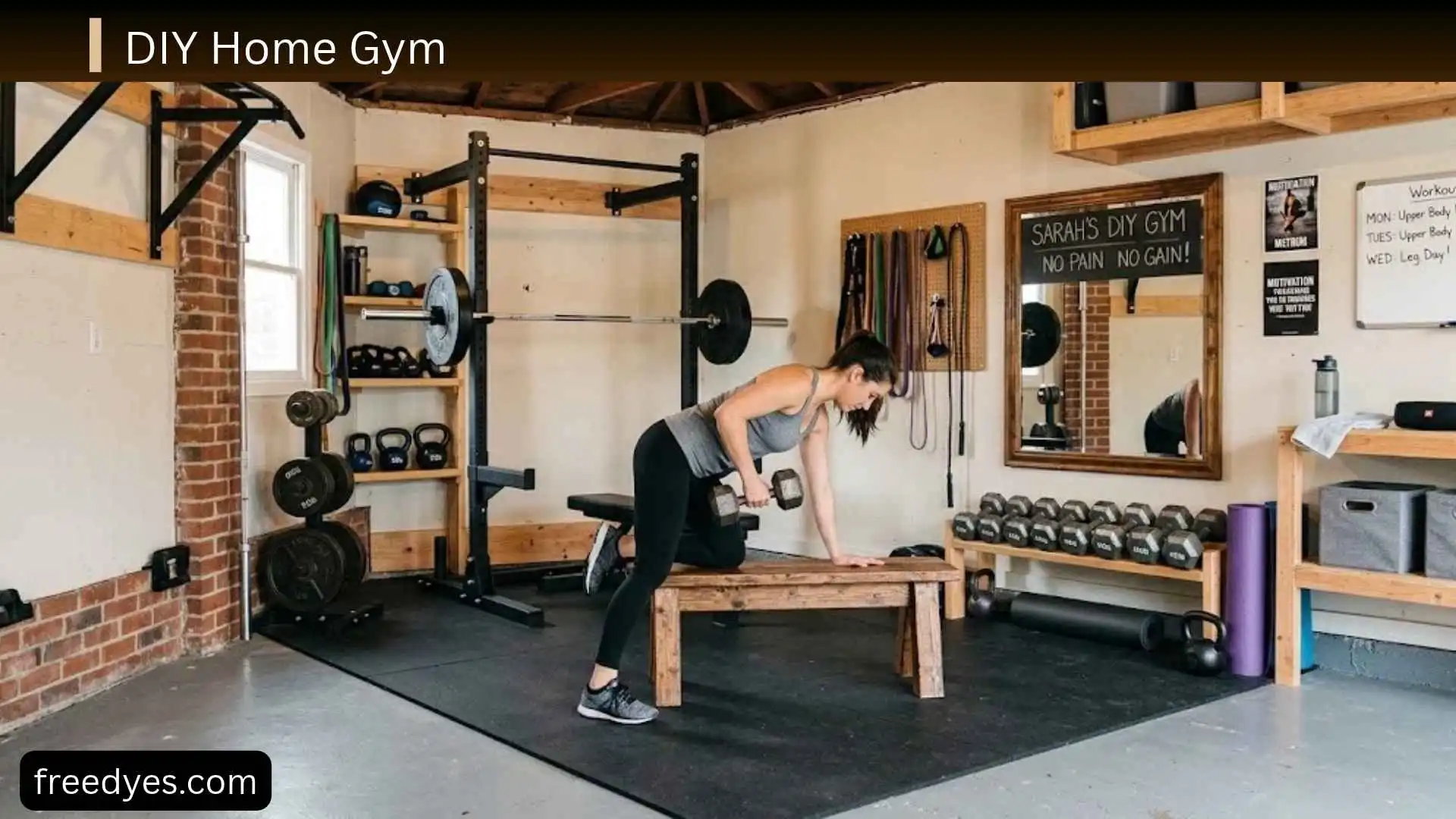
Building a DIY home gym is one of the smartest ways to stay active without spending a fortune on expensive gym memberships or high-end fitness equipment. With a little planning, creativity, and the right setup, almost any room, garage, basement, or even a small corner of a home can become a functional workout space. Whether the goal is strength training, cardio, yoga, or full-body fitness, a personalized home gym makes it easier to stay consistent and exercise on a schedule that fits everyday life.
This guide covers everything needed to create a practical DIY home gym, from choosing the best location and budget-friendly equipment to organizing the space for maximum comfort and efficiency. By the end, finding the perfect setup for personal fitness goals will feel simple, affordable, and achievable
Can You Build a DIY Home Gym on a Budget?
Yes. A useful home gym does not have to begin with a large investment.
The biggest mistake is assuming that a home gym needs every piece of equipment found in a commercial gym. Most people can get started with a relatively small number of versatile items.
A beginner might only need:
- Exercise mat
- Resistance bands
- Adjustable dumbbells
- One kettlebell
- Jump rope
- Simple storage
Someone focused on serious strength training will eventually need different equipment, but even that setup can be built gradually.
The goal is to purchase equipment according to your actual training needs rather than trying to make the room look like a professional fitness center.
A good rule is:
Build the workout space first, then build the equipment collection.
DIY Home Gym at a Glance
Before buying anything, answer five questions.
| Question | What It Helps You Decide |
| How much clear space do I have? | Equipment and exercise options |
| What is my main fitness goal? | Which equipment deserves your budget |
| How much can I spend now? | Whether to build in stages |
| Where will everything be stored? | Whether the room stays organized |
| Am I renting or owning? | Whether drilling or permanent changes are practical |
A successful DIY gym needs more than equipment.
You need:
- Exercise space
- Storage space
- Safe flooring
- Good lighting
- Ventilation
- Easy access
- Appropriate equipment
- A layout that works for your actual workouts
Choose Your Home Gym Goal Before Buying Equipment
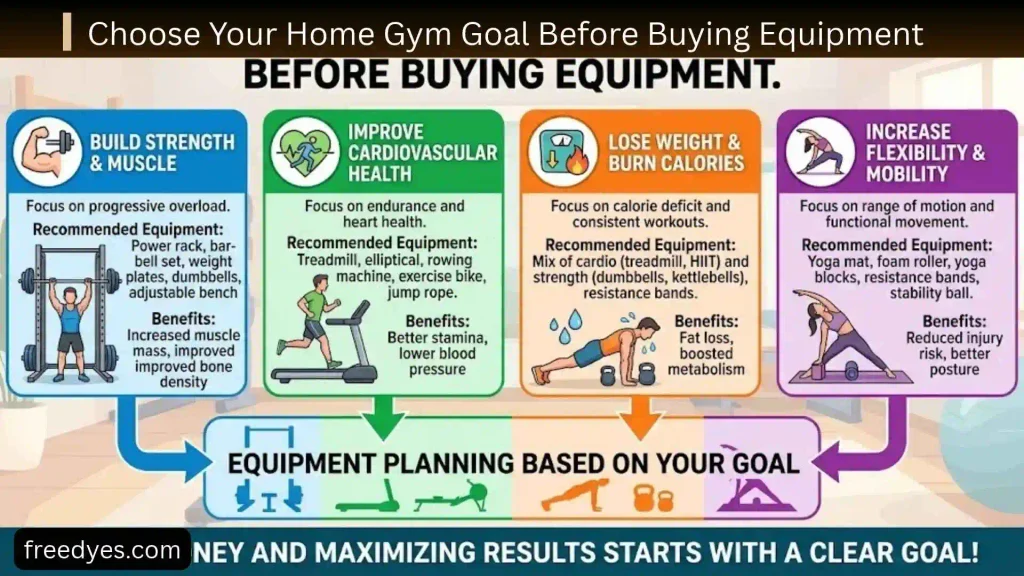
Your goal should determine your equipment, not the other way around.
If you buy equipment first and decide how to use it later, you can quickly end up with expensive items taking up valuable floor space.
General Fitness
For general fitness, choose versatile equipment.
A practical starter setup could include:
- Mat
- Resistance bands
- Adjustable dumbbells
- Kettlebell
- Jump rope
- Optional bench
This can support many movements without requiring a large room.
Strength Training
Strength training requires more planning.
You may eventually want:
- Barbell
- Weight plates
- Bench
- Squat rack or power rack
- Dumbbells
- Storage
- Appropriate flooring
Heavy lifting also requires more attention to clearance, stability, equipment ratings, and floor protection.
Cardio
Cardio does not always require a large machine.
You can use:
- Jump rope
- Step exercises
- Bodyweight circuits
- Low-impact routines
- Stationary bike
- Treadmill
Before purchasing a treadmill or similar machine, measure the entire space it requires and consider how much room remains when you are actually using it.
Mobility and Low-Impact Training
If your goal is yoga, stretching, Pilates, mobility, or gentle exercise, prioritize open floor space.
A large collection of equipment can make this type of gym less useful.
A mat, bands, blocks, and a small storage area may be enough.
Measure Your Space Before Buying Anything
Do not begin your DIY home gym by ordering equipment.
Begin with a measuring tape.
Measure:
- Room length
- Room width
- Ceiling height
- Door width
- Door swing
- Windows
- Existing furniture
- Wall space
- Electrical outlets
- Stairs
- Storage areas
Then measure the equipment you are considering.
But there is one more measurement that matters:
usable workout space.
Your room may be 10 feet by 10 feet, but furniture, storage, equipment, and door clearance reduce the area available for exercise.
Measure Exercise Clearance
Equipment footprint and exercise space are not the same thing.
A bench may physically fit in a corner, but you still need room around it to use it.
A dumbbell rack may fit against a wall, but the space in front of it may need to remain clear.
A rack may fit vertically, but ceiling height can become a problem during overhead movements.
Think about the complete movement rather than the equipment alone.
Use Tape Before You Buy
One simple DIY planning trick is to mark equipment footprints on the floor with painter’s tape.
Mark:
- Bench
- Rack
- Dumbbell storage
- Main workout zone
- Walking paths
Then stand inside the marked areas and perform simple unloaded movements.
This can reveal problems that a product’s dimensions will not show.
How Much Does a DIY Home Gym Cost?
There is no universal price because costs depend on your location, equipment quality, training goals, and whether you buy new or used.
Instead of treating one price as a fixed answer, think in budget levels.
A $100-Style DIY Home Gym
A low-cost setup could focus on:
- Exercise mat
- Resistance bands
- Jump rope
- Basic accessories
- Used or existing equipment
- DIY storage
This setup is suitable for bodyweight workouts, mobility, resistance-band training, and general fitness.
The key is to avoid spending most of the budget on one specialized item.
A $300-Style DIY Home Gym
A larger starter budget could include:
- Adjustable dumbbells
- Resistance bands
- Kettlebell
- Exercise mat
- Compact bench
- DIY storage
This gives you considerably more exercise variety while still keeping the setup relatively compact.
A $500-Style DIY Home Gym
At this level, you can begin creating a more serious strength and conditioning setup.
Possible additions include:
- Better adjustable weights
- Bench
- Kettlebell
- More resistance options
- Improved flooring
- Storage
- Additional accessories
A $1,000-Style Strength Gym
A larger budget may allow for:
- Rack
- Barbell
- Plates
- Bench
- Flooring
- Dumbbells
- Storage
- Resistance bands
The important point is that these are illustrative budget builds, not fixed prices.
Equipment prices vary considerably.
What Should You Buy First?
Do not treat every piece of equipment as equally important.
Create an equipment priority list.
Buy First
Start with equipment that supports multiple exercises.
Good examples include:
- Mat
- Resistance bands
- Adjustable dumbbells
- One kettlebell
- Basic storage
Buy Next
Add equipment when your current setup becomes limiting.
Examples include:
- Bench
- Additional weight
- Pull-up equipment
- Better flooring
- More storage
Buy Later
Only add larger equipment when your training requires it.
Examples include:
- Rack
- Barbell
- Large plate collection
- Cardio machines
- Specialized equipment
Skip Unless You Need It
You probably do not need:
- Multiple similar machines
- Huge fixed-dumbbell collections
- Several cardio machines
- Every new fitness gadget
- Decorative equipment
- Equipment you rarely use
Before buying something, ask:
What exercise will this equipment allow me to perform that I cannot already perform?
If you cannot answer clearly, wait.
What Should You DIY and What Should You Buy?
This is one of the most important parts of a DIY home gym.
The word “DIY” does not mean you should manufacture every piece of equipment yourself.
DIY-Friendly Projects
These are generally better candidates for home projects:
- Resistance-band organizers
- Mat holders
- Jump-rope storage
- Towel holders
- Accessory shelves
- Lightweight storage
- Organization boards
- Storage bins
These projects solve practical problems without making your workout depend on a homemade load-bearing structure.
DIY With Caution
Some projects can be built yourself, but construction quality becomes important.
Examples include:
- Dumbbell shelves
- Weight-plate storage
- Heavy equipment shelves
- Wooden platforms
- Wall-mounted storage
The structure, fasteners, mounting surface, and expected load all matter.
Equipment Better Purchased
For safety-critical equipment, buying a properly manufactured product is usually the more sensible choice.
This can include:
- Barbells
- Benches
- Squat racks
- Power racks
- Cable machines
- Safety catches
- Heavy-duty lifting attachments
What Should You Not Improvise?
Avoid homemade equipment when failure could cause serious injury.
For example, a homemade storage hook falling off the wall is inconvenient.
A homemade rack failing while supporting a heavy barbell is a completely different risk.
The potential consequence should determine whether something becomes a DIY project.
How to Build a DIY Home Gym in a Small Space
Small spaces require a different strategy.
You cannot simply shrink a commercial gym.
Instead, prioritize:
- Multi-purpose equipment
- Foldable equipment
- Vertical storage
- Open floor space
- Lightweight accessories
- Equipment that can be moved
The goal is to get the highest amount of training variety from the smallest footprint.
DIY Home Gym in a Bedroom
Choose one wall or corner as your equipment zone.
A compact bedroom setup could include:
- Mat
- Adjustable dumbbells
- Resistance bands
- Small kettlebell
- Folding or movable bench
- Wall or furniture-based storage
Keep the center of the room open whenever possible.
DIY Home Gym in a Corner
A corner can work surprisingly well.
Use the two walls for organization and reserve the floor area in front of them for movement.
Keep heavier items low and securely stored.
DIY Home Gym Under 50 Square Feet
For very limited space, avoid bulky equipment.
A practical combination can include:
- Mat
- Resistance bands
- Adjustable dumbbells
- One kettlebell
- Compact storage
The most valuable feature is not the amount of equipment.
It is the amount of clear movement space.
DIY Home Gym in a 10×10 Room
A 10×10 room gives you more flexibility, but you can still overcrowd it.
One useful approach is to keep equipment around the perimeter and preserve the middle for training.
For a strength-focused room, a rack may become the main equipment zone.
For general fitness, keeping the center open can be more useful.
DIY Apartment Home Gym
Apartment gyms need additional consideration for:
- Noise
- Vibration
- Floor protection
- Storage
- Neighbors
- Lease restrictions
Choose equipment that can be stored easily and avoid exercises that repeatedly produce heavy impact if noise is a concern.
DIY Garage Home Gym
A garage can provide much more room, but it comes with its own challenges.
Before moving equipment into the garage, consider:
- Temperature
- Humidity
- Moisture
- Ventilation
- Lighting
- Ceiling height
- Door clearance
- Storage
- Floor condition
Garage Flooring
A garage floor may be durable, but it is hard and can be uncomfortable for floor-based workouts.
Appropriate rubber flooring or another suitable protective surface can make the space more practical.
Garage Ventilation
Exercise generates heat and moisture.
Good airflow can make the room much more comfortable.
Garage Storage
Use wall and vertical storage where appropriate, but make sure heavy items are mounted or stored using structures capable of supporting their loads.
Do not let plates, dumbbells, or bars become obstacles around vehicles or walking paths.
DIY Basement Home Gym
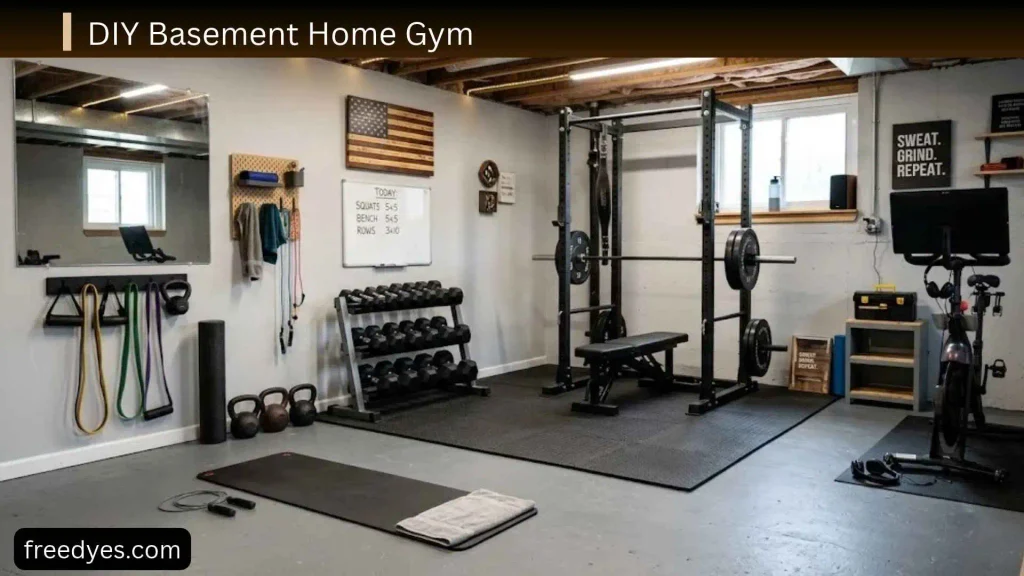
Basements can make excellent gyms, but moisture deserves special attention.
Before setting up equipment, inspect for:
- Dampness
- Water intrusion
- Mold or mildew problems
- Low ceilings
- Poor ventilation
- Uneven flooring
A basement with ongoing moisture issues is not a good place for expensive equipment until the underlying problem is addressed.
DIY Home Gym Flooring
Flooring should be selected according to your workout.
Rubber Flooring
Rubber can be useful for strength-training spaces because it is durable and provides a stable surface.
It can also help protect the underlying floor from normal equipment contact.
Foam Flooring
Foam tiles can work well for:
- Mobility
- Yoga
- Stretching
- Bodyweight exercises
- Light workouts
They are not automatically the right choice for heavy lifting.
Exercise Mats
A thick exercise mat can be enough for a bedroom corner or multipurpose room.
It provides a defined workout surface without permanently changing the room.
Carpet
Carpet can be comfortable for certain light workouts, but it may be harder to clean and may not provide the ideal surface for all strength exercises.
Concrete
Concrete is common in garages and basements.
It is durable but hard.
A suitable protective workout surface can make it more comfortable and help reduce direct contact between equipment and the floor.
How to Choose the Right Flooring
Ask three questions:
What exercises will I perform?
Will weights contact the floor?
Do I need the entire room covered?
You do not necessarily need expensive flooring throughout the room.
If your workout zone occupies one section, you may only need appropriate protection in that area.
DIY Home Gym Storage Ideas
Good storage can make a small gym feel dramatically larger.
The rule is simple:
Every piece of equipment needs a home.
DIY Resistance Band Organizer
Use suitable hooks, pegs, or another secure organizer to keep resistance bands together.
Organize them by type or resistance so you can quickly find the one you need.
Inspect bands regularly for damage.
DIY Mat Holder
A simple vertical holder can keep rolled mats against a wall.
This prevents mats from occupying valuable floor space.
DIY Jump Rope Storage
Jump ropes can become tangled when thrown into a drawer.
A small hook or organizer can keep them accessible and off the floor.
DIY Accessory Board
A wall organizer can hold lightweight items such as:
- Resistance bands
- Straps
- Jump ropes
- Handles
- Towels
- Small mobility accessories
DIY Dumbbell Shelf
A dumbbell shelf can be useful, but this is a more serious DIY project because weights are heavy.
The shelf, supports, fasteners, and mounting surface must be appropriate for the total load.
Never assume that a decorative shelf can safely hold gym weights.
DIY Weight-Plate Storage
Weight plates should have a stable storage location.
Do not leave heavy plates leaning where they can fall or become a trip hazard.
How to Repurpose What You Already Own
A DIY gym does not always require new construction.
Look around your home before buying storage.
You may already have useful items such as:
- Shelves
- Baskets
- Storage bins
- Closet space
- Under-bed storage
- Furniture with unused compartments
- Wall hooks
- Cabinets
A closet can become an equipment station.
An existing shelf can hold lightweight accessories.
Under-bed storage can work for suitable flat equipment.
A storage bench can sometimes serve both as seating and equipment storage.
However, do not repurpose furniture for heavy weights unless you are confident that its construction and load capacity are suitable.
How to Build a Home Gym Without a Rack
A rack is useful for certain strength exercises, but it is not essential for every home gym.
A no-rack setup can focus on:
- Adjustable dumbbells
- Kettlebells
- Resistance bands
- Bench exercises
- Floor exercises
- Bodyweight training
- Carries
- Controlled lower-body movements
This approach is particularly useful for:
- Small rooms
- Apartments
- Beginners
- Budget setups
- Multipurpose rooms
If your training eventually requires heavy barbell work, you can upgrade later.
How to Build a Quiet DIY Home Gym
Noise is one of the biggest challenges for apartment and upstairs gyms.
Choose Quieter Equipment
Good choices include:
- Resistance bands
- Exercise mats
- Controlled dumbbell exercises
- Mobility equipment
- Low-impact workouts
Avoid Dropping Weights
Repeatedly dropping weights creates impact and vibration.
Even when the sound seems manageable inside your room, vibration can travel through floors and walls.
Reduce Jumping
High-impact jumping can create significant noise in shared buildings.
If you live above another occupied space, choose lower-impact alternatives when appropriate.
Create a Quiet Workout Zone
Use suitable floor protection and keep equipment controlled during placement.
The objective is not to make the gym completely silent.
The objective is to reduce unnecessary impact and vibration.
DIY Home Gym Layout Ideas
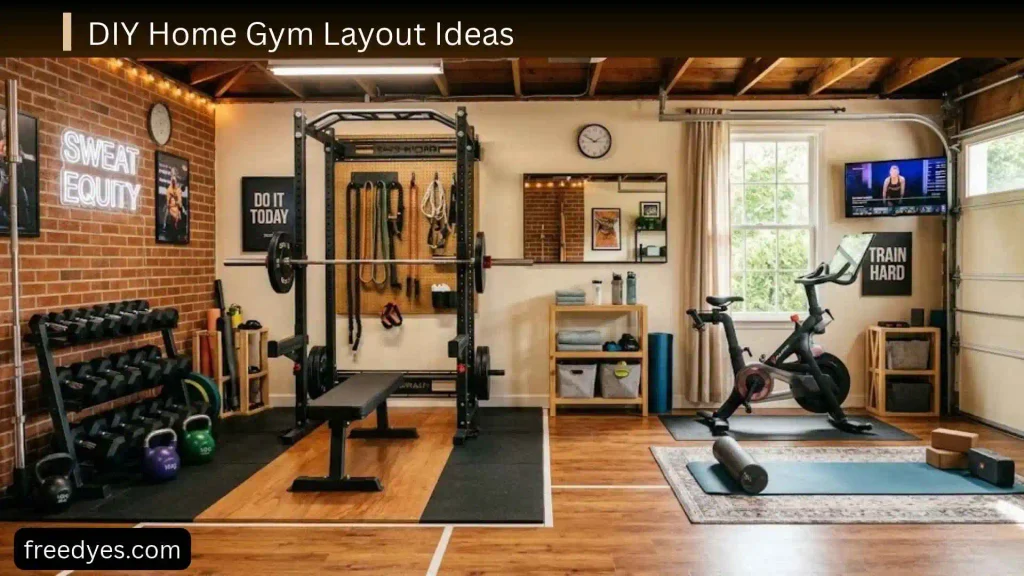
A good layout should have three zones:
Active Zone
This is where you perform your workout.
Keep it as open as possible.
Equipment Zone
This is where weights, bands, benches, and other equipment live.
Access Zone
This includes doors, walkways, stairs, and areas needed to enter or leave the room.
Do not let equipment storage interfere with access.
Small Corner Layout
Use two walls for storage and leave the corner’s front area open.
Bedroom Layout
Keep one side of the room dedicated to fitness and preserve the rest for normal bedroom use.
Garage Layout
Put large equipment along one wall and keep the central area open for movement.
10×10 Layout
A strength-focused 10×10 room can use one side for a rack and the other walls for storage.
A general-fitness setup can keep the center open and use the perimeter for compact equipment.
How to Build a DIY Home Gym Step by Step
Step 1: Define Your Main Goal
Decide whether you primarily want:
- Strength
- General fitness
- Cardio
- Mobility
- Weight management
- Home workouts
Step 2: Measure the Space
Record the room dimensions, ceiling height, doors, windows, furniture, and available wall space.
Step 3: Calculate Usable Space
Remove the areas occupied by permanent furniture, storage, and equipment.
Then protect the remaining space for movement.
Step 4: Set Your Budget
Decide how much you can spend now.
Do not create a shopping list based on everything you might want someday.
Step 5: Choose Your Essential Equipment
Select equipment that supports several exercises.
Step 6: Plan Storage
Decide where everything will go before buying more items.
Step 7: Install or Place Flooring
Protect the floor according to your workout type.
Step 8: Create Your Workout Zone
Keep the main area open.
Step 9: Test the Layout
Walk through your exercises before permanently installing anything.
Step 10: Add Equipment Gradually
Only upgrade when your existing equipment creates a real limitation.
DIY Home Gym Projects You Can Actually Make
DIY Band Storage Rack
Create a simple organizer using suitable hooks or pegs mounted securely to an appropriate surface.
The goal is organization rather than heavy load-bearing.
DIY Mat Holder
Build or install a simple vertical holder that keeps mats rolled and off the floor.
DIY Accessory Station
Create one organized area for:
- Bands
- Ropes
- Straps
- Towels
- Small accessories
DIY Lightweight Shelf
Use a suitable shelf for lightweight equipment and accessories.
Do not overload it with weights unless it has been designed and installed for that load.
DIY Workout Station
Instead of building a complicated exercise machine, consider creating a dedicated area where your existing equipment can be organized.
A good DIY project does not have to manufacture equipment.
Sometimes the smartest DIY improvement is simply making the equipment you already own easier to use.
What Not to DIY in a Home Gym
Not every homemade project is worth the risk.
Be particularly cautious with:
- Squat racks
- Power racks
- Heavy benches
- Barbells
- Cable systems
- Safety catches
- Heavy overhead mounting systems
- Load-bearing structures
These items can experience significant forces.
If you are not certain about the materials, construction, mounting, and expected loads, buy a properly designed product instead.
How to Make Your DIY Home Gym Look Better
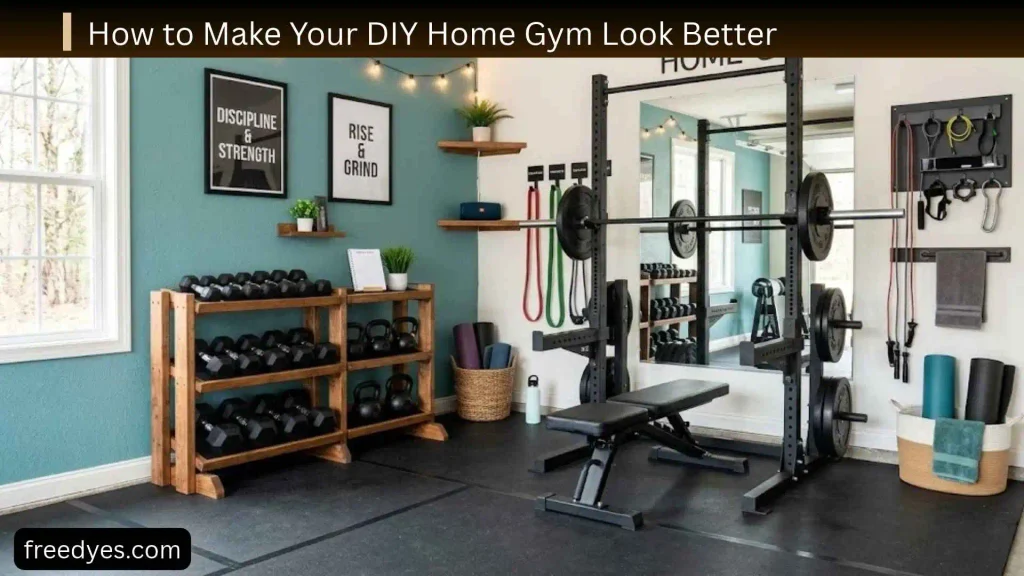
Function should come first, but appearance can affect whether you want to use the space.
Keep Equipment Organized
A clean room feels easier to use.
Use Consistent Storage
Instead of having equipment scattered everywhere, create one storage zone.
Improve Lighting
Good lighting makes the room more comfortable and easier to navigate.
Keep Walls Simple
You do not need excessive decoration.
A clean wall can make a small room feel more spacious.
Use a Mirror Carefully
A properly positioned mirror can help you observe exercise form and make the room feel larger.
Make sure it is securely installed.
How to Make Your Home Gym Future-Proof
Your fitness goals may change.
You might start with resistance bands and later decide to focus on strength training.
Build your gym so that upgrades are possible.
Choose Versatile Equipment
Adjustable equipment can provide several resistance levels without requiring multiple pieces.
Leave Expansion Space
Do not fill every available corner.
A little unused space today can become valuable later.
Use Flexible Storage
Choose storage that can adapt as your equipment collection changes.
Upgrade Because of a Limitation
A useful rule is:
Do not upgrade because an item looks impressive. Upgrade because your current setup is limiting your training.
Common DIY Home Gym Mistakes
Buying Equipment Before Measuring
A piece of equipment can fit physically while making the room unusable.
Filling Every Square Foot
A gym needs open space.
Ignoring Storage
Equipment scattered across the floor makes the room harder to use.
Buying Too Many Similar Items
Multiple pieces that perform the same job can waste money and space.
Choosing Flooring Without Considering the Workout
Yoga, bodyweight training, and heavy lifting do not place the same demands on a floor.
Ignoring Noise
Apartment and upstairs gyms need special consideration for vibration and impact.
DIYing Safety-Critical Equipment
Saving money is not worth creating unnecessary risk.
Blocking Doors or Walkways
Never sacrifice safe access for equipment.
Buying for an Imaginary Future Routine
Buy for the training you actually perform.
Forgetting Ventilation
A small closed room can become hot and uncomfortable quickly.
DIY Home Gym Safety
Safety should be part of the design from the beginning.
Keep Walkways Clear
Do not leave:
- Dumbbells
- Plates
- Bands
- Cables
- Jump ropes
in walking paths.
Inspect Equipment
Regularly check for:
- Loose bolts
- Cracks
- Frayed bands
- Damaged cables
- Unstable benches
- Bent components
- Worn padding
Stop using damaged equipment until it is properly repaired or replaced.
Secure Heavy Storage
Heavy weights should have stable storage.
Do not place them where they can easily tip.
Be Careful With Wall Mounting
Know what your wall is made from before installing heavy equipment.
Use appropriate mounting hardware for the structure and intended load.
Protect Children and Pets
Gym equipment can create hazards when left accessible.
Store weights and accessories appropriately.
Keep Emergency Access Clear
Never place equipment where it blocks a door, stairway, or necessary exit route.
Follow Equipment Limits
Never exceed stated weight or usage limits.
How to Maintain a DIY Home Gym
Maintenance does not need to take long.
Weekly Maintenance
- Return equipment to storage
- Clean frequently touched surfaces
- Inspect bands
- Check the floor
- Remove clutter
Monthly Maintenance
- Check bolts
- Inspect benches
- Check storage
- Examine cables
- Look for loose mounting hardware
Periodic Maintenance
Replace worn components before they become a failure risk.
Pay particular attention to items that naturally wear with use, such as bands, cables, grips, and padding.
Three Complete DIY Home Gym Setups
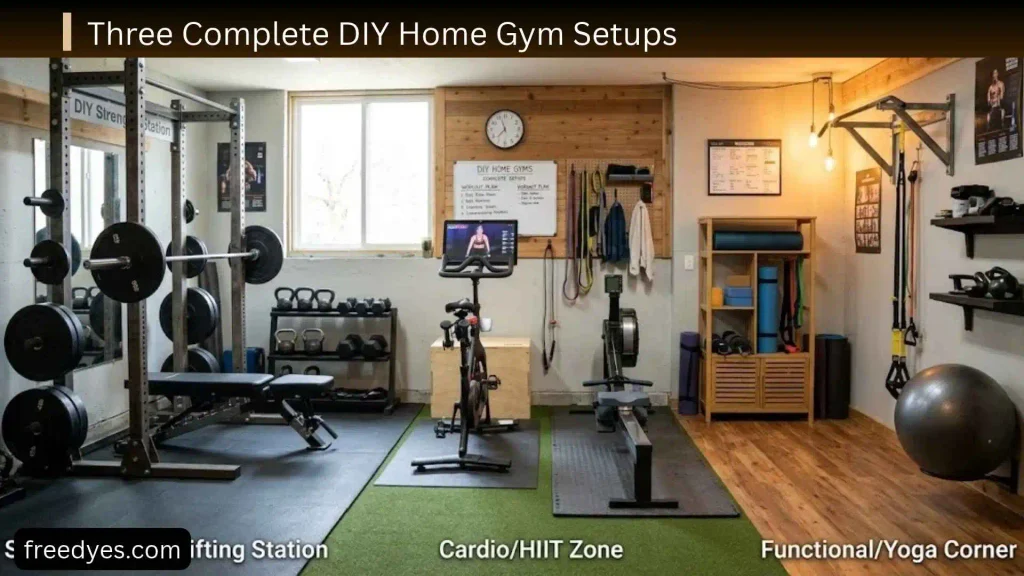
Tiny-Space DIY Home Gym
Best for: Bedroom corners, apartments, and very small rooms
Equipment:
- Exercise mat
- Resistance bands
- Adjustable dumbbells
- One kettlebell
- Compact storage
Layout:
Place storage against the wall and keep the center open.
Main advantage:
Almost everything can be moved or stored when the room needs another purpose.
Budget DIY Home Gym
Best for: Beginners who want more versatility
Equipment:
- Mat
- Adjustable dumbbells
- Resistance bands
- Kettlebell
- Bench
- DIY storage
Upgrade path:
Add more resistance or specialized equipment only after you establish a consistent routine.
Garage Strength Gym
Best for: Serious strength-focused training
Equipment:
- Rack
- Barbell
- Plates
- Bench
- Dumbbells
- Bands
- Storage
Additional planning:
- Suitable flooring
- Ventilation
- Lighting
- Ceiling clearance
- Equipment stability
- Weight storage
- Safe walking paths
This setup requires more space and a greater focus on safety than a basic bedroom gym.
How to Upgrade Your DIY Home Gym Over Time
A home gym does not have to be finished in one weekend.
A gradual approach can actually produce a better setup.
Stage One: Start Moving
Build a basic setup and establish consistency.
Stage Two: Improve Versatility
Add equipment that expands the exercises you already perform.
Stage Three: Solve Limitations
If you cannot increase resistance, add appropriate weight.
If storage is becoming a problem, improve organization.
If the floor needs protection, upgrade flooring.
Stage Four: Specialize
Only after you know what type of training you enjoy should you consider specialized equipment.
This prevents expensive purchases that later become unused.
How to Use Your DIY Home Gym Consistently
The best home gym is the one you actually use.
Keep your workouts realistic.
You can organize your training around:
- Full-body strength sessions
- Cardio
- Mobility
- Conditioning
- Recovery
The exact schedule should match your experience, goals, and available time.
Make Starting Easy
Keep frequently used equipment accessible.
If you have to move furniture, search through boxes, and assemble equipment every time you want to exercise, you create unnecessary friction.
Track Your Progress
You can record:
- Exercises
- Sets
- Repetitions
- Resistance
- Workout duration
- Personal goals
Progress can mean more than simply adding weight.
You may improve technique, control, repetitions, consistency, or endurance.
Frequently Asked Questions About DIY Home Gyms
What is the cheapest way to build a DIY home gym?
Start with versatile equipment such as a mat, resistance bands, and adjustable resistance. Use existing storage where practical and add equipment gradually.
Can I build a DIY home gym for $100?
Yes, a basic setup can be created around low-cost, versatile equipment. A $100-style setup will naturally have fewer options than a larger strength-focused gym, but it can still provide a useful workout space.
What should I buy first for a home gym?
Start with equipment that supports several exercises and matches your main goal. For many beginners, resistance bands, a mat, and adjustable weights are useful starting points.
What can I DIY for a home gym?
Storage and organization are among the best DIY projects. You can make organizers for bands, mats, ropes, towels, and lightweight accessories.
Should I build my own squat rack?
A squat rack is a safety-critical piece of equipment. Unless you have the appropriate construction knowledge and can confidently account for structural loads and stability, purchasing a properly designed rack is the safer approach.
Can I build a home gym in a bedroom?
Yes. A bedroom corner can work well with compact equipment, vertical storage, and a clear movement area.
How much space do I need for a DIY home gym?
There is no single required room size. The important factors are the equipment footprint, movement clearance, ceiling height, storage, and safe access.
Can I build a home gym in a small apartment?
Yes. Focus on quiet, compact, and easy-to-store equipment. Resistance bands, adjustable dumbbells, mats, and compact benches can be useful choices.
What is the best flooring for a DIY home gym?
The answer depends on the workout. Rubber can be useful for strength areas, while exercise mats and foam surfaces can work well for lighter floor-based workouts.
How do I make my home gym quieter?
Use controlled movements, avoid dropping weights, reduce high-impact exercises when appropriate, and use suitable floor protection.
Can I build a home gym without a rack?
Yes. Dumbbells, kettlebells, bands, benches, and bodyweight exercises can support many training styles without requiring a rack.
Should I buy new or used gym equipment?
Used equipment can reduce costs, but inspect it carefully. Avoid equipment with serious structural damage, excessive corrosion, cracks, or questionable safety.
How do I store gym equipment in a small room?
Use vertical storage where appropriate, under-bed or closet storage for suitable items, and one dedicated equipment zone. Keep the main workout area open.
Is a DIY home gym worth it?
It can be worthwhile if having equipment at home makes exercise more convenient and consistent. The value comes from regular use, not from how expensive the room looks.
What equipment do I not need?
You do not need every machine or accessory available. Avoid buying specialized equipment until you know that it solves a genuine training problem.
Final Thoughts
A successful DIY home gym is not about creating the biggest workout room possible.
It is about creating the most useful workout space for your available room, budget, and fitness goals.
Start by measuring your space.
Decide what type of training you actually want to do.
Protect your usable floor area.
Buy versatile equipment first.
Use DIY projects mainly for storage and organization.
Be cautious with anything that carries heavy loads.
Create a layout that allows you to move comfortably.
And resist the temptation to buy equipment simply because it looks impressive.
A small corner with a mat, adjustable weights, resistance bands, and smart storage can be more valuable than a huge room filled with equipment you never use.
Build slowly, keep the space organized, upgrade when your training requires it, and make safety part of every decision.
That is what turns a collection of fitness equipment into a genuinely useful DIY home gym.