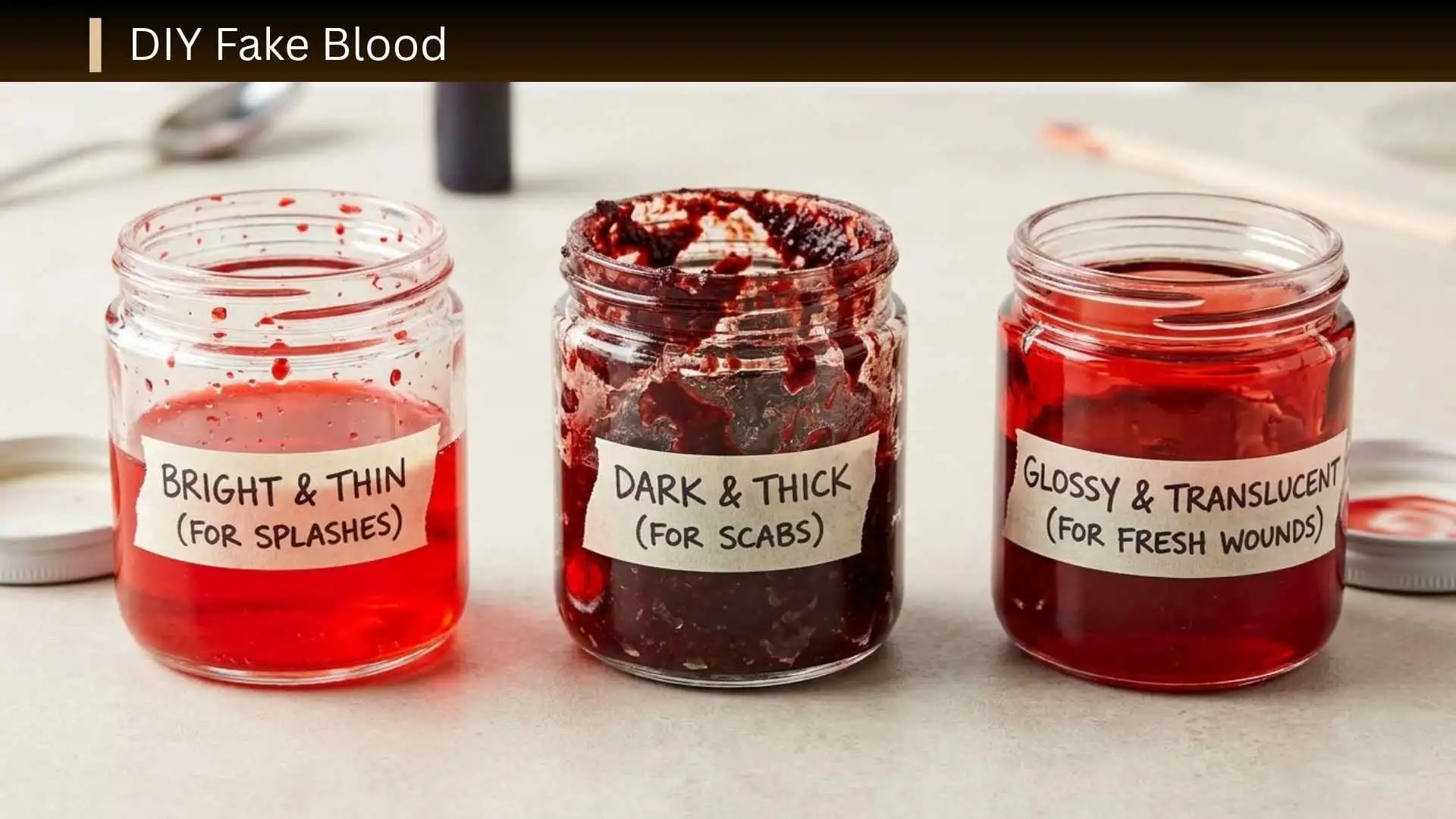
Making DIY fake blood at home is one of the easiest ways to add a creepy finishing touch to a Halloween costume, zombie makeup, vampire look, fake wound, haunted-house prop, or spooky party decoration. The trick is getting more than just the color right. Realistic fake blood also needs the right thickness, shine, flow, and shade for the effect you want.
A thin mixture works well for dripping and splattering, while thicker fake blood stays in place on fake wounds and props. If you are decorating food, you need a completely edible recipe made only with food ingredients. If you are using fake blood on clothing or props, staining becomes an important consideration.
This guide explains several ways to make homemade fake blood, how to change the color and consistency, which recipe is best for different Halloween projects, how to troubleshoot common problems, and how to avoid mistakes that can ruin a costume or irritate your skin.
Important: A homemade fake-blood recipe should not automatically be considered cosmetic or skin-safe just because its ingredients are edible. Never put homemade fake blood into real cuts, open wounds, eyes, or other sensitive areas. For skin use, patch-test a small area of intact skin first and stop if irritation occurs.
The Best Easy DIY Fake Blood Recipe
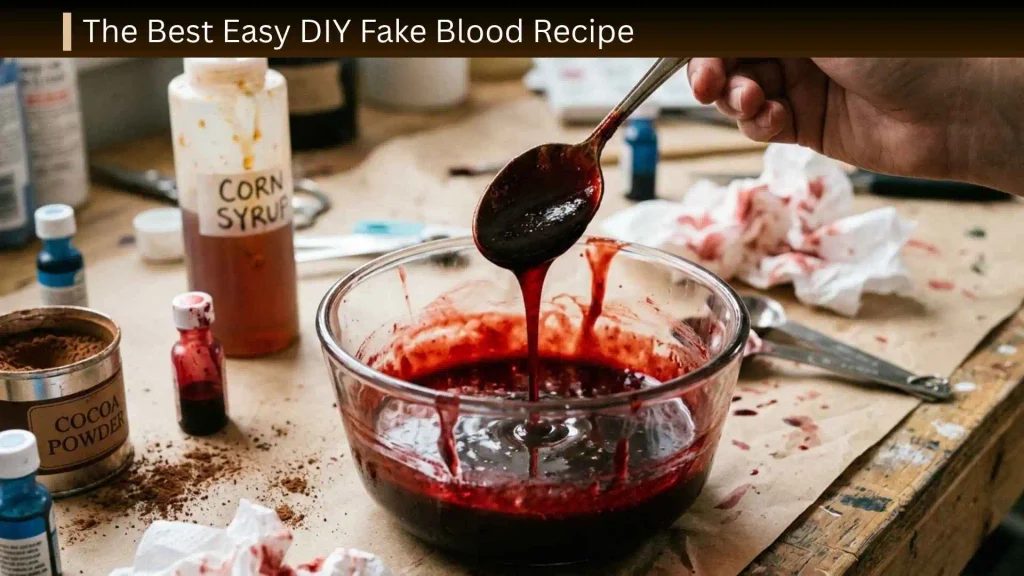
If you want a simple all-purpose recipe for a Halloween costume, prop, or theatrical effect, start with a thick syrup-based mixture.
Ingredients
- 1/2 cup light corn syrup
- Red food coloring
- 1–2 teaspoons unsweetened cocoa powder
- A few drops of water, if needed
- Optional: a tiny amount of blue food coloring for a deeper red
Why These Ingredients Work
The corn syrup gives the mixture its thick, glossy body. That makes it much more convincing than a watery red liquid.
Red food coloring provides the main color, while cocoa powder can take the shade away from a bright, artificial red and toward a deeper red-brown appearance. Published fake-blood recipes commonly use a syrup base with red coloring and a small amount of cocoa or another darkening ingredient for this reason.
A tiny amount of blue can deepen the color, but use it sparingly. Too much can turn your mixture purple.
How to Make DIY Fake Blood
- Pour the corn syrup into a clean mixing bowl.
- Add red food coloring a few drops at a time.
- Stir slowly until the color is evenly distributed.
- Add the cocoa powder and mix thoroughly.
- Check the color under the lighting where you will actually use it.
- If the mixture is too thick, add water one drop or teaspoon at a time.
- If it is too bright, add a very small amount of cocoa powder.
- If it looks too purple, add more red rather than adding additional blue.
- Let the mixture sit for a few minutes before making final adjustments.
Do not add a large amount of coloring at once. It is much easier to darken fake blood gradually than to correct an overly dark or purple mixture.
Quick Recipe Card
| Detail | Information |
| Preparation | About 5 minutes |
| Difficulty | Easy |
| Best for | Costumes, props and Halloween effects |
| Texture | Thick and glossy |
| Color | Deep red |
| Edible | Only when all ingredients used are food-grade |
| Skin use | Patch-test first; not suitable for open wounds |
| Main warning | Can stain fabric and surfaces |
| Equipment | Bowl and spoon or whisk |
How to Choose the Right DIY Fake Blood
There is no single consistency that works for every Halloween project.
| Your project | Best consistency | What you want |
| Zombie costume | Medium-thick | Dark, uneven red |
| Vampire costume | Thick and glossy | Deep red |
| Fake wound | Thick | Blood that stays in place |
| Bloody shirt | Thin to medium | Drips and splashes |
| Splatter effect | Thin | Small droplets |
| Halloween prop | Medium-thick | Visible drips |
| Dried-blood effect | Thick and dark | Brown-red appearance |
| Cake or dessert | Edible gel | Food-safe ingredients |
| Children’s food decoration | Edible | Food-only ingredients |
The most important thing is to choose the recipe before you start changing the color. A fake wound needs a very different consistency from blood that is supposed to run down a shirt.
How to Make Edible Fake Blood
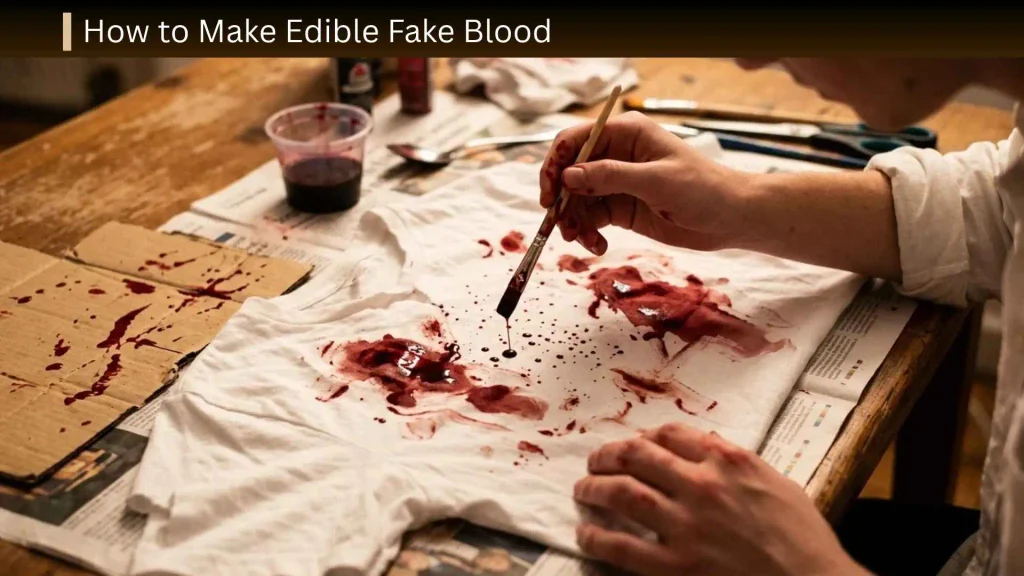
If your fake blood will touch food or may reasonably end up in someone’s mouth, make a separate edible version using food ingredients only.
A simple edible recipe can use a syrup base, food coloring, and a thickening ingredient. Published edible recipes use combinations such as glucose or corn syrup, food coloring, water or fruit juice, and cornflour/cornstarch to create a thick, slow-moving gel.
Ingredients
- 1 cup light corn syrup or glucose syrup
- 1 tablespoon cornstarch or cornflour
- 2–3 tablespoons water
- Red food coloring
- Optional: a very small amount of cocoa powder for a darker shade
Method
- Place the cornstarch in a small bowl.
- Add the water gradually while stirring until the starch is smooth.
- Add the syrup and mix thoroughly.
- Add red food coloring gradually.
- Add a tiny amount of cocoa powder if you want a darker red-brown shade.
- Stir until there are no visible lumps.
- Let the mixture sit briefly so the texture can develop.
- Add a little more water if it is too thick.
For a thinner edible blood effect, gradually add a small amount of water or suitable fruit juice. For a thicker result, increase the thickening ingredient cautiously.
How to Make Edible Fake Blood Darker
Bright red fake blood can look more like red icing than blood.
To deepen the color, try:
- A tiny amount of cocoa powder
- A small amount of blue food coloring
- A small amount of dark-colored edible syrup
Use darkening ingredients gradually. A little can make a significant difference.
How to Make Edible Fake Blood Thinner
If your edible fake blood sits in a blob instead of flowing, add a small amount of water or fruit juice.
Stir completely before deciding whether you need more.
Do not add large amounts of liquid at once, because you can quickly turn a thick gel into a watery mixture.
How Long Does Edible Fake Blood Last?
Storage depends on the ingredients and recipe. Some published edible formulations recommend refrigerated storage for up to several weeks, but you should not assume that storage period applies to every homemade mixture.
Store homemade edible blood in a clean, sealed container and follow normal food-safety practices. If it develops an unusual smell, appearance, mold, or other signs of spoilage, discard it.
How to Make DIY Fake Blood for Skin
Homemade fake blood requires more caution when it is being used as a makeup effect.
An edible ingredient is not automatically a cosmetic ingredient, and homemade mixtures are not tested in the same way as commercial cosmetic products.
Before Applying Fake Blood to Skin
- Patch-test a small amount on intact skin first.
- Wait and check for irritation.
- Keep it away from your eyes.
- Do not put it inside your mouth unless the entire recipe is specifically made from food-safe ingredients.
- Do not apply it to broken or irritated skin.
- Do not put it into real cuts or wounds.
- Wash it off if burning, itching, swelling, or significant irritation develops.
If you have sensitive skin or are unsure about an ingredient, use a commercially formulated cosmetic product rather than experimenting with a homemade mixture.
Where Not to Apply Homemade Fake Blood
Avoid applying homemade fake blood:
- Inside the eyes
- Directly around the eye where it could run into the eye
- Inside real wounds
- On open cuts
- On badly irritated skin
- On mucous membranes
- On areas that are particularly sensitive
For a realistic fake-wound appearance, create the effect around a suitable cosmetic wound product rather than treating an actual injury.
How to Create Realistic Blood Drips
The secret to convincing drips is consistency.
If the mixture is too thick, it will sit where you place it.
If it is too thin, it will immediately run away from the area you are trying to cover.
For a controlled drip:
- Start with medium-thick fake blood.
- Place a small amount at the starting point.
- Let gravity do most of the work.
- Add more only when necessary.
- Allow some drips to vary in length.
Perfectly identical lines often look less convincing than irregular drips.
How to Make Fake Blood for Fake Wounds
Fake wounds usually need a thicker mixture because you want the blood to remain around the wound instead of flowing immediately across the skin.
For a Fresh-Wound Look
Use:
- Deep red coloring
- Medium-thick consistency
- A glossy finish
- A few irregular drips
For a Clotted Look
Use a thicker mixture with a darker red-brown appearance.
Realistic fake blood is not always bright red. A darker, thicker effect can work better for older or dried-looking wounds.
For Dried Blood
Dried blood should generally look darker and less glossy than fresh blood.
You can create this effect by making the mixture thicker and adding a small amount of a darkening food ingredient to an edible formula.
Scientific American’s discussion of fake blood also notes that thicker, darker mixtures can create a more dried or clotted appearance, while viscosity affects how naturally the mixture flows.
How to Make Fake Blood Thicker
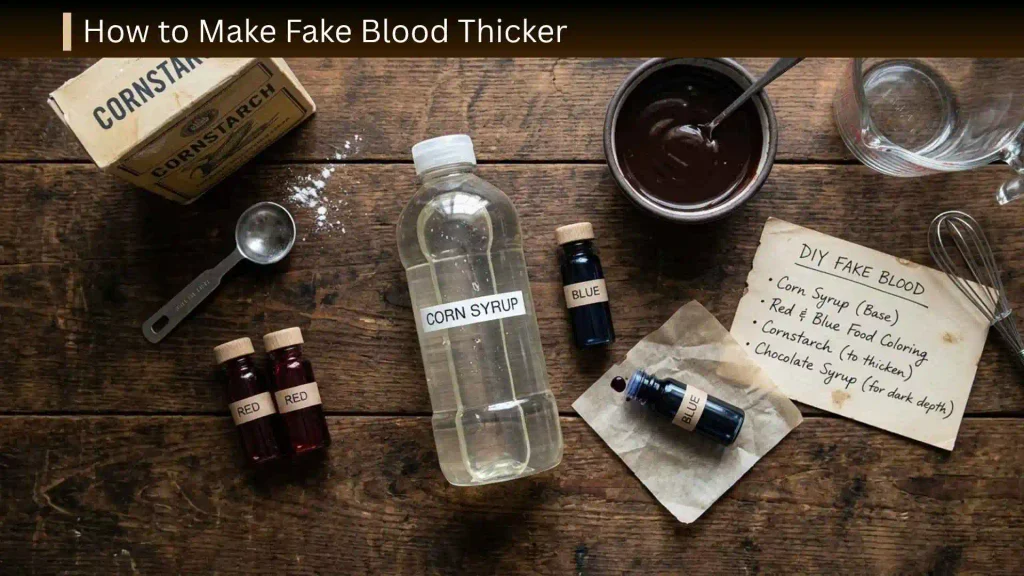
If your mixture is running too quickly, don’t immediately dump in a large amount of thickener.
Try this process:
- Add a small amount of thickening ingredient.
- Mix thoroughly.
- Wait briefly.
- Test the consistency.
- Repeat only if necessary.
For edible recipes, cornstarch or cornflour can help create a thicker gel.
For a syrup-based recipe, simply reducing the amount of added water can also help preserve a thicker texture.
Best Texture for Fake Wounds
Aim for a consistency that:
- Clings to the surface
- Forms a slow drip
- Does not immediately flatten
- Remains glossy
- Can be spread in small amounts
How to Make Fake Blood Thinner
Thin fake blood is useful for:
- Shirt splatters
- Dripping effects
- Large props
- Spatter patterns
- Blood running down a surface
Add liquid gradually.
Water is the simplest option for many food-based recipes, but fruit juice can also be used in some edible formulations.
The goal is to make the mixture flow without turning it into red water.
How to Make Dark Fake Blood
A common beginner mistake is making fake blood too bright red.
A realistic-looking effect often benefits from a deeper red or red-brown tone.
If Your Blood Is Too Bright
Try:
- A tiny amount of cocoa powder
- A small amount of dark edible syrup
- A very small amount of blue food coloring
If Your Blood Is Too Purple
You probably added too much blue.
The easiest correction is usually to add more of the red base and mix thoroughly.
If Your Blood Looks Brown
You have probably added too much darkening ingredient.
Add more red coloring gradually until the shade moves back toward deep red.
How to Make Fake Blood Without Food Coloring
You can make an edible-style fake blood effect without conventional food coloring by using strongly colored food ingredients.
Possible options include:
- Beet juice
- Pomegranate juice
- Cranberry juice
- Other strongly colored fruit ingredients
These alternatives are mentioned in existing food and Halloween recipes, but they do not behave exactly like concentrated food coloring.
What Changes When You Skip Food Coloring?
Natural color sources can change:
- Final shade
- Flavor
- Thickness
- Staining potential
- Storage characteristics
For example, adding a large amount of juice can make a syrup-based mixture thinner.
Start with a small amount and adjust gradually.
How to Make Fake Blood Without Corn Syrup
Corn syrup is popular because it naturally provides a thick, glossy texture, but it is not your only possible base.
Depending on the intended effect, you can experiment with:
- Glucose syrup
- A suitable thick edible syrup
- Gel-based food mixtures
- Fruit-based mixtures for thinner effects
The important point is that changing the base also changes the final consistency.
If your substitute is thinner than corn syrup, you may need additional thickening.
If it is already very thick, adding more thickener could make the mixture look more like paste than blood.
How to Make Fake Blood for a Zombie Costume
Zombie blood usually looks better when it is not perfectly clean and bright.
Try a darker red mixture with varied thickness.
Zombie Blood Effect
Use:
- Dark red fake blood
- A few thicker areas
- Some thin drips
- Uneven smears
- Small splatter marks
Avoid making every drip identical.
For a more aged appearance, use darker blood around some areas and fresher red blood in others.
How to Make Fake Blood for a Vampire Costume
Vampire blood can be glossy, deep red, and concentrated.
A thicker syrup-based mixture works well when you want a dramatic drip around the mouth area or costume.
Do not put homemade fake blood inside your mouth unless you are using a specifically edible formulation made entirely from food-safe ingredients.
Even with edible ingredients, avoid getting food coloring into your eyes.
How to Make Fake Blood for Clothes
This is one of the most important practical considerations.
Food coloring can stain fabric, and a mixture that looks perfect on a costume may be difficult or impossible to remove completely.
Published Halloween recipes also warn that syrup-and-coloring mixtures can stain clothing.
Always Test Fabric First
Before covering a costume:
- Find a hidden area or scrap of the same fabric.
- Apply a small amount.
- Let it dry.
- Try your intended cleaning method.
- Check the result before applying more.
Never assume that “washable” means every fabric will return to its original condition.
Delicate, expensive, vintage, or special-occasion clothing deserves extra caution.
How to Make Fake Blood for Splatter
Splatter requires a thinner mixture than a fake wound.
Start with a controlled amount rather than making the whole batch extremely thin.
For a simple splatter effect:
- Place the mixture in a small container.
- Dip the end of a disposable brush into it.
- Practice on scrap material first.
- Flick or tap the brush to create small droplets.
- Increase or decrease the amount of liquid depending on the size of the droplets you want.
Protect nearby surfaces before splattering.
A few tiny droplets can travel much farther than expected.
How to Make Fake Blood That Looks Realistic
Realism comes from more than color.
Pay attention to:
Color
Use deep reds rather than a single flat, bright red.
Texture
Blood should not always have the same thickness.
Shine
Fresh-looking blood can appear glossy.
Flow
Different surfaces make liquid move differently.
Placement
A few strategically placed marks can look more convincing than covering everything.
Variation
Combine thin drips, thicker areas, small smears, and occasional darker patches.
Scientific explanations of fake blood emphasize viscosity because the way a liquid flows contributes to how convincing it looks.
Fresh Blood vs. Dried Blood
Different effects require different appearances.
| Effect | Color | Texture | Finish |
| Fresh blood | Deep red | Runny/medium | Glossy |
| Wet blood | Dark red | Medium | Shiny |
| Thick blood | Deep red | Thick | Glossy |
| Dried blood | Brown-red | Thick | Less glossy |
| Clotted effect | Dark red-brown | Very thick | Uneven |
This is especially useful for zombie costumes, fake wounds, and Halloween photography.
How to Make Fake Blood Less Sticky
Syrup-based fake blood is naturally sticky.
If the mixture is too sticky:
- Add a small amount of water.
- Mix completely.
- Test the consistency.
- Repeat gradually if necessary.
Do not add enough water to make the mixture completely runny.
For costume applications, also consider whether a syrup-heavy formula is appropriate for the surface. A sticky mixture can attract dust and make cleanup harder.
How to Make Fake Blood Look Better in Photos
A mixture that looks realistic in person can look too bright under strong lighting.
Before your Halloween event or photo session, test the effect under the same lighting you plan to use.
Try:
- Natural daylight
- Indoor warm lighting
- Flash photography
- Phone-camera lighting
A small amount of darkening ingredient may make a significant visual difference.
Do not judge the final color only under one type of light.
DIY Fake Blood for Halloween Crafts
Fake blood can also be used on:
- Cardboard props
- Fake weapons
- Haunted-house decorations
- Plastic surfaces
- Halloween signs
- Costume accessories
- Decorative scenes
Before applying it to a valuable prop, test the mixture on a hidden section.
Some food-based mixtures can remain sticky or leave stains even after they appear dry.
Ingredients You Should Not Use on Skin
Not every fake-blood recipe found online is intended for skin.
Some recipes use household products specifically to create stains or costume effects. For example, published fabric-effect recipes can include laundry detergent and explicitly warn that the resulting mixture is not edible and should not be applied directly to skin.
Do not assume that a recipe is safe for skin simply because it creates a convincing effect.
Never use laundry detergent, cleaning products, craft chemicals, or other non-cosmetic household substances as face makeup.
If you need a skin effect, choose ingredients and products specifically appropriate for cosmetic use.
DIY Fake Blood Mistakes to Avoid
1. Using Too Much Red Coloring
Too much coloring can create an unnaturally bright result.
Add color gradually.
2. Adding Too Much Blue
Blue is powerful. A few drops can change the entire appearance.
3. Making It Too Thin
Thin blood may disappear into fabric or run everywhere.
4. Making It Too Thick
Very thick blood can look like red frosting or paste.
5. Skipping the Fabric Test
A recipe can look perfect but permanently stain a costume.
6. Applying It Directly to a Real Wound
Fake blood belongs on a fake wound effect, not an actual injury.
7. Assuming Edible Means Eye-Safe
Food-safe ingredients are not a reason to put homemade mixtures into or near the eyes.
8. Making the Entire Batch Dark
It is easier to darken a small portion than to correct a batch that has become almost black.
9. Judging Color Too Quickly
Give the mixture time to fully combine before making repeated adjustments.
10. Forgetting the Surface
Blood behaves differently on skin, cotton, plastic, cardboard, and other materials.
Always test the intended surface.
How to Fix Common DIY Fake Blood Problems
| Problem | Why it happens | How to fix it |
| Too bright | Too much red or not enough darkening | Add a tiny amount of cocoa or another suitable darkener |
| Too purple | Too much blue | Add more red base |
| Too brown | Too much cocoa/darkener | Add red gradually |
| Too watery | Too much liquid | Add thickener or more syrup base |
| Too thick | Too much thickener | Add liquid gradually |
| Too sticky | Too much syrup | Dilute carefully |
| Doesn’t drip | Too thick | Add a small amount of liquid |
| Runs everywhere | Too thin | Add more thick base |
| Looks like paint | Poor texture balance | Adjust both color and viscosity |
| Stains badly | Strong coloring ingredients | Test and protect fabric first |
How to Store Homemade Fake Blood
Storage depends on the ingredients.
Edible Fake Blood
Use a clean, sealed food-safe container and refrigerate when appropriate for the recipe.
Do not keep homemade edible blood indefinitely just because it contains sugar.
Costume or Prop Fake Blood
Keep it in a sealed container away from heat and direct sunlight.
Label it clearly if the mixture is not edible.
Before Reusing Stored Fake Blood
Check for:
- Strange odor
- Mold
- Separation that does not remix normally
- Unusual texture
- Unexpected color change
When in doubt, discard it.
How to Remove Fake Blood From Skin
For skin-safe products or food-based mixtures used appropriately on intact skin, gently wash with mild soap and water.
Do not aggressively scrub irritated skin.
If coloring remains temporarily, repeated gentle washing may be preferable to harsh rubbing.
If a commercial cosmetic product was used, follow its removal instructions.
How to Remove Fake Blood From Clothing

Treat stains according to the fabric and ingredients involved.
Before using a stain-removal product:
- Check the garment’s care label.
- Test the cleaner on an inconspicuous area.
- Avoid aggressive rubbing that pushes the stain deeper.
- Wash according to the fabric’s care instructions.
Do not put a badly stained garment into a dryer until you know the stain is gone, because heat can make some stains more difficult to remove.
How to Remove Fake Blood From Hard Surfaces
Clean the area as soon as practical.
Use a suitable cleaner for the surface and test it in an inconspicuous area first.
For porous materials such as unfinished wood, cardboard, or some fabrics, staining can be much harder to reverse.
How Much DIY Fake Blood Do You Need?
The amount depends on how you are using it.
For One Small Costume
A small batch is usually enough for a few drips and splatters.
For a Full Bloody Costume
Make a larger batch, but test the recipe before scaling it up.
For Multiple People
Multiply the recipe only after confirming the color and texture.
For a Haunted House
Make a test batch first and determine whether the surfaces can tolerate staining.
Making a large batch before testing is one of the easiest ways to waste ingredients.
DIY Fake Blood: Which Recipe Should You Choose?
| If you want… | Choose… |
| Easiest recipe | Syrup-based fake blood |
| Edible fake blood | Food-only syrup recipe |
| Thick fake wounds | Thickened edible/cosmetic-appropriate formula |
| Dripping blood | Medium or thin syrup mixture |
| Splatter | Thinner mixture |
| Dark blood | Red base with a small amount of darkener |
| No food coloring | Beet, pomegranate or cranberry-based option |
| No corn syrup | Glucose or another suitable thick syrup |
| Costume blood | Test a syrup-based formula on scrap fabric |
| Dried blood | Darker, thicker mixture |
| Zombie effect | Dark red with varied textures |
| Vampire effect | Deep red, glossy and controlled |
Frequently Asked Questions About DIY Fake Blood
What is the easiest DIY fake blood recipe?
A syrup-based mixture is one of the easiest options because the syrup already provides a thick, glossy base. Add red food coloring gradually and use a small amount of cocoa or another suitable darkening ingredient if you want a deeper shade.
How do you make fake blood look realistic?
Focus on three things: color, consistency, and placement.
Avoid making every mark bright red and identical. Use different thicknesses, irregular drips, and darker areas to create a more convincing effect.
Can I make fake blood without corn syrup?
Yes. You can experiment with glucose syrup or other suitable thick edible bases. The final consistency will depend on the substitute, so adjust the amount of liquid and thickener gradually.
Can I make fake blood without food coloring?
Yes. Strongly colored ingredients such as beet, pomegranate, or cranberry juice can provide color in edible recipes. They may produce a different shade and can also change the consistency and staining behavior.
Is homemade fake blood safe for skin?
Not automatically.
A recipe containing edible ingredients is not necessarily a cosmetic formulation. Patch-test first, keep homemade mixtures away from the eyes and broken skin, and never apply fake blood to real wounds.
Is DIY fake blood edible?
Some recipes are made entirely from food ingredients and can be edible. Others contain ingredients intended only for costumes, props, or fabric effects.
Always check every ingredient before treating a recipe as edible.
Can I put fake blood in my mouth?
Only use a recipe specifically made from food-safe ingredients if the effect involves the mouth. Never put a non-edible costume recipe in your mouth.
How do I make fake blood thicker?
Use less liquid or gradually add a suitable thickening ingredient. Mix thoroughly after each small addition and test before adding more.
How do I make fake blood thinner?
Add a small amount of water or another suitable liquid gradually. Mix thoroughly after each addition.
How do I make fake blood darker?
A small amount of cocoa powder or another appropriate darkening ingredient can deepen a food-based mixture. A tiny amount of blue food coloring can also alter the shade, but too much will make the mixture purple.
Why does my fake blood look too bright?
Bright red food coloring alone can create a cartoon-like appearance. Try adding a very small amount of cocoa powder or another suitable darkening ingredient.
Why is my fake blood purple?
There is probably too much blue coloring. Add more of the red base and mix thoroughly rather than adding more colors randomly.
Does DIY fake blood stain clothes?
It can. Food coloring and strongly colored ingredients may stain fabric, while syrup-based recipes can also be sticky.
Always test the mixture on scrap fabric or an inconspicuous area before applying it to a valuable costume.
Can I use DIY fake blood on a white shirt?
You can create the effect on a white shirt, but staining may be permanent. Use an old shirt or test fabric first if you do not want to risk the garment.
How long does homemade fake blood last?
There is no single shelf-life for every recipe. Storage depends on the ingredients and preparation method. Edible mixtures containing perishable ingredients require appropriate food storage, while non-edible prop mixtures should be stored sealed and clearly labeled.
What is the best fake blood for a zombie costume?
A dark red mixture with medium-to-thick consistency works well. Combine controlled drips with small splatters and uneven smears rather than using one identical texture everywhere.
What is the best fake blood for a vampire costume?
A deep red, glossy mixture works well for the dramatic vampire look. Keep the application controlled so it looks intentional rather than simply messy.
What is the best fake blood for a fake wound?
A thicker mixture works better because it stays near the wound instead of immediately running across the skin.
How can I make fake blood look like dried blood?
Use a thicker, darker red-brown mixture and reduce the glossy appearance. Dried-looking blood generally benefits from a darker and less liquid texture.
Can children make DIY fake blood?
Children can participate in a supervised craft using appropriate food ingredients, but adults should handle hot ingredients, staining materials, and skin application decisions.
For food projects, use an edible recipe.
Final Tips for Better DIY Fake Blood
The best homemade fake blood is not necessarily the recipe with the most ingredients. It is the one that matches your project.
Before making a large batch, decide:
- Does it need to be edible?
- Will it touch skin?
- Will it touch clothing?
- Should it drip or stay in place?
- Do you want fresh or dried blood?
- How dark should the color be?
- Can the surface tolerate staining?
Once you know those answers, adjusting the recipe becomes much easier.
For a quick Halloween costume, start with a small syrup-based batch. For food decoration, use a dedicated edible formula. For a fake wound, aim for a thicker consistency. For splatter, thin it gradually. And whenever fabric or skin is involved, test before applying it widely.
The goal is not simply to make something red. The goal is to create the right color, texture, flow, and finish for the effect you want while keeping the ingredients and application appropriate for the surface.
Conclusion
DIY fake blood is an inexpensive way to transform a basic Halloween costume, prop, decoration, or spooky food project. A thick syrup base makes a useful starting point because it naturally provides body and shine, while food coloring and small amounts of darkening ingredients allow you to control the final appearance.
The most important trick is to make adjustments slowly. Add color little by little, change thickness gradually, and always test the finished mixture before using it on valuable clothing, furniture, props, or skin.
Most importantly, remember that edible, skin-appropriate, and costume-only are three different categories. Choose your recipe according to its intended use, and never apply homemade fake blood to real wounds or inside the eyes.
With the right consistency and a little experimentation, you can create convincing drips, splatters, fake wounds, zombie effects, vampire looks, and Halloween decorations without needing an expensive special-effects kit.